Get Full Government Meeting Transcripts, Videos, & Alerts Forever!
Get email alerts on the Sfmta Joint Development topic
No spam. Unsubscribe anytime.
SFMTA presents 'joint development' goals to Planning Commission, aims to use agency land for housing and revenue
Summary
SFMTA staff presented a new joint development program that would identify roughly 25 SFMTA-owned properties for potential redevelopment to generate revenue for transit, deliver housing (including an explicit affordable housing target), and upgrade aging transit facilities.
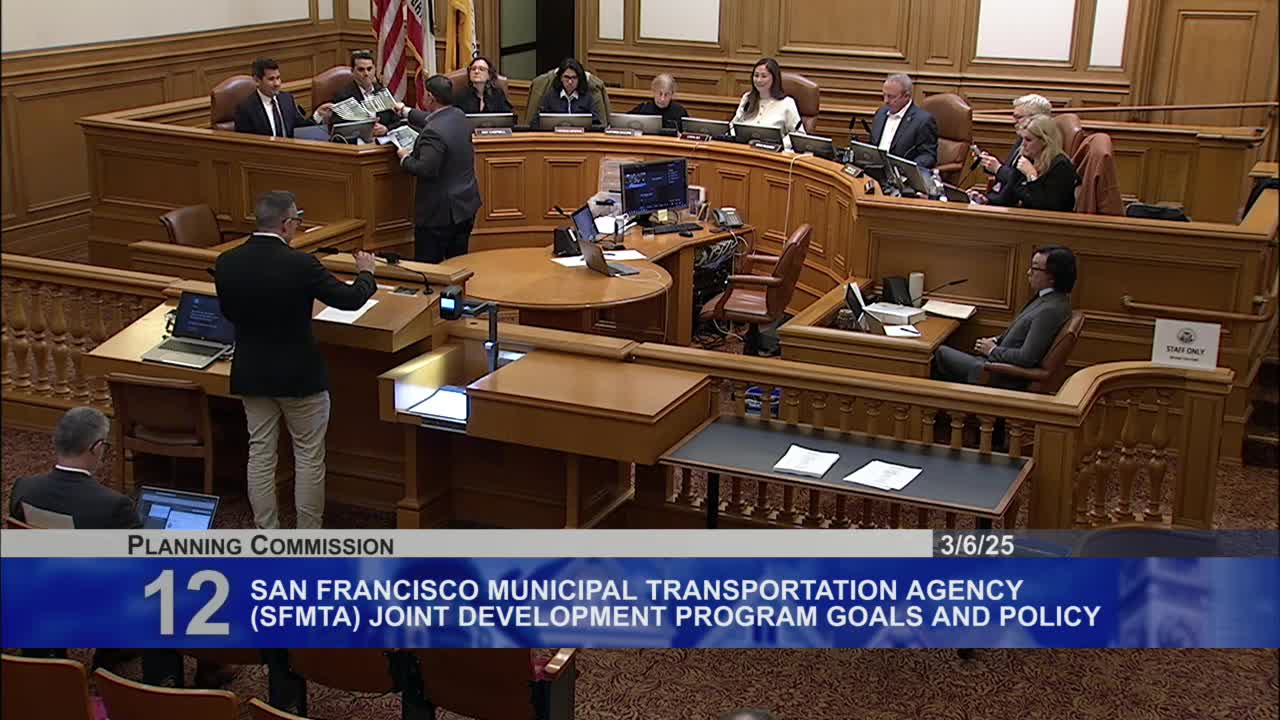
The San Francisco Municipal Transportation Agency presented its first joint development program goals and policy to the Planning Commission on March 6, 2025, describing a citywide portfolio of SFMTA-owned properties it intends to evaluate for potential non-transit uses such as housing and commercial development that can finance long-term transit investments.
Why it matters: SFMTA described a structural budget gap of about $320 million beginning in July 2026. The agency said generating revenue from underused land is one of several long-term approaches to help fund Muni facilities and services while contributing to housing production in well-resourced neighborhoods.
What SFMTA presented: Project manager Wade Whitgraf described a portfolio narrowed from more than 90 SFMTA properties to 25 candidate sites for joint development. Of the 25 sites, 24 are downtown or within areas the Planning Department is rezoning for the Housing Element. SFMTA said none of the portfolio sites would displace existing residents; the sites are largely parking lots (14), parking garages (7), or facility-related parcels (4). The agency proposes to designate at least 50% of the land at large properties for residential uses, and aims for at least 25% of the units on those sites to be affordable at 80% area median income or below, a floor that the agency described as double typical city inclusionary requirements for many projects.
Questions and concerns: Commissioners asked about the implementation of the California Surplus Land Act, whether affordable housing developers could feasibly acquire or lease parcels, how parking and paratransit needs would be balanced, and the timeline. Whitgraf said SFMTA received federal grant funding to evaluate sites, and that early analysis suggests development and revenue would be medium- to long-term; realistic earliest revenue for ground-lease returns would be five to ten years after a project starts.
Next steps: SFMTA will procure consultants under the grant to evaluate portfolio parcels in collaboration with Planning, the Mayor’s Office of Housing and Community Development (MOHCD), and community stakeholders. Commissioners asked SFMTA to continue reporting back as evaluations advance.