Get Full Government Meeting Transcripts, Videos, & Alerts Forever!
Get email alerts on the Board Training Procedures topic
No spam. Unsubscribe anytime.
City staff and attorney brief Ocala preservation board on COA process, ex parte rules and conflicts
Summary
Growth Management Director Jeff Rimm and city attorney counsel reviewed chapter 94 COA procedures, quasi‑judicial standards, ex parte communications, conflicts of interest and meeting process for the Ocala Historic Preservation Advisory Board.
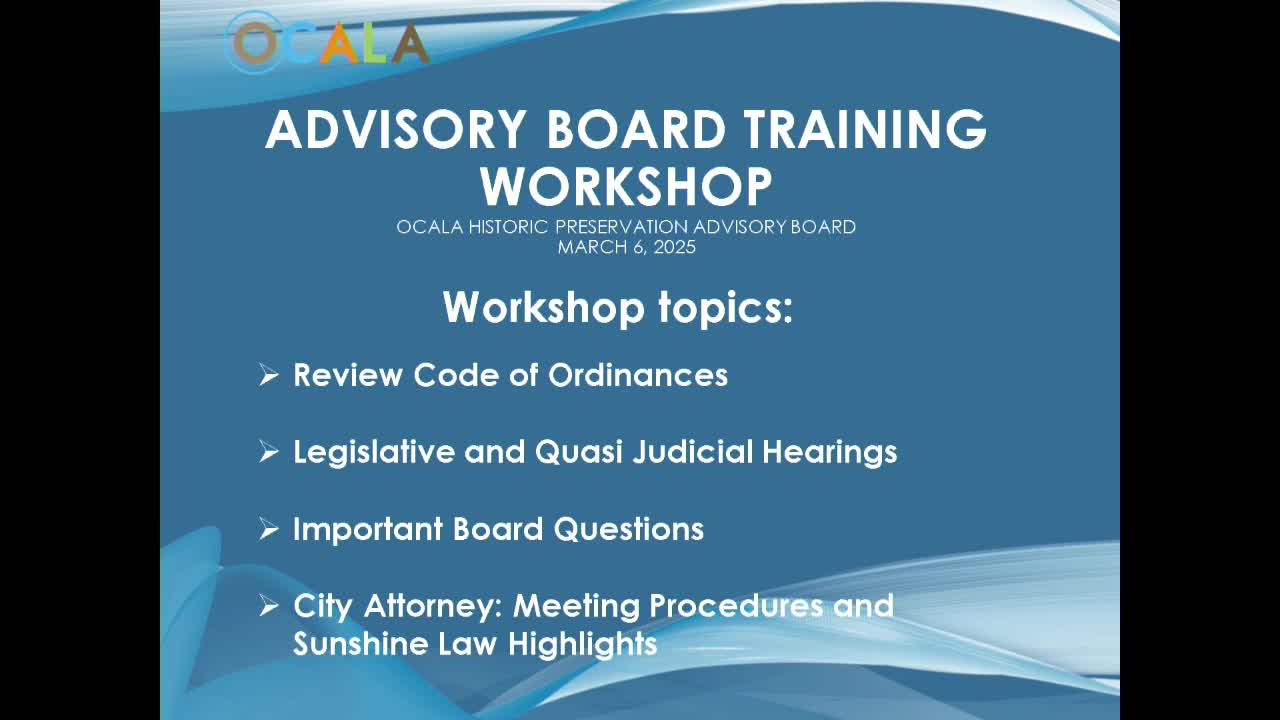
City staff gave an extended training to the Ocala Historic Preservation Advisory Board covering the board’s duties under chapter 94, the certificate of appropriateness process, and legal constraints on board members’ outside communications.
Jeff Rimm, growth management director, told the board the training was intended as a refresher on local code and meeting procedures. He reviewed the board’s membership and quorum rules, noted which historic districts the board regularly considers for COAs, and walked members through the five COA criteria in section 94‑82, emphasizing that COAs should generally precede other city permits.
Rimm focused on quasi‑judicial hearings — the format that applies to COAs — and the four elements that support those decisions: avoiding ex parte communications, relying on competent substantial evidence, conducting deliberations after public testimony has closed, and issuing findings of fact. He said staff reports supply a professional recommendation but are “just a recommendation” and the board may rule differently if its reasons are supported by evidence presented at the hearing.
City attorney Will (last name not stated) reinforced the legal limits on outside discussion, telling members they must comply with Florida’s Sunshine Law and avoid private conversations about items that will come before the board. He explained the fairness rationale for restricting site visits and other off‑record investigations: information obtained outside the public hearing cannot be tested by other parties and can create grounds for a legal challenge. Will encouraged board members to consult the city attorney early if they think they may have a conflict of interest.
Both presenters urged members to use the agenda’s staff‑presentation and applicant‑presentation sequence: staff presents, members may question staff, the applicant presents, members may question the applicant, public comment is allowed, the public hearing is closed, and the board then deliberates. They recommended identifying a date certain when continuing or tabling items and using continuances when additional evidence is needed.
Rimm and the attorney said staff will work to increase legal staffing presence at future meetings and to provide clearer guidance, updated guidelines, and additional photographic exhibits when necessary to help the board make competent, substantial findings.
The presentation addressed common procedural pitfalls and answered board members’ questions about site visits, independent research, contractor referrals, and the status of the city’s historic preservation design guidelines.