Get Full Government Meeting Transcripts, Videos, & Alerts Forever!
Get email alerts on the Magnet Programs topic
No spam. Unsubscribe anytime.
Richardson ISD outlines plan to strengthen magnet programs, emphasizes K–12 pipeline and alignment
Summary
District staff presented a detailed review of magnet programs, proposed alignment across elementary, junior high and high school, and described recruitment and identity-building steps; trustees and principals discussed leadership, program clarity and community partnerships.
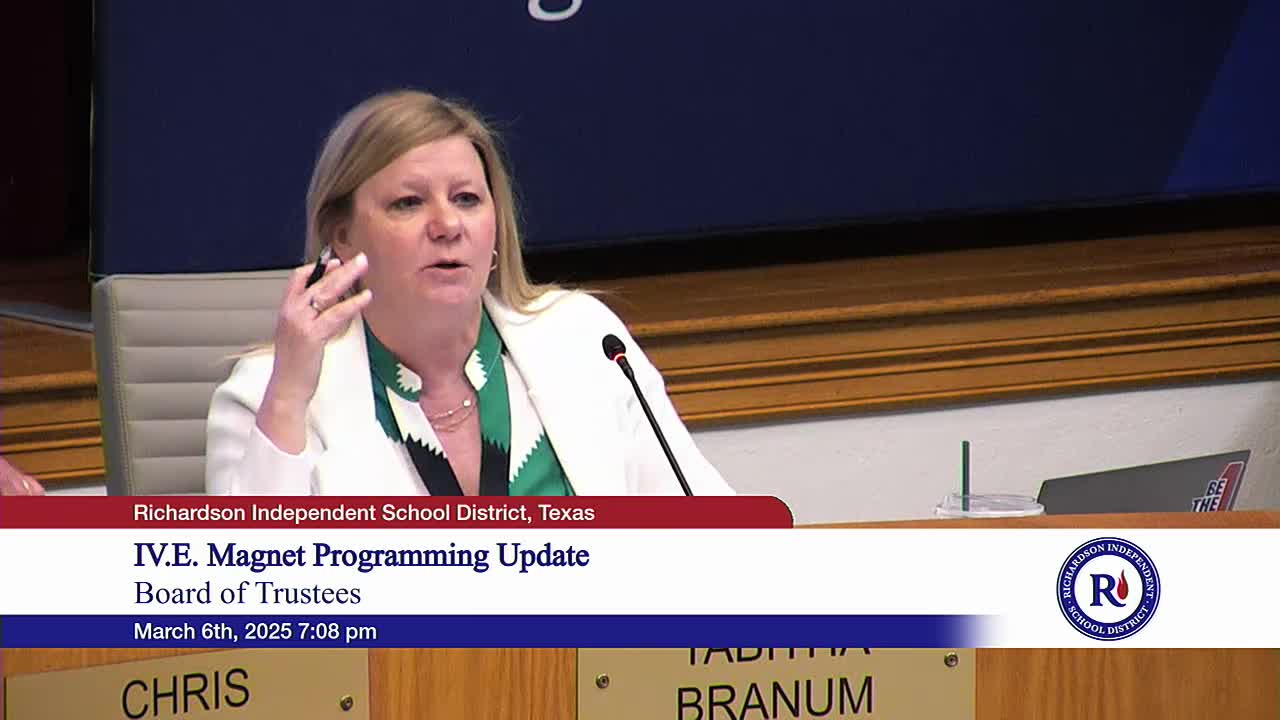
Richardson ISD staff presented a multi-part plan March 14 to strengthen the district's magnet programs, emphasizing alignment across grade levels, recruiting, and identity-building at campuses.
District staff (introduced as Ms. Brandon and other magnet leaders) reviewed the history and current status of magnet programming in Richardson and described next steps: ensure existing magnet programs are strong before any expansion; align elementary, junior high and high-school offerings to create a K–12 pathway; and increase collaboration among principals and instructional leaders.
Staff said successful magnet models feed higher-level programs and that investment in existing sites will support future expansion. The presentation described a concept the staff called Opportunities, Neighborhoods and Experiences (an acronym presented during the meeting) as part of recruitment messaging for 2025–26.
Trustees and principals asked for clearer common program definitions so families can compare offerings across campuses. Board members and staff discussed specific program elements raised by principals — for example, leadership pathways, arts instruction, robotics, advanced math and vocational connections — and urged creating a shared, concise description of what distinguishes each magnet offering.
Staff described next steps: monthly updates on magnet programming; deeper local research comparing peer districts; partnership development with community sponsors and foundations; and efforts to optimize existing funds rather than immediately seeking new district dollars. Several trustees encouraged stronger community outreach so families understand magnet options and wait-list processes.
No formal action to expand or change magnet boundaries or funding was taken at the meeting; staff said any expansion would follow a review confirming program strength and alignment across feeder patterns.