Get Full Government Meeting Transcripts, Videos, & Alerts Forever!
Get email alerts on the Regional Climate Strategy topic
No spam. Unsubscribe anytime.
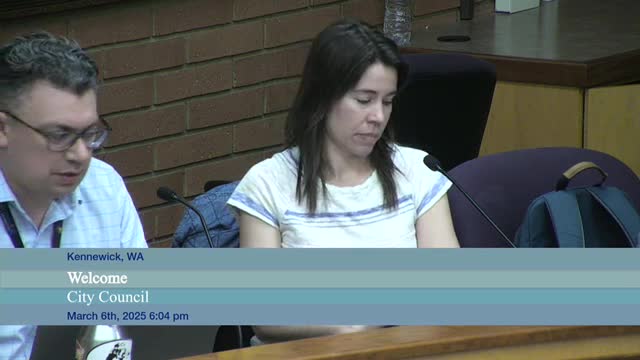
Kennewick meeting gathers public input on regional climate strategy amid concerns over wildfire, heat and water
Summary
City of Kennewick staff and consultants presented preliminary climate-impact findings and solicited public input on a regional resilience and emissions-reduction strategy; attendees focused discussion on wildfire and smoke, summer heat, water scarcity and landscaping or building measures to reduce risk.
City of Kennewick planning staff and consultants summarized early technical findings on heat, wildfire risk, drought and changing precipitation patterns and invited public input on a regional climate strategy that also aims to reduce greenhouse-gas emissions.
The meeting, convened by the City of Kennewick as part of a five-jurisdiction effort with Pasco, Richland, West Richland and Benton County, presented preliminary analysis and asked residents for reaction and priorities as staff draft policies to include in comprehensive-plan updates required under a 2023 state law that added climate requirements.
Anthony Mawai, planning director for the City of Kennewick, told attendees the five jurisdictions “are working together to develop a regional strategy to reduce the risk of climate-related hazards,” and that the jurisdictions are pooling resources and consultant support through the regional process.
Consultants laid out the project scope and timeline and reviewed key findings. Catherine Allison of Cascadia Consulting Group summarized a climate-impact analysis that examined historical trends and future projections under commonly used greenhouse-gas scenarios. Allison said the team is using the high-emissions scenario commonly called RCP 8.5 for much of the analysis because it helps identify policies robust enough for severe outcomes: “for our work, we’re focusing mostly on what’s called RCP 8.5, and this represents sort of a business-as-usual scenario.”
Among the findings presented for the Kennewick area: - Historically the city has averaged about three days per year with highs above 100°F; under a high-emissions scenario Allison said that could rise to as many as about 45 days per year by the end of the century. - Average summer high temperatures in the region are currently roughly in the mid-80s Fahrenheit; consultants showed projections that average summer highs could increase substantially under high-emission scenarios. - Wildfire risk and smoke events were expected to increase in frequency and severity; consultants reported roughly 54 high fire-danger days historically in the area and projections that the number could increase (consultants referenced tools including wildfirerisk.org to illustrate local exposure). - Seasonal precipitation changes are uneven: modeling showed modest declines in summer precipitation but increases in winter precipitation and an increase in heavy-precipitation intensity; consultants reported a near-10% winter precipitation increase in some projections and an approximately 8.5% decrease in summer precipitation by the end of the century.
Consultants emphasized that the technical work also includes a vulnerability analysis, vehicle-mile-travel and emissions inventories, and that a public survey and a 30-person advisory group are informing policy options. The project began in December and the team is aiming for a regional strategy agreement by June, with a possible extension under discussion.
Public commenters largely echoed concerns highlighted in the analysis and suggested local solutions. Rachel Rosen, a resident who participated online, said the presentation “lines up with my experiences,” and added, “personally for me it’s fire,” describing anxiety about visible wildfires and wind-driven spread.
Several attendees urged the jurisdictions to consider landscape- and design-focused measures to reduce fire risk, improve water retention and lower heat. Don Kenning, a Kennewick resident, urged more organic mulches and tree plantings instead of rock-and-tarp landscaping, arguing such choices improve soil health, shade and pollutant capture. Attendees asked about incentives or regulations for xeriscaping, permeable surfaces and low-water trees, and whether building efficiency measures and expanded electric-vehicle infrastructure could reduce local emissions.
A participant who identified himself as Robert urged attention to both air quality and water availability because of the local agricultural economy, saying the “air quality aspect, I think the water aspect are really important and they’re important now.” Participants also raised questions about how best to use limited water resources and how planning might account for temperature differences within parts of the city.
Meeting facilitators noted there were technical and audio difficulties at times; staff offered follow-up contacts for attendees who could not be heard clearly. Attendees were directed to the project website and public survey to submit further input.
The meeting produced no formal motions or votes. Staff and consultants framed this session as an early public-input step: gather community experience, confirm which hazards matter most locally, and use that feedback—alongside technical analysis and advisory-group review—to craft policy options that jurisdictions can adapt into their comprehensive-plan updates.
The project team asked participants to share additional feedback through the project website and a public survey; staff and consultants plan further public engagement as draft policies are developed.