Get Full Government Meeting Transcripts, Videos, & Alerts Forever!
Get email alerts on the Historic Preservation topic
No spam. Unsubscribe anytime.
McKinney preservation board views Texas Historical Commission video on federal preservation law
Summary
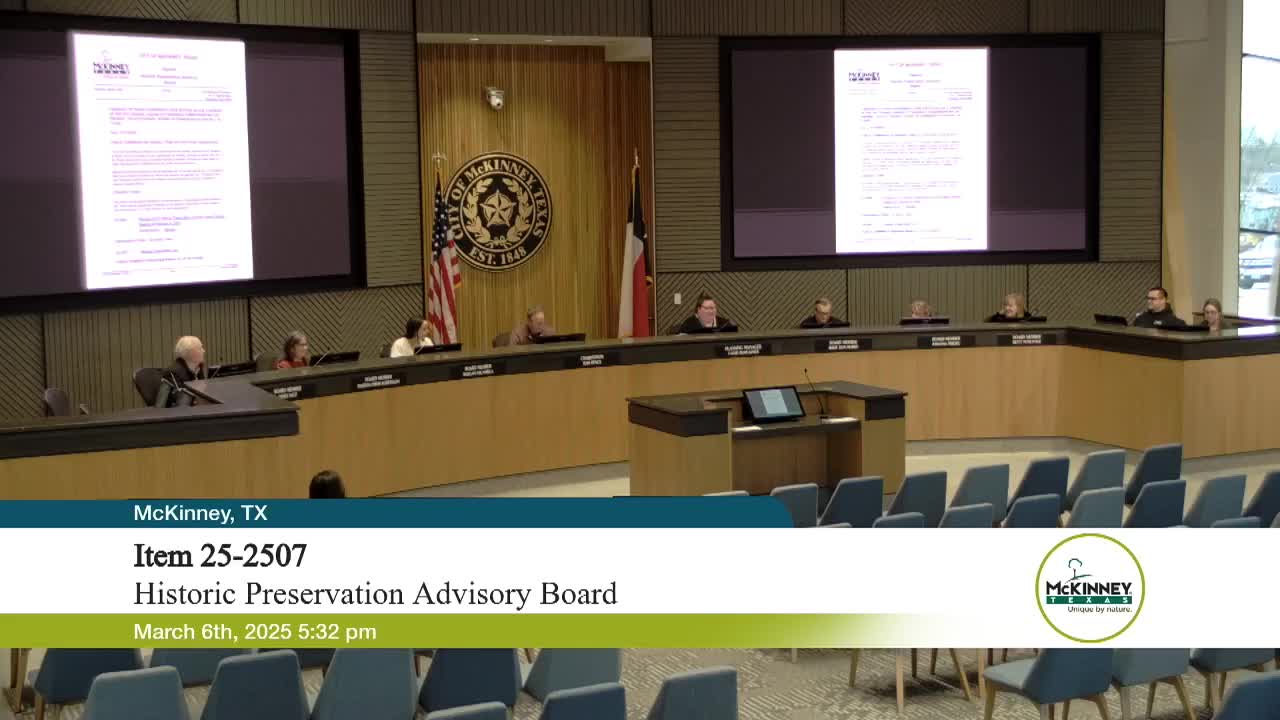
The City of McKinney Historic Preservation Advisory Board watched a roughly 10‑minute Preservation Boot Camp video from the Texas Historical Commission at its March 6, 2025 meeting that reviewed federal preservation law, the board heard.
The City of McKinney Historic Preservation Advisory Board watched a roughly 10‑minute Preservation Boot Camp video from the Texas Historical Commission at its March 6, 2025 meeting that reviewed federal preservation law, the board heard.
The video covered the National Historic Preservation Act (NHPA), the National Register of Historic Places and the criteria used to assess historic significance, the Section 106 review process for federal undertakings, the National Environmental Policy Act (NEPA) and Section 4(f) protections tied to Department of Transportation projects.
Board members said the presentation helped clarify common questions about age, significance and integrity used to evaluate properties. The video explained the National Register’s four standard criteria—association with events, association with persons, architectural significance and archaeological value—and noted the 50‑year threshold often used to assess eligibility. It also emphasized that listing on the National Register is largely honorary and does not by itself restrict private owners, though it can enable tax credits and triggers easier listing at state and local levels.
Cassie Bumgarner, who introduced the video to the board, summarized the Section 106 process described in the video as a four‑step review that begins when a federal undertaking (for example, a project involving federal money or permits) is identified; the review then defines the area of potential effect (APE), identifies historic properties, assesses adverse effects and seeks consultation with State Historic Preservation Offices (SHPOs), tribes and the public to avoid or mitigate impacts. The video also noted that National Historic Landmarks are a smaller subset of National Register properties with exceptional national significance and that Texas has 47 such landmarks.
Board members asked how the federal rules relate to local ordinance processes. Tom (board member) asked whether the board’s local ordinance focuses on the same significance criteria; Bumgarner said the NHPA provides authority that filters down and that the board’s certificate of appropriateness reviews consider both significance and integrity. She also explained that McKinney’s HNIZ program focuses on documenting properties within a defined geographic boundary and a qualifying age and does not require an independent finding of exceptional significance.
The video gave examples of projects that typically trigger NEPA or Section 106 review—road expansions, work in national parks and projects affecting archaeological sites or submerged resources such as shipwrecks. Cassie directed board members with follow‑up questions to staff: "If you have any other questions regarding the laws I discussed or any that I haven't discussed, please feel free to reach out to Lorelei or myself at our contact information here," she said.
Board members said the episode cleared up several recurring questions about significance and integrity and the difference between National Register listing, National Historic Landmark status and local designations. The presentation will remain part of the board’s educational materials for future meetings and staff follow‑up.