Get Full Government Meeting Transcripts, Videos, & Alerts Forever!
Get email alerts on the Stadium Development topic
No spam. Unsubscribe anytime.
Haslam Sports Group pitches $3.4 billion Brook Park dome and mixed‑use district; asks state for $600 million in bonds
Summary
Haslam Sports Group officials told the Arts, Athletics and Tourism Committee that the Cleveland Browns plan to build a 67,500‑seat enclosed stadium and a privately financed mixed‑use district in Brook Park and asked the state to provide $600 million in upfront bond proceeds under a new enabling statute to be written into the Ohio Revised Code.
Haslam Sports Group officials told the Arts, Athletics and Tourism Committee that the Cleveland Browns plan to build a 67,500‑seat enclosed stadium and a privately financed mixed‑use district in Brook Park and asked the state to provide $600 million in upfront bond proceeds under a new enabling statute to be written into the Ohio Revised Code.
The presentation, delivered by Ted Tai Wong, chief administrative officer and general counsel for Haslam Sports Group, described the project as “a transformational opportunity” and said the package includes a $2.4 billion dome stadium plus about $800 million to $1 billion of private mixed‑use development for a total project value presented as roughly $3.4 billion. “This is so much more than a stadium project,” Tai Wong said, describing the stadium as the anchor for hotels, experiential retail, and housing in a new Brook Park district.
Committee members were shown renderings and a series of financing charts that, according to Tai Wong, were prepared with consultants including RCLCO, Lincoln Property Company, HKS, and Inner Circle Sports. That analysis, he said, projects roughly $2.3 billion in state tax increment over the life of the bond period and about $1.3 billion of projected excess after debt service under the assumptions on the slides. To protect the state if revenues fall short, Haslam Sports Group proposed a combination of structural protections: (1) a statutory construct to allow the state to issue bonds against projected district tax receipts; (2) delaying state bond proceeds in escrow until private and local funds are used first (which the presenter said would generate roughly $60 million by holding the state proceeds two years); and (3) an upfront escrow payment of $38 million, described by the presenter as the present value of a back‑end $150 million prepaid‑rent backstop.
Why it matters: Tai Wong said the site—about 176 acres of former industrial land near Cleveland Hopkins International Airport—would allow year‑round events that are not feasible at the open‑air lakefront stadium and could drive construction employment and new ongoing jobs. He cited consultant projections of about 6,000 construction jobs during buildout and roughly 5,000 full‑time jobs once the district is mature. The presentation framed the move as a long‑term solution for the team and a way to free valuable downtown lakefront property for other uses.
Key numbers and timeline: Tai Wong said the stadium and a Phase 1 development are expected to be ready in 2029, the stadium cost is $2.4 billion, the private development range is $800 million to $1 billion, and the Haslams’ private investment would be more than $2 billion. The presenter described the state bond ask as $600 million, with total projected debt service of about $1 billion, and stated the projected tax increment attributable to the new district at about $2.3 billion over the bond term. He further said the projections would have to be off by around 40% for the state to be at risk on debt service, per the slide logic presented.
Concerns raised by committee members: Representatives asked about ticket price pressure on local fans, downtown economic effects, potential cannibalization of existing businesses, infrastructure demands, environmental remediation on the former Ford site, and what happens if the Brook Park plan fails. Tai Wong repeatedly said the Haslams would continue to invest in the region, that the proposal is not a traditional grant but a repayable financing construct, and that the team is committed to Northeast Ohio. On affordability, he said the planned venue would include about 2,500 standing‑room‑only seats intended to provide a lower‑cost price point that “doesn’t exist today.” On infrastructure, he estimated preliminary public infrastructure needs at roughly $57 million to $73 million and said the project team had begun formal discussions with ODOT and NOACA and is working with engineering firms.
Policy and statutory ask: The group proposed a new Ohio Revised Code provision to enable “Transformational Sports Mixed Use Development Districts” that would allow the state to lend its balance sheet against projected future state tax receipts from a defined ring‑fenced district (state income tax, sales tax and commercial activity tax increments, as described in the presentation). Tai Wong emphasized that the statute would include criteria such as a required minimum of $1 billion private investment and credible long‑term fiscal projections. He also referenced NFL rules when explaining why the team structured the proposed prepaid rent protection the way it did.
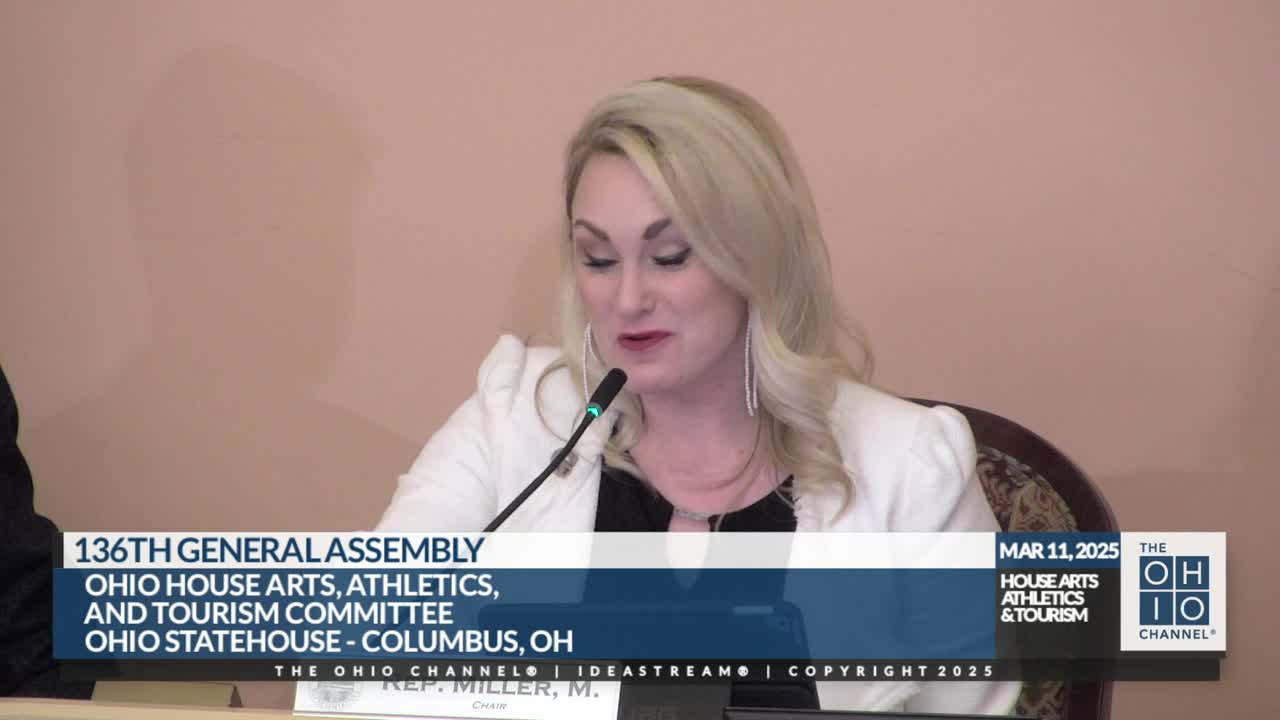
Committee next steps and outcome: No formal vote was taken. Chair Miller closed the hearing by saying the committee would perform additional research to determine whether to recommend language in the operating budget and to consider possible amendments. The presentation and the financial slides will be available to committee members for further review.
What the presentation did not resolve on the record: several committee members asked about the exact lease term end date and some slide numbers that appeared in the deck (for example, a slide listed a lease running through “02/1958” in the presenter’s slide notes); the presenter did not otherwise clarify that notation during the hearing. The project’s final tax‑increment accounting, detailed local funding commitments, and the precise legal drafting of the proposed enabling statute were not adopted or approved by the committee during the session.
Sources and attribution: The article is based on a presentation by Ted Tai Wong, chief administrative officer and general counsel for Haslam Sports Group, and on questions and remarks from members of the Arts, Athletics and Tourism Committee including Chair Miller, Vice Chair Heiner, Ranking Member Jerrells and Representatives Upchurch, Dieter, Rob Blaisdell, Swearingen, Thomas, Gambari, and others during the committee hearing.
Ending: The committee did not act on the proposal; members said they will review the materials and consultant work, and may consider budget language or other follow‑up in the coming weeks.