Get Full Government Meeting Transcripts, Videos, & Alerts Forever!
Get email alerts on the Watershed Management topic
No spam. Unsubscribe anytime.
Committee hears amendment to Maumee River Basin commission statute to refocus watershed spending and restore local representation
Summary
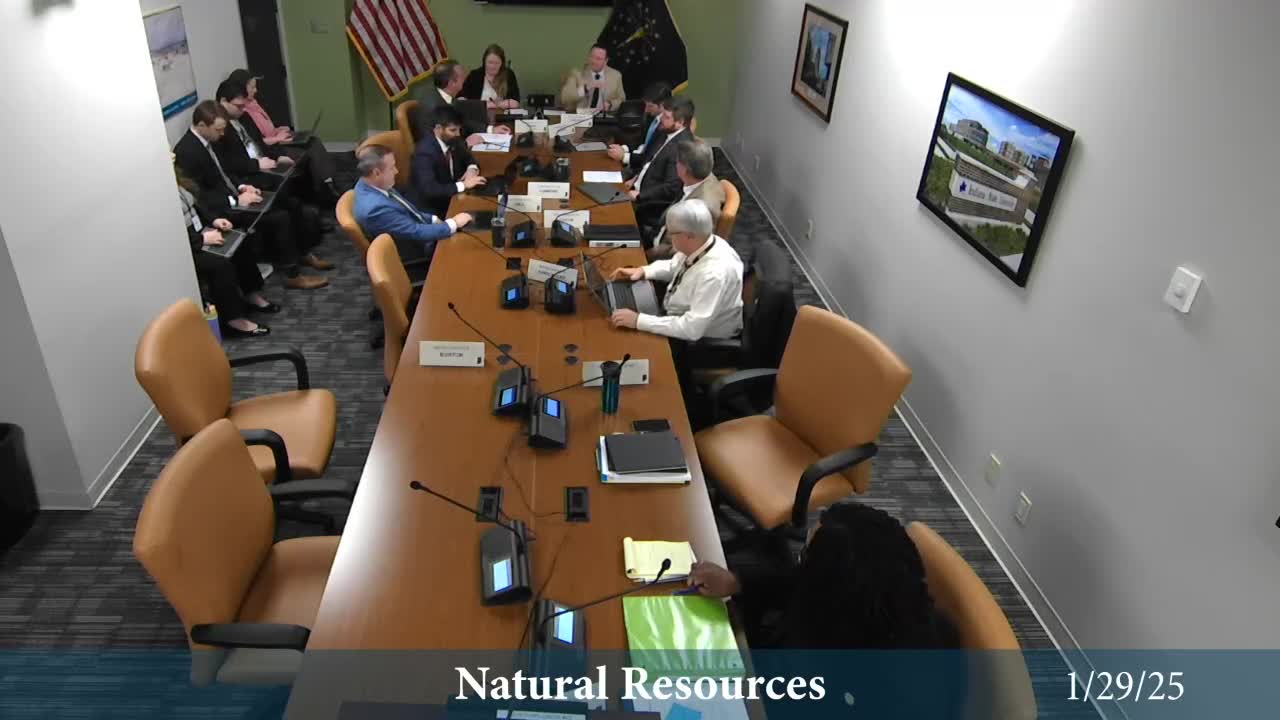
Lawmakers and watershed stakeholders told the House Natural Resources Committee that House Bill 11‑26 would restore local representation and require more funding be used for best management practices in the Maumee River Basin; the committee moved to pass the bill as amended but left the committee vote open for final tally.
House lawmakers heard testimony on House Bill 11‑26, an amendment to existing watershed development commission law that would tailor commission authority and funding to the Maumee River Basin and restore seats for soil and water conservation districts.
Supporters told the House Committee on Natural Resources the bill updates a prior, one‑size‑fits‑all statute so the Maumee basin can pursue projects and best management practices specific to local watershed needs. Rodney Ringenberger, executive director of the Maumee River Basin Commission, said the amendment “is designed to enhance the current watershed legislation” and to “keep the soil and water conservation district board representation on the board.”
The bill would keep the commission’s current six‑county footprint — Adams, Allen, DeKalb, Noble, Steuben and Wells Counties — and emphasize that a majority of commission funds be spent on best management practices that aim to reduce flood damage and improve water quality. Jared Hahn, Wells County surveyor and president of the County Surveyors Association, said county surveyors support allowing each river basin to adjust language to fit local conditions. Mike Fruchey, elected Allen County surveyor and MRBC president, said the region’s “unique challenges” justify tailoring the law to Maumee basin practice.
Testimony came from agricultural and conservation stakeholders. Tom Miller, president of the Allen County Farm Bureau, framed the local agricultural perspective and said the commission can help develop, test and implement conservation practices that benefit both farm operations and water quality. David Van Gilder of the Hoosier Environmental Council highlighted the bill’s explicit list of best management practices, including cover crops, grass buffers and nutrient management.
Chris Smith of the Department of Natural Resources told the committee the department supports flexibility for each watershed commission because “these watershed commissions have different challenges and different geography.” He said the Maumee‑specific amendment responds to basin needs and recognized the bill leaves other commissions and statutory schemes unchanged.
Representative Tim Heiney, the bill sponsor, and several co‑authors described the amendments as building on prior river‑basin work and preserving local representation while directing more resources toward on‑the‑ground conservation practices.
After testimony the committee moved to pass the bill as amended. The chair instructed staff to call the roll but then left the committee vote open to allow additional members who were serving on other committees to register their positions; the transcript records the motion and the roll call beginning but does not record a final tally.
If advanced, the measure would modify the state’s watershed development framework for the Maumee River Basin but would not replace existing drainage law, soil and water conservation districts, or other river basin commissions.
Supporters and opponents were heard at the committee hearing; no final committee vote is recorded in the transcript excerpt.
The committee continued to other business after leaving the HB 11‑26 vote open for completion at a later time.