Get Full Government Meeting Transcripts, Videos, & Alerts Forever!
Get email alerts on the Stormwater topic
No spam. Unsubscribe anytime.
House panel approves bill barring local stormwater rules stricter than state construction permit
Summary
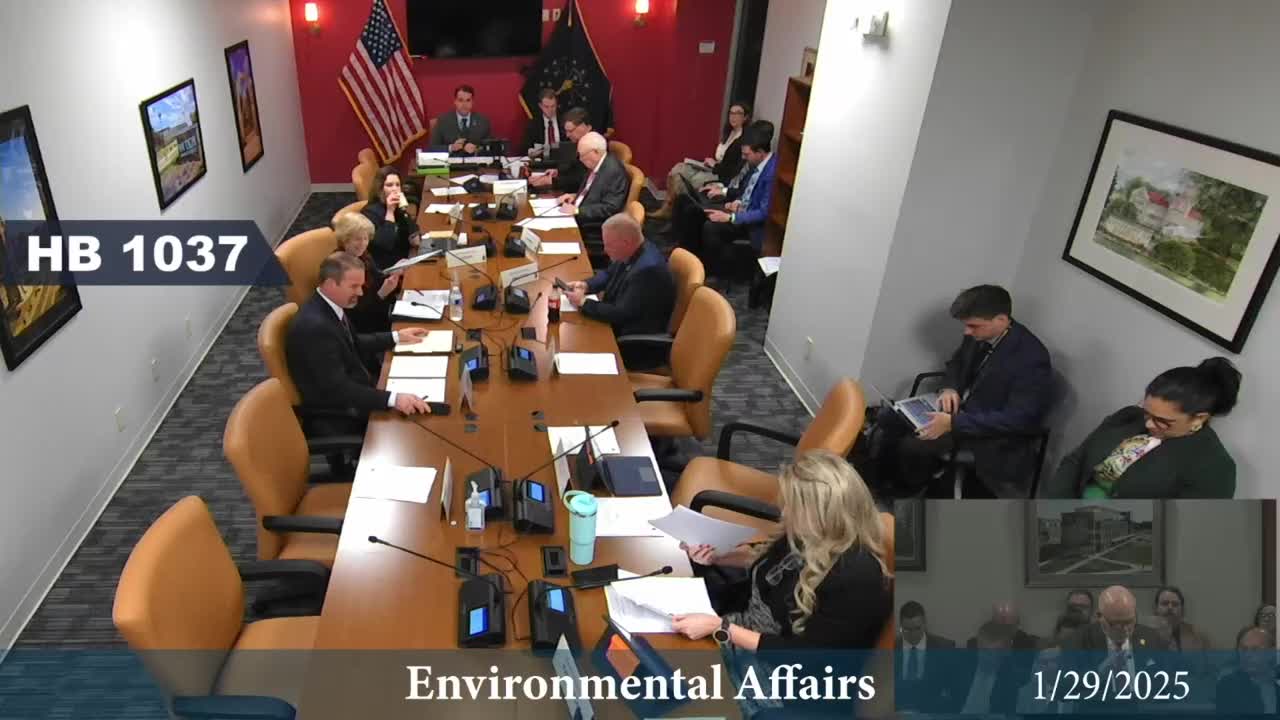
The House Environmental Affairs Committee on Wednesday approved House Bill 1037, which would bar municipalities and MS4 operators from enforcing sediment and erosion controls more stringent than Indiana's construction stormwater general permit, moving the measure forward on a 9-4 vote.
The House Environmental Affairs Committee on Wednesday approved House Bill 1037, which would prohibit municipalities and municipal separate storm sewer system (MS4) operators from adopting or enforcing sediment and erosion control measures that are stricter than the state'issued construction stormwater general permit. The committee vote was 9 in favor, 4 opposed.
Proponents, including bill sponsor Rep. Doug Miller, said the bill clarifies that local ordinances may not exceed the state permit and would reduce a patchwork of local rules that complicate construction across multiple jurisdictions. "This bill would not lessen current federal standards," Miller said, adding the measure aims to "provide certainty to property owners operating in multiple areas across the state."
Supporters at the hearing included industry groups and trade associations who told the committee that, after the U.S. Environmental Protection Agency-approved transition of IDEM's program from a rule to a general permit, some local MS4 ordinances became more restrictive than state requirements. Rick Wojda of the Indiana Federal Bureau Association and a representative of the Indiana Manufacturers Association both urged passage, saying consistent rules improve compliance and reduce costs for builders who operate in many jurisdictions.
Opponents warned the bill would limit local governments'ability to respond to local conditions. "We are standing in opposition to this bill," said David Van Gilder, senior policy and legal director for the Hoosier Environmental Council, citing concerns that local officials better understand site-specific problems and that the bill risks worsening water quality. Shannon Killian, stormwater administrator for the City of Indianapolis, said the measure "will remove the city's ability to develop protections that address stormwater quantity and quality challenges we face" and described local permitting practices that review runoff calculations and downstream storm-sewer capacity.
Environmental groups and local officials emphasized a gap in federal and state coverage: the construction stormwater general permit generally applies to sites that disturb 1 acre or more. Bill Blomquist of the White River Alliance used a 20-year photo comparison of one city block to argue that many redevelopment projects under one acre can cumulatively generate large amounts of sediment. "The construction stormwater general permit excludes sites of less than 1 acre," Blomquist said, adding, "how do you avoid being more stringent than nothing?"
Committee members who opposed the bill cited local control. Representative Lindsay Patterson said local officials and Republican and Democratic mayors "have the best interest at heart between economic development and also maintaining healthy soils and waters." Those concerns did not carry the day: the committee recorded nine ayes and four nays and moved HB 1037 forward.
Votes at a glance: Chairman Beau Baird (aye); Rep. Ellsworth (aye); Rep. Culp (aye); Rep. Haggard (aye); Rep. Miller (aye); Rep. Patterson (aye); Rep. Pierce (aye); Rep. Smith (yes); Rep. Yocum (aye); Rep. Bauer (no, minute to explain); Rep. Arrington (no); Rep. Boye (no); Rep. Jackson (no).
The bill text references IDEM's construction stormwater general permit and the EPA-approved transition of the program; the committee hearing included requests from multiple local jurisdictions and technical stakeholders for the state to allow local exceptions or processes to address special geologic conditions, such as karst or urban drainage constraints. The bill sponsor and supporters said they are focused solely on construction-site stormwater runoff and sediment controls.
The committee record contains technical exchanges about enforcement and the difference between state permit triggers and local ordinances; proponents argued uniform rules aid consistent installation and enforcement, while opponents argued local rules fill regulatory gaps for sites under the permit threshold. The bill now moves to the next step in the House process.