Get Full Government Meeting Transcripts, Videos, & Alerts Forever!
Get email alerts on the Code Alignment Permit Reform topic
No spam. Unsubscribe anytime.
Committee forwards code-alignment ordinance to full council to pause select upgrade triggers until 2029
Summary
The Homelessness and Housing Committee on Aug. 12 voted to forward an ordinance from Portland Permitting and Development (PPD) to City Council that temporarily pauses several upgrade-trigger requirements that apply to alterations and additions to existing buildings.
The Homelessness and Housing Committee on Aug. 12 voted to forward an ordinance from Portland Permitting and Development (PPD) to City Council that temporarily pauses several upgrade-trigger requirements that apply to alterations and additions to existing buildings.
Committee members and staff described the measure, part of a broader Code Alignment Project, as a targeted, cross-bureau effort to reduce permitting barriers that disproportionately burden small businesses and smaller renovation projects.
"This is the business of government doing better," said Daniela Rivera, introducing the package and thanking staff and council partners for the multi-bureau coordination that shaped the proposal.
What the ordinance would pause
The staff proposal would temporarily suspend four cost-threshold upgrade triggers for additions and alterations (not new construction) through Jan. 1, 2029, while bureaus study long-term alignment: the Title 33 nonconforming upgrade threshold (a current trigger at $356,000), certain Title 11 street-tree planting requirements for alterations and additions (current street-tree frontage triggers tied to a $25,000 project threshold), significant street-frontage improvement triggers tied to a "35% of assessed value" significant-alteration test, and other associated submittal and plan requirements. PPD staff told the committee the pause is intended to limit unexpected costs and delays that can cause applicants to abandon or downsize projects.
Staff said the pause would affect roughly 70 sites per year (about 8% of total permits) and would not apply to new building construction, certain PBOT frontage-triggered projects, or institutional projects such as K'12 schools, hospitals or parks where frontage upgrades remain required.
Presenters and public testimony
Terry Thiessen, Mika Steckelenburg (code alignment project manager), and other PPD staff summarized the problem set: codes across bureaus have different dollar thresholds, dates and formulas, creating surprises for applicants. Staff said the project was launched in November 2024 and that the pause would buy time to develop a coordinated long-term approach.
Several witnesses from the development community spoke in favor. Michael Harrison of OHSU requested a related change (longer grace period after campus upgrades); Kelly Ross of NAOP Oregon and Michelle Schultz of GBD Architects said the pause would reduce cost and speed reinvestment in existing buildings. Sarah Radcliffe of Habitat for Humanity urged further work sessions focused on public-works costs for housing production.
Committee debate and vote
Councilors praised the package as a first phase of a larger effort to cut regulatory clutter. Councilor Zimmerman asked staff to ensure tree-planting goals are preserved where they are critical to city policy; staff said the package preserves street-tree requirements for new construction and for PBOT frontage-triggered projects and includes minor technical adjustments to allow smaller-caliper trees and waive tree plans where no tree impacts occur.
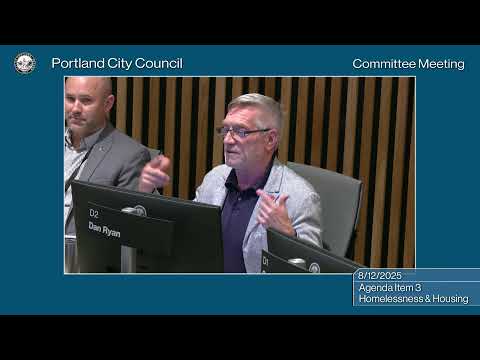
Councilor Ryan, who had championed earlier permit-improvement work, urged continued collaboration and cautioned against last-minute amendments that can create lasting confusion.
The committee moved to send the ordinance (document number 2025-314) to full council with a recommendation to pass. The motion, moved by Councilor Zimmerman and seconded by Councilor Murillo, passed by a roll call of five ayes. The committee's action forwards the pause to the full City Council, with a scheduled council hearing on Sept. 3 at 10 a.m.
Clarifying details and next steps
Staff emphasized the pause applies to additions and alterations and does not change requirements for new building construction. The pause timeline (through Jan. 1, 2029) is intended to allow time for cross-bureau data collection and a more durable alignment of upgrade thresholds. Staff said unreinforced masonry rules were not part of the proposal and that the suspension would not affect projects that increase vehicle trips to a site or certain institutional projects where frontage improvements remain required.
The ordinance will be considered by full council on Sept. 3, with staff expected to return with analysis during the pause and a plan for the next phase of code alignment work.