Get Full Government Meeting Transcripts, Videos, & Alerts Forever!
Get email alerts on the Homelessness Shelter Services topic
No spam. Unsubscribe anytime.
Mayor Wilson outlines rapid-exit shelter push, reunification goals and cites federal executive order
Summary
Mayor Wilson presented a multi-pronged plan to expand emergency shelter capacity, speed exits to housing, and scale reunification efforts; the city attorney summarized a recent federal executive order that could reorient discretionary grant priorities toward required treatment-based programs.
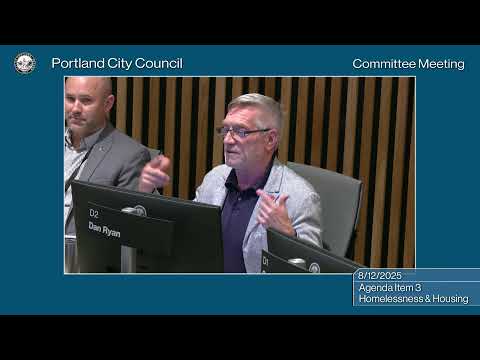
Mayor Wilson told the Homelessness and Housing Committee on Aug. 12 that the city is pursuing a multi-part strategy to reduce unsheltered homelessness by expanding low-barrier shelter capacity, increasing reunifications with family or prior communities, and reestablishing community safety and sanitation standards.
"Homelessness is a housing problem. Full stop," Mayor Wilson said, outlining what he described as six goals that include opening more emergency shelter beds, creating rapid-exit pathways into housing, and increasing outreach and enforcement where safe shelter is available.
Wilson said the city had opened or sponsored six shelters representing 630 beds and reported 31,280 nights of safe, secure sleep provided as of Aug. 3. He described utilization rates over recent months of about 73% for "safes" and 84% for the Moore Street facility and said the city is aiming to have 1,500 new emergency shelter beds by Dec. 1, while Multnomah County has a separate commitment of 1,000 beds by Dec. 31.
The mayor framed reunification — helping people return to live with family or previous communities — as an immediate relief strategy. "Reunification is housing," he said, and set a goal of meeting or exceeding 14 reunifications per week. He cited the city's most recent point-in-time count, saying 26% of respondents who answered where they were last housed reported coming from out of state.
Wilson described operational changes intended to reduce bottlenecks in shelter flow, including clearing minor legal barriers (for example, misdemeanors or warrants) "within hours instead of weeks," and applying a "rapid exit" model to shorten average shelter length of stay. He said the city's policy will keep overnight, life-saving beds available even when individuals exit full-service 24/7 sites.
On neighborhood impacts and encampments, Wilson said the city will adopt a more prescriptive "good neighbor" approach to new shelters, requiring standard mitigation commitments and site assessments before openings. He defended increased outreach and limited enforcement tied to availability of shelter as a means to reduce health and safety harms, and said the city plans to increase RV removals from the current ~38 to a funded goal of about 96 to address public-safety risks.
"We have to reestablish community standards on safety, health, and sanitation in our city," the mayor said, listing public-safety concerns he associated with lived-in RVs and makeshift encampments.
Council members pressed for detail on how short-term shelter exits will translate into permanent housing. Councilor Murillo asked whether the 90-day stay limits at some 24/7 shelters would be compatible with the availability of rental assistance and other housing subsidies. "When you say we're gonna rapidly rehouse people within those 90 days, I don't know how that practically happens because the federal government, the state have not actually funded rental assistance to the capacity that we need," Murillo said, urging that rental assistance and housing stabilization investments accompany shelter expansion.
Wilson and members of his team responded that the city has substantial resources and that the strategy is to pair shelter access with efforts to unlock existing vacancy and deeply affordable inventory, use gap financing where needed, and emphasize reunification to reduce inflow pressure on the system.
Skyler Rucker, identified in the meeting as director of Portland Solutions, said the city is also coordinating with philanthropic and private partners to extend capacity and services while federal and state funding gaps remain.
City attorney's office summary of federal executive order
Naomi Sheffield, chief deputy city attorney, gave a brief review of President Trump's executive order described in the meeting as "Ending Crime and Disorder on America's Streets." Sheffield said the order itself does not immediately change municipal authority but directs federal agencies (including HUD and DOJ) to reprioritize discretionary grant criteria. She identified three primary federal priorities signaled by the order: (1) an emphasis on civil commitment for individuals with serious mental illness; (2) reprioritization of discretionary grants toward programs aligned with enforcement and with conditions requiring recipients to engage in treatment; and (3) deprioritizing or conditioning funding for harm-reduction and safe consumption programs.
"We haven't seen specific implementation," Sheffield said, "but we're monitoring how these directives may affect grant funding and compliance conditions that could impact local programs."
Sheffield and others on the panel noted that if agencies change discretionary funding priorities, it could affect which local models receive federal support. Councilors asked how that might interact with Portland's existing shelter-first or voluntary-engagement models; Sheffield said the order would steer federal agencies toward programs that require treatment engagement for recipients, which could shift grant scoring or eligibility but does not instantaneously change local law.
What the committee asked and directed
Councilors asked for more transparent, trackable reporting on shelter spending and housing exits. Skyler Rucker said the city will present monthly budget and utilization reports and can provide additional detail to the committee upon request.
Members also sought clearer public metrics on county progress toward its pledged 1,000-bed goal; Wilson said he is working closely with Multnomah County leadership and believes the county remains committed to that target. In committee exchanges the mayor said the county was at roughly 500 beds at the time of the meeting, and he urged accountability to the community promise of 1,000 beds by year end.
The mayor and staff emphasized that shelter expansions are being deployed as a temporary emergency response paired with a housing strategy they described as longer-term, including vacancy activation, a housing "strike team," and other interventions the administration said are intended to increase permanent housing production.
Ending note
The committee's discussion continued through questions from multiple councilors about program design, enforcement thresholds, and measures of success. The mayor said city staff will continue to provide data to the committee on utilization, shelter exits and budget details as the emergency shelter rollout proceeds.