Get Full Government Meeting Transcripts, Videos, & Alerts Forever!
Get email alerts on the Energy Infrastructure topic
No spam. Unsubscribe anytime.
Surry County planning commission tables proposed battery storage ordinance after extended technical and community discussion
Summary
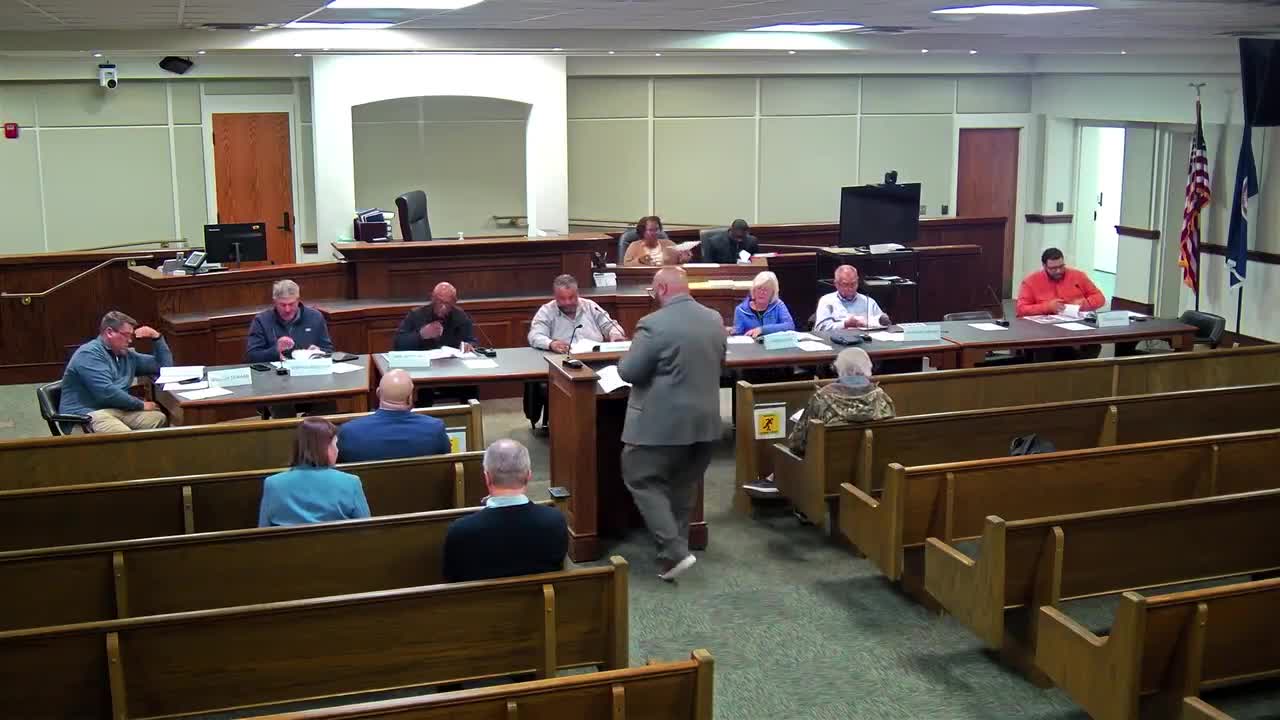
The Surry County Planning Commission on Jan. — (work session portion) voted to table PC Ordinance Amendment 2024‑O‑4, the county's proposed rules for battery energy storage systems, after more than an hour of technical and policy discussion.
The Surry County Planning Commission on Jan. — (work session portion) voted to table PC Ordinance Amendment 2024‑O‑4, the county's proposed rules for battery energy storage systems, after more than an hour of technical and policy discussion.
Commissioners and staff focused on public‑notice rules, emergency and fire safety measures, setbacks, noise limits and whether to allow BESS in agricultural (AR) zoning with a conditional use permit. Planning Director Mister Wade and legal advisor Miss Perkins guided the commission through the draft ordinance and answered questions from commissioners, including Miss Cheek, Mister Bremer, Mister Coggan and Mister Hardy.
The commission’s action: A motion to table the ordinance, made by Commissioner Cheek and seconded (second not specified in the record), carried by voice vote. The commission directed staff to return with a revised draft and, as part of follow‑up, to arrange a site visit for commissioners.
Why it matters: Several utility‑scale BESS projects are entering permitting nationwide and counties are defining local rules for land use, fire safety and community impacts. The commission’s decision delays a final local standard while staff incorporates technical guidance and community concerns.
What the draft and discussion covered
Scope and public participation: The draft largely mirrors language from Surry County’s solar ordinance on public‑meeting requirements. Commissioners debated the draft’s notice timing: the ordinance as written requires applicants to notify property owners at least seven days and not more than 14 days before a community meeting. Commissioner Cheek urged increasing the minimum to 15 days “to give people reasonable time” to attend; staff said in practice applicants are typically asked to do broader notification and sometimes provide more notice than the bare minimum.
Permit‑by‑rule meetings: Staff and a permit‑process speaker, Scott Flosser, explained that the DEQ “permit by rule” (PBR) process already requires more extensive community meetings and advertising (including a 60‑day notice window in some PBR cases). The draft allows applicants to count a PBR meeting toward the ordinance’s public‑participation requirement if it meets timing thresholds.
Safety and fire protection: The draft requires 24/7 automated fire detection and containment/passive mitigation within container assemblies; it also anticipates built‑in suppression in cases where a design does not provide certain active systems. Staff said the ordinance opts into NFPA 855 as the guiding standard for design and emergency response; Miss Perkins said NFPA 855 is the current national standard even though Virginia has not fully adopted it statewide. Commissioners pressed for clearer detail on de‑energizing timelines, hazardous‑materials risks and the emergency‑response plan required at final site plan approval.
BESS configuration, alarms and signage: The draft requires battery management systems capable of shutdown and alarm in unsafe conditions and remote monitoring by a control center. Commissioners asked what form the alarm would take; staff said the alarm is primarily a feed to a remote operations center that in turn notifies local emergency responders. The commission agreed to require warning signage at facility entrances and, as needed, on individual containers.
Zoning districts and footprint: The draft lists BESS as a conditional use in AR, M‑1 and M‑2 districts. Commissioners debated allowing BESS in AR, with staff noting that use would be by conditional use permit to avoid unintentional spot zoning; staff said typical BESS footprints are much smaller than typical solar farms (often under 50 acres for the unit itself) and that many localities treat BESS similarly to substations until dedicated ordinances exist.
Setbacks, height and buffers: The draft includes district‑specific setbacks: roughly 200 feet from property lines in AR, 500 feet from residential in some contexts, and 75 feet in M‑1/M‑2 (the same as those industrial districts’ underlying setbacks). Commissioners expressed concern that 75 feet was too small near non‑industrial uses and discussed whether 200–750 feet would be more appropriate depending on adjacent uses. Maximum structure height in the draft appeared as 30 feet in a separate provision. Landscaping and perimeter screening (including a 25‑foot buffer around perimeter fencing) were proposed to moderate visual impacts.
Noise: The ordinance draft proposed demonstrating conformance with a noise standard (staff suggested demonstrating compliance with 65 dBA at the property line using a sound‑engineering model). Commissioner Cheek urged a substantially lower limit (she suggested 40 dBA at the nearest occupied structure), saying residents near solar projects had reported persistent noise. Staff cautioned that very low dBA limits often force visual mitigation solutions (for example tall sound walls) that raise the visible profile; staff proposed a dual approach—property line modeling plus consideration of impacts at the nearest occupied receptor.
Technical review and standards: Commissioners and staff agreed the county will require technical reviews paid for by applicants where specialist analysis is required (for example noise modeling and NFPA compliance). Staff noted that older BESS technologies may not meet NFPA 855 and that most modern systems used in recent projects are designed to comply.
Next steps and follow up: The commission voted to table the ordinance and asked staff to draft revisions that respond to the issues raised, to coordinate any necessary technical review (including outside peer review when appropriate), and to schedule a site visit for commissioners and supervisory members prior to returning the measure for a future vote. Staff indicated the draft will be refined with input from legal counsel, consultants and the applicant where relevant.
A direct quote from the motion: "Yes, ma'am. I would like to, make a motion to table this new version of this given the input," said Commissioner Cheek (motion maker). The motion carried by voice vote.
Ending: The tabling preserves additional time for the commission to incorporate technical standards and community input. Staff said they expect to present a revised ordinance and accompanying analyses at the commission’s next meeting after the subcommittee/staff review and the planned site visit.