Get Full Government Meeting Transcripts, Videos, & Alerts Forever!
Get email alerts on the Behavioral Health topic
No spam. Unsubscribe anytime.
San Francisco reports drop in overdose deaths, expands street-based addiction care and crisis services
Summary
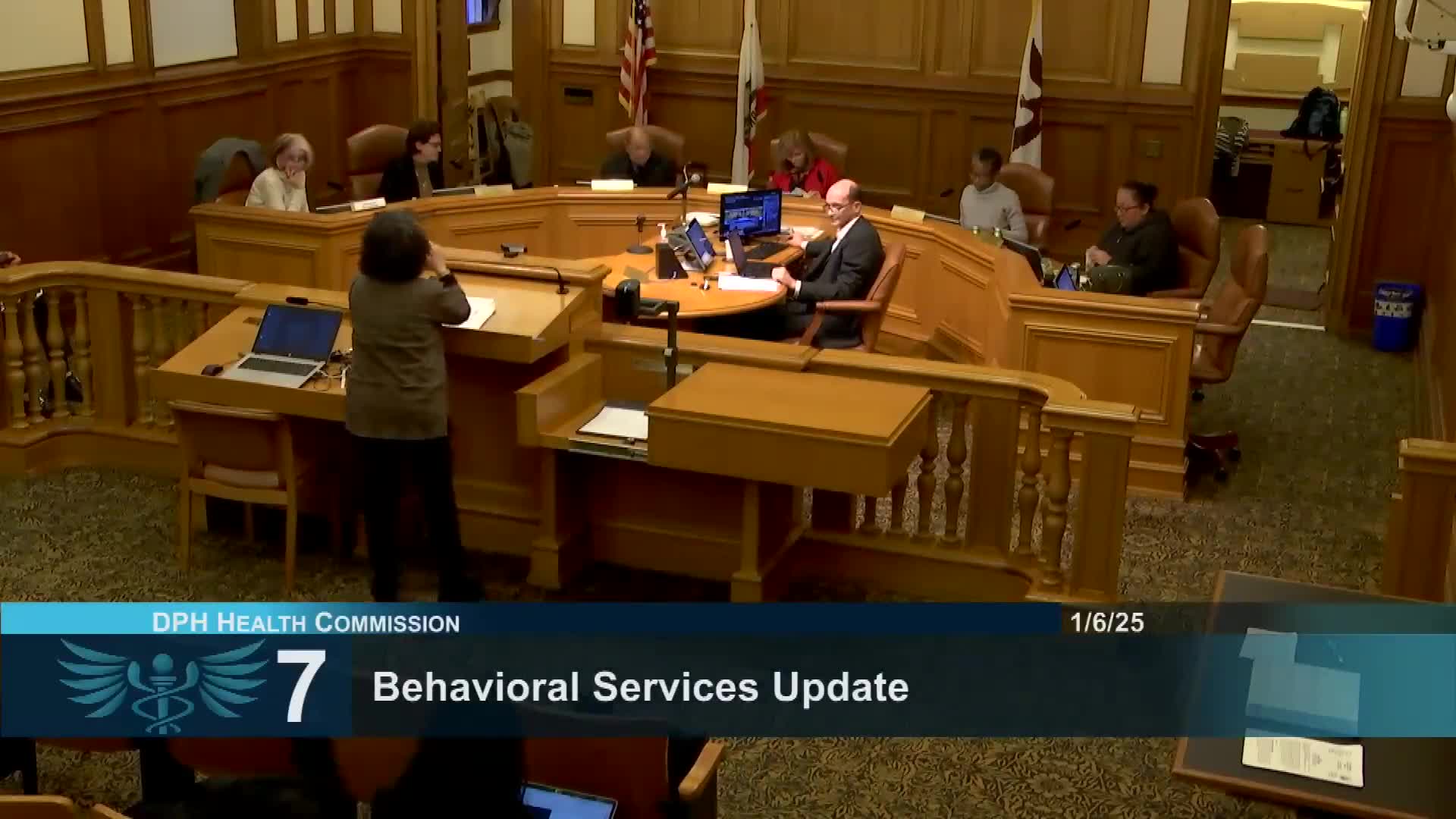
San Francisco Department of Public Health officials reported preliminary data showing a notable decrease in overdose deaths and outlined continuing expansions in behavioral-health services, crisis care and residential capacity.
San Francisco Department of Public Health officials reported preliminary data showing a notable decrease in overdose deaths and outlined continuing expansions in behavioral-health services, crisis care and residential capacity.
Dr. Hilary Coonens, Director of Behavioral Health Services, told the Health Commission that preliminary figures through November 2024 place the city on track for more than a 20% reduction in overdose deaths compared with 2023. "We are on track to see greater than 20 percent fewer deaths compared to 2023," Coonens said, and she attributed progress to expanded access to medications for opioid use disorder, new telehealth navigation programs and street-based care.
Why this matters: 2023 was a record year with more than 800 overdose deaths in San Francisco. City leaders said the decline is preliminary but encouraging and tied to a range of interventions designed to reduce fatal and nonfatal overdoses and racial disparities in outcomes.
Key program updates provided to commissioners:
- Medications and access: The city expanded a 16-hour, seven-days-a-week telehealth buprenorphine program and navigation services; between March and October, the evening program enabled nearly 1,500 telehealth visits and led to substantial treatment starts. The Health Network has also expanded office-based buprenorphine clinic hours and begun mechanisms to start methadone in nontraditional settings to increase access.
- Bed capacity and Mental Health SF: Coonens said the city has added roughly 400 residential care and treatment beds since Mental Health SF was legislated in 2019. A 16-bed voluntary crisis stabilization unit is expected to open in the spring at 822 Geary; the unit is designed to accept walk-ins and stabilize people medically and psychiatrically with nursing care and short stays.
- Street-based and outreach services: Best Neighborhoods street teams have had more than 9,000 engagements and 1,300 direct connections to services in the last fiscal year. The department also reported increases in admissions to DPH-funded methadone clinics (a 35% increase Jan–Oct 2024 versus the same period in 2023).
- Crisis line and 988: The Felton Institute operates San Francisco’s 988 crisis line and handled about 12,000 calls from January–October 2024; the line referred callers to mobile crisis, EMS, shelter and treatment services and required emergency dispatch in a small fraction of calls.
- Oversight and quality: The department described intensified oversight of community providers following several fatal overdoses at a contracted provider, including immediate investigations, required performance-improvement plans and agency technical assistance. Dr. Coonens said the provider had used safety checks exceeding state minimums but that DPH required further improvements and heightened monitoring.
Director Colfax and commissioners discussed sustainability of new programs, state funding strings tied to capital versus operations, and workforce challenges in the high-cost Bay Area. Commissioners asked for follow-up data on response times and criteria for specific contracted teams (for example, child crisis and Seneca), and DPH said it would provide additional details by email.
Ending: Commissioners praised the breadth of changes while noting continued operational and funding challenges; DPH said it will return with more precise data on access, wait times and program outcomes.