Get Full Government Meeting Transcripts, Videos, & Alerts Forever!
Get email alerts on the Avian Flu topic
No spam. Unsubscribe anytime.
San Francisco public health officials say H5N1 risk to general public remains low; monitoring and planning underway
Summary
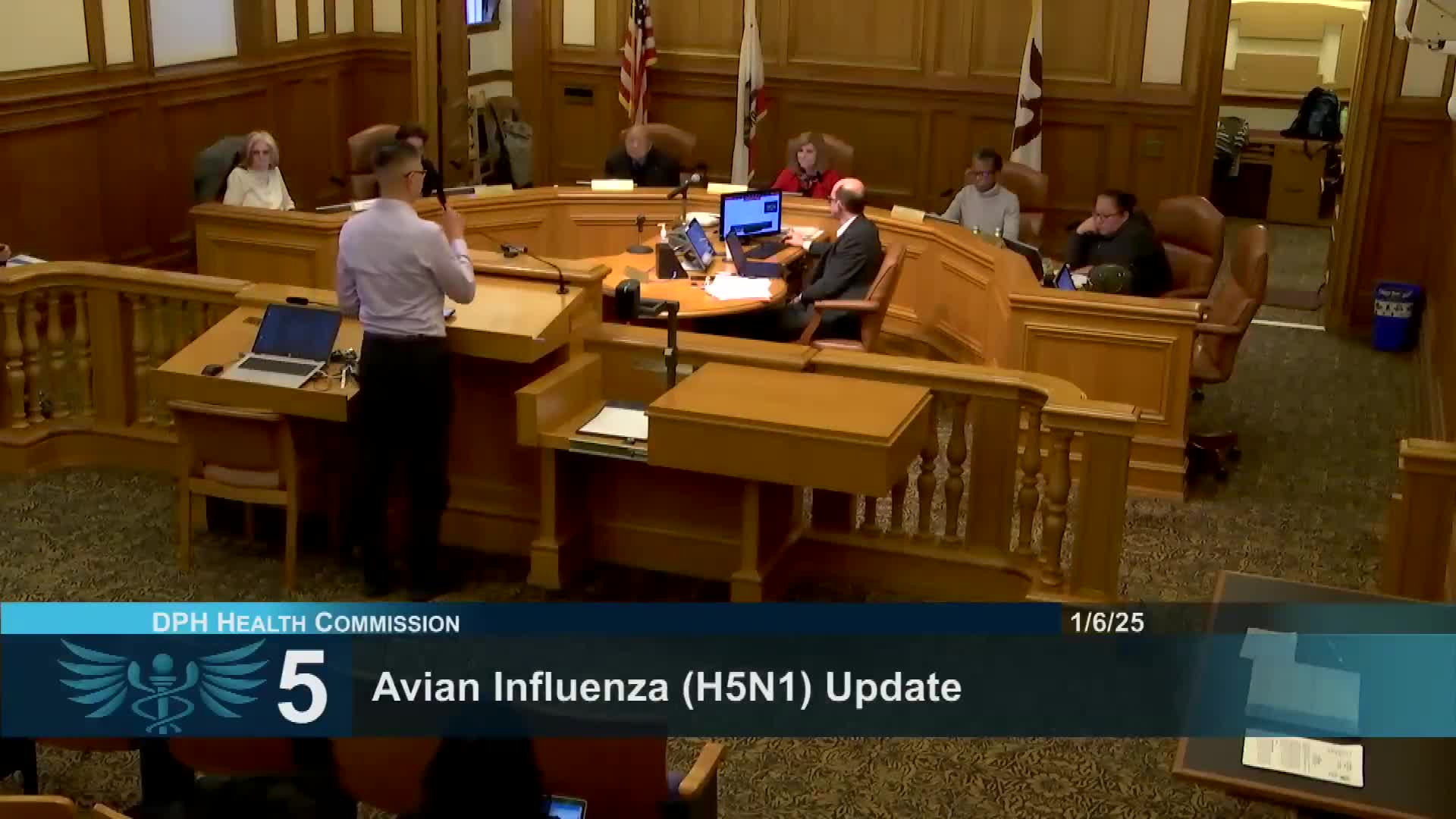
San Francisco health officials told the Health Commission that the risk to the general public from the H5N1 avian influenza strain remains low but requires continued surveillance and planning.
San Francisco health officials told the Health Commission that the risk to the general public from the H5N1 avian influenza strain remains low but requires continued surveillance and planning.
Dr. George Hahn, Communicable Disease Section Director, said the strain now circulating in North America arrived in 2021 and has infected poultry and dairy herds, including dairy outbreaks that spread across the U.S. in 2024. "To date, the virus has not gained the ability to transmit easily from person to person," Hahn said. He added that most U.S. human cases have been mild and that infections so far have occurred mainly in dairy and poultry workers in close contact with infected animals.
Why this matters: California has seen extensive dairy herd impacts this year, and officials said those livestock outbreaks are the primary reason the state declared a limited emergency. Governor Gavin Newsom’s declaration, officials said, is intended to speed contracting and increase operational flexibility for the state response to dairy herd outbreaks, not because of increased public risk in San Francisco.
What San Francisco is doing: the Department of Public Health (DPH) described three surveillance streams. First, clinicians and the San Francisco Health Network are being informed and supported to test and consult on suspected cases. Second, the San Francisco Public Health Laboratory is subtyping influenza A specimens unavailable from local hospital labs; the lab has subtyped more than 300 specimens since the summer and has not found H5N1. Third, city wastewater surveillance has been extended to distinguish H1, H3 and H5 subtypes; officials said detected H5 in wastewater likely reflects nonhuman sources such as raw milk in drains or wild-bird waste rather than human infection.
Hahn outlined three planning scenarios the city is preparing for: isolated human cases that do not increase community risk; emergence of sustained person-to-person transmission; and a larger pandemic scenario. The department has stood up a planning incident management team with a structure that can pivot into an operations IMT if needed, and is developing mitigation strategies for each scenario including public messaging and a tabletop exercise to test plans.
Public-health context and open questions: officials said antiviral medications (for example, oseltamivir) appear effective against the current strain, and that pasteurized dairy products are safe. They noted limited H5N1 vaccine supply nationally; initial federal stockpiles are small and allocation decisions are under federal authority. Dr. Hahn also said there is a theoretical but unquantified risk that co-infection with seasonal influenza and H5N1 could enable viral reassortment.
Asked about wastewater signals and how to interpret H5 detections, Hahn and colleagues said the data are still being understood; a sustained unexplained rise in H5 levels would prompt further investigation. The department also emphasized coordination with state agencies including the California Department of Food and Agriculture and with federal partners such as CDC and FDA on testing and recalls when raw milk has tested positive.
The commission received no remote or in-room public comment specific to the presentation during the item.
Ending note: commissioners thanked the presenters and urged continued public communication as the situation evolves.