Get Full Government Meeting Transcripts, Videos, & Alerts Forever!
Get email alerts on the Housing Adus topic
No spam. Unsubscribe anytime.
Commission backs ADU condo‑conversion ordinance with staff limits to protect rent‑controlled units
Summary
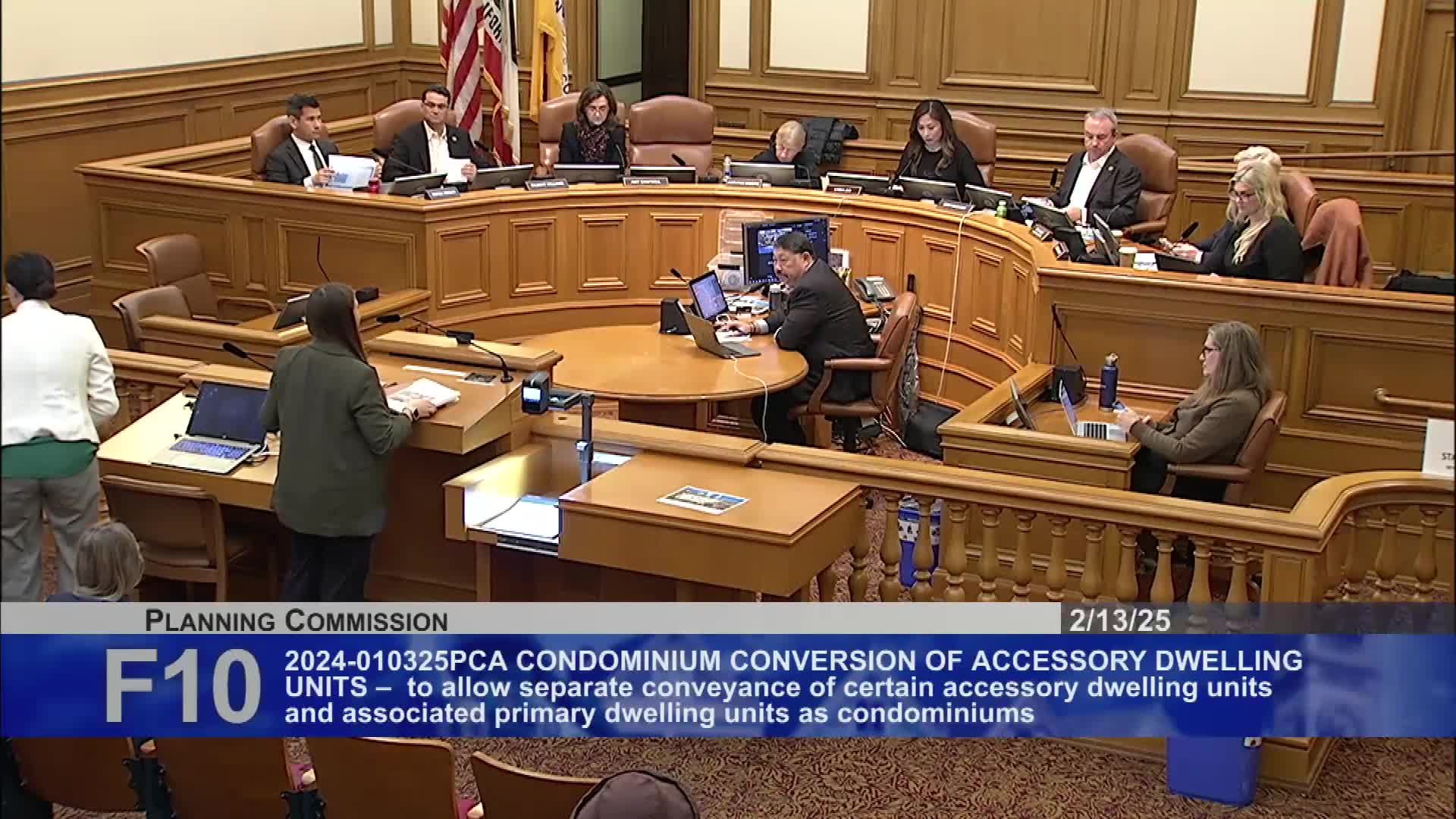
The Planning Commission voted 5–1 Feb. 13 to recommend approval of a local ordinance allowing some accessory dwelling units (ADUs) to be converted into condominiums, adopting staff modifications to limit eligibility and address tenant‑displacement risks.
The Planning Commission voted 5–1 on Feb. 13 to recommend approval of local legislation that would allow certain accessory dwelling units (ADUs) to be sold as condominiums, subject to staff‑recommended restrictions intended to protect rent‑controlled housing and minimize displacement.
Planning staff emphasized the ordinance would not change who can build ADUs but would create a pathway for some ADUs to be conveyed as separate condominium units. “This ordinance is not going to change any of the eligibility requirements or how you can build an ADU,” Planning staff presenter Adrienne Marloney said in her presentation to the commission.
Staff and the sponsor described the proposed program’s goals as creating homeownership opportunities in lower‑density, higher‑resource neighborhoods and helping long‑time homeowners access equity. Joel Engadio, who introduced the legislation to the commission as the sponsor, said ADUs are an opportunity to increase housing options and help families and seniors. “I consider accessory dwelling units as an opportunity to increase housing options and density within the existing fabric of our neighborhoods,” Engadio told commissioners.
Planning staff identified two main risks if the ordinance were adopted without limits: (1) the loss of rent‑controlled units when conversion removes rent‑control protections; and (2) increased eviction risk from owner‑move‑in provisions that apply to condominiums. To reduce those risks, staff recommended narrowing the program’s eligibility so condo conversions would apply only in constrained circumstances — primarily to newly constructed detached ADUs on single‑family lots or to ADUs on lots already organized as condominiums and in buildings of four units or fewer — and not to ADUs created through the local program that are subject to rent control.
Opponents, including tenant advocates, argued the ordinance still risks removing rental units in small multifamily buildings. “It would result in a loss of an unlimited number of rental units in buildings of up to 4 units,” Mitchell Omerberg with the Affordable Housing Alliance said, urging the commission to reject the measure.
Supporters, including housing advocates and the sponsor’s office, said the measure creates a modest incentive for homeowners to build ADUs and for middle‑income buyers to gain a path to ownership. “This ordinance brings a lot of benefits to San Francisco,” Brianna Morales of the Housing Action Coalition said in public comment.
After deliberation commissioners largely supported the staff’s “belt‑and‑suspenders” approach — restricting eligible ADU types, limiting the program to detached new ADUs in many cases, and moving some state‑mandated conveyance requirements into the appropriate code sections and permit processes. Commissioner Lebron moved to adopt a recommendation for approval with staff modifications; the motion passed 5–1, with Commissioner Williams voting no.
The commission’s recommendation advances the ordinance to the Board of Supervisors. Staff told the commission the draft includes a state law reference (the enabling state bill discussed in the hearing) and additional code amendments to address subdivision and conveyance processes at other departments. The commission asked staff to refine implementation details and to coordinate with the city attorney and relevant permitting agencies before the Board of Supervisors hearing.
Votes at a glance: Motion to recommend approval with staff modifications — passed 5 to 1 (Commissioner Williams opposed).