Get Full Government Meeting Transcripts, Videos, & Alerts Forever!
Get email alerts on the Fire Operations topic
No spam. Unsubscribe anytime.
SFFD operations report highlights two multi-alarm fires, warns of dry hydrants and live-wire hazards
Summary
Deputy Chief Darius Letrop told the Fire Commission that two multi-alarm fires in November and December exposed hazards including a downed high-voltage line and unreliable hydrants at Hunters Point, prompting changes to water-supply procedures and after-action mapping.
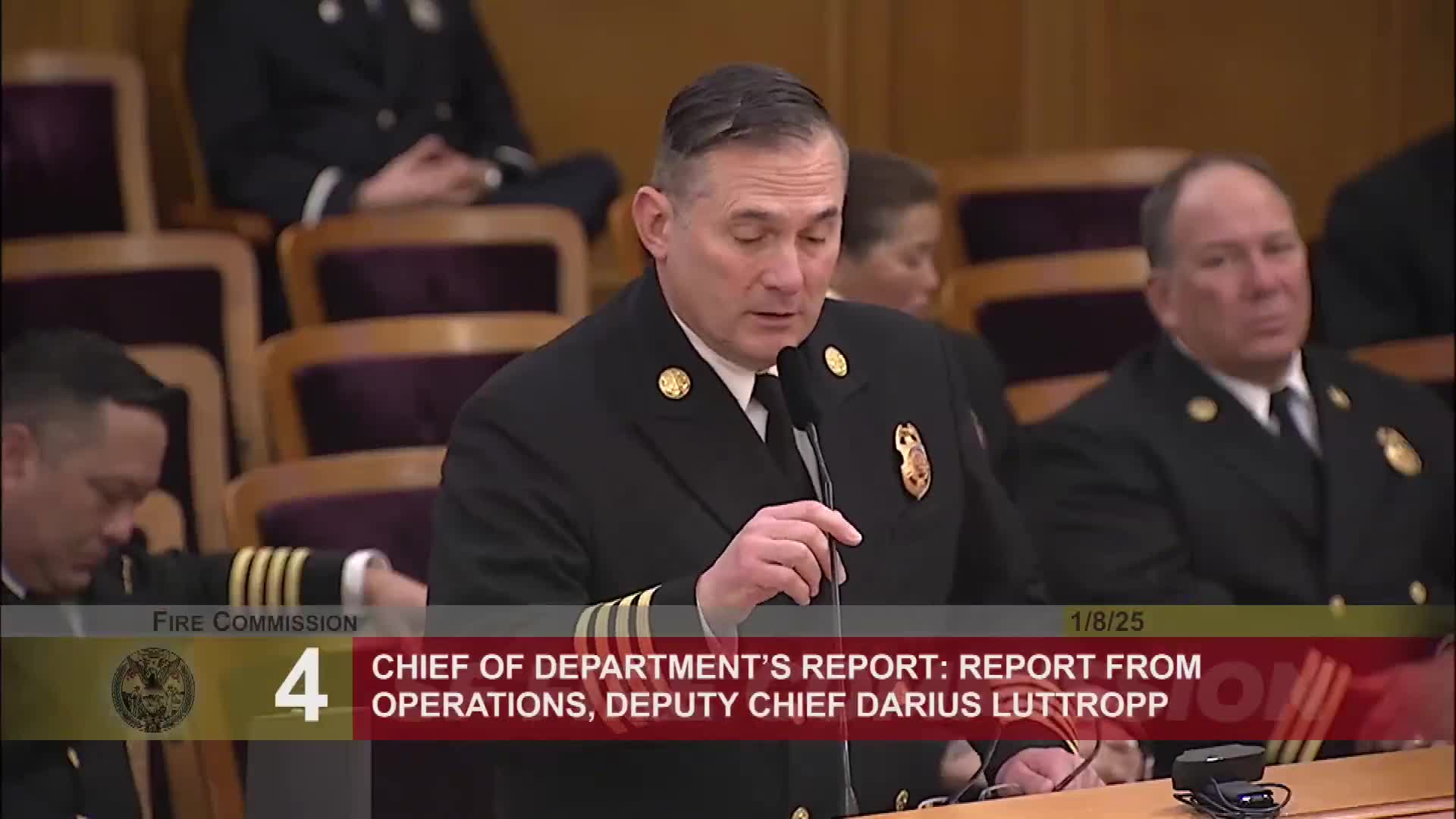
Deputy Chief Darius Letrop reported to the San Francisco Fire Commission on Jan. 8 that two multi-alarm fires in November and December required unusual tactics and highlighted gaps in water supply and scene safety.
The first, a Nov. 18 fire on Washburn Alley behind 150 Ninth Street, began as an outside fire and building alarm and quickly extended into a four-story residential structure. Engine 1 arrived to find heavy fire; crews discovered construction materials and a porta-potty involved and a separated high-voltage line in front of the building. Letrop said crews split to perform interior search-and-rescue while others worked on the roof, and a second alarm was struck as additional companies arrived.
"It is one of the strengths of our doctrine that we are committed enough to the work of the other members of this fire department that we will put people in harm's way above a fire without a hose line ... to search for and rescue the occupants of the building," Letrop told the commission, commending crews for rapid action and coordination.
The second incident, Dec. 15 at the former Hunters Point shipyard, began with an early-morning caller reporting smoke. The initial engine found a Type V wood structure fully involved and attached to a large Type II warehouse; a second alarm was struck while crews sought water. Letrop said site hydrants on portions of the shipyard were unreliable or dry because the system was not consistently maintained, requiring engines to run long hose lines and, temporarily, a relay shuttle operation using multiple engines' tank water until a usable hydrant was found.
"The incident commander on scene came up with a very good plan, which was just a relay or a shuttling water operation," Letrop said. He described crews running split-line leads and using extended hose lengths — as much as 1,400 feet — to try to reach a working hydrant before establishing a sustained supply.
Letrop told commissioners the two fires underline the need for better preincident mapping, more robust water‑supply planning and a formalized water‑supply officer role on large incidents. He said battalion and operations chiefs in Battalion 10 will develop maps and processes so crews know where reliable water sources exist and how to establish continuous, redundant water quickly on arrival.
Commissioners asked about the ownership and maintenance of shipyard hydrants. Letrop said the hydrants were connected to the municipal system historically but were not maintained by the city in the same way; the property is managed by a private development company, and he said the department will coordinate with that entity and other stakeholders to address hydrant reliability.
The commission did not take formal action on the items during the meeting. Letrop closed by thanking line officers and training staff for preparing crews to adapt quickly to unexpected conditions.