Get Full Government Meeting Transcripts, Videos, & Alerts Forever!
Get email alerts on the Budget topic
No spam. Unsubscribe anytime.
Planning Department adopts 2025–27 budget after review of declining fee revenue
Summary
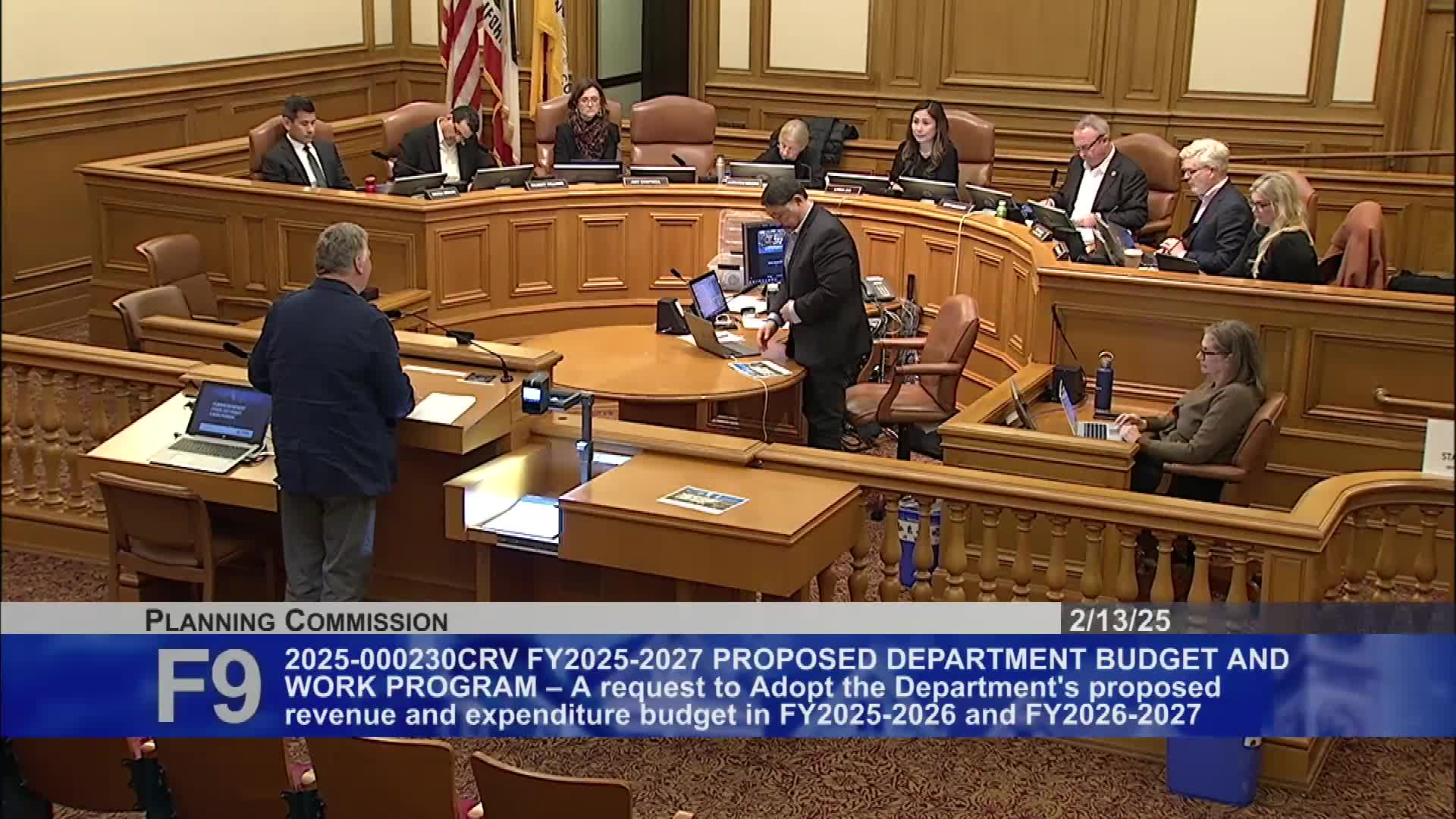
The San Francisco Planning Commission voted 6–0 on Feb. 13 to adopt the Planning Department’s proposed fiscal years 2025–27 budget and work program after staff described multi-year revenue declines driven by lower permit volume and smaller projects.
The Planning Commission adopted the Planning Department’s proposed fiscal years 2025–27 budget and work program on a unanimous 6–0 vote Feb. 13.
The department presented a high‑level summary of a budget staff reviewed earlier in January, telling commissioners the principal drivers are permit and entitlement volume, fee revenue those projects generate, and how many staff the department can fund from that revenue. “There’s really three major factors that drive our budget, and that is entitlements and permits that walk through the door, the revenue that those entitlements and permits generate, and then, how many staff we can fund from that money,” Director of Administration Thomas DeSanto said.
The planning department reported a substantial revenue decline in the last two years — including two recent drops of about 14% and 16% — and said it had trimmed staffing and vacant positions in prior years to match lower receipts. To address the shortfall in the proposed budget, staff said they will reduce assumed fee revenue by roughly $2 million and absorb an annual CPI increase of about $1 million, for an overall near‑term revenue reduction of about $3 million. Staff also expect an increase in grant‑funded project revenue primarily tied to a roughly $7 million federal pro‑housing HUD grant in the project budget.
In response to the reduced fee projection, the department proposed eliminating about six vacant positions in the operating budget this year; it eliminated 17 positions last year and about 20 the year before, staff said. The department emphasized that the vacancies targeted for removal are currently unfilled. “We’re going to eliminate about six positions out of the budget this year,” DeSanto said.
Commissioners asked about the causes of lower revenue per case and the department explained that post‑pandemic work has shifted toward smaller, ministerial projects that generate less fee revenue, and that statewide changes to permit review reduced some discretionary review fees. On the durability of grant funding, Commissioner Moore cautioned about relying on grants for operating stability: “I only want to add a word of caution ... grants ... are being canceled literally at the snap of a finger,” he said, urging contingency planning.
Commissioners discussed the possibility of future layoffs if fee declines continue; staff said they have not yet reached that point and would return to the commission with proposed reductions to work programs if further cuts were necessary. “If there are layoffs, which again, we don’t anticipate ... we’ll come talk to you about kind of the work programs we would propose to reduce,” DeSanto said.
On the motion to adopt the budget, Commissioner Brown moved to adopt and the motion was seconded; the commission recorded a unanimous 6–0 vote in favor. The adopted materials will be submitted to the mayor’s office for inclusion in the city budget process.
The commission’s action is a final adoption for the department’s internal submission schedule. Staff said the mayor will release a citywide budget on June 1 and the Board of Supervisors will consider adoption in July.