Get Full Government Meeting Transcripts, Videos, & Alerts Forever!
Get email alerts on the Local Housing Trust Fund topic
No spam. Unsubscribe anytime.
Finance committee forwards $5 million housing recommendation, asks council for fuller reserve-policy review
Summary
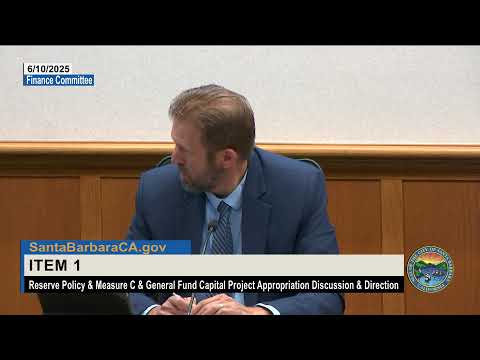
Santa Barbara’s City Finance Committee voted unanimously to forward a recommendation to City Council that would keep the administrator’s $3 million annual housing allocation and add a one-time $2 million boost for fiscal 2026, and also asked council to hold a standalone review of the city’s reserve policy.
The City Finance Committee on June 10 forwarded to the full City Council a recommendation that would keep the city administrator’s proposed $3 million annual allocation to the Local Housing Trust Fund and add a one-time $2 million allocation for fiscal year 2026, producing $5 million available for housing in FY26. The committee also asked the council to schedule a separate, agendized review of the city’s reserve policy.
Committee members and staff framed the vote as a short-term funding step while reserving a fuller, standalone discussion of the reserve policy for a later council meeting. Chair Freeman made the motion, which the committee approved unanimously.
The committee heard a detailed staff presentation about the city’s reserve policy and multiyear general fund forecast from Finance Director Keith DeMartini and budget staff. DeMartini said the city’s formal reserve policy currently targets 25% of annual operating expenditures, composed primarily of a 15% disaster reserve and a 10% contingency reserve, and that under the city administrator’s recommended budget the forecasted reserve levels would fall below that target during the budget horizon.
DeMartini warned that even lowering the policy to 22% would not yield sustained, ongoing funds available in FY26 because the recommended budget and long-range forecast already project reserves below that level. He told the committee the unfunded actuarial liability for the city’s pension is “the largest liability on the city’s balance sheet at over $450,000,000,” and that recent policy changes direct portions of year-end surpluses into a pension stabilization reserve and a Section 115 trust.
Council Member Harmon pressed staff on what a small change in the reserve target would generate. “A 1% reduction is not going to give me a million dollars. Is that correct?” Harmon asked during the discussion. Staff answered that small reductions (1–3 percentage points) would not provide the sort of ongoing revenue advocates requested for housing. Harmon and other committee members said that, because of that math, a one-time use of reserves or Measure C funds is a more feasible short-term approach than a small, permanent cut to the reserve-policy target.
The committee received numerous public comments urging larger, expedited investments in affordable housing. Members of the public and local advocacy groups asked the committee to commit $5 million immediately to the Local Housing Trust Fund, and speakers described the housing shortage as an urgent community need. Staff and committee members also noted that the city is awaiting a decision from the California Department of Housing and Community Development on a matching award; staff said the city’s application received a score of 90 and remains under consideration.
The approved recommendation sent to council endorses the administrator’s recommended $3,000,000 allocation in each of fiscal years 2026 and 2027, and adds a one-time $2,000,000 allocation for FY26 funded from a combination of reserves and Measure C proceeds as determined by staff and council direction. The committee also directed staff to bring the reserve-policy discussion back to City Council as a standalone item for a thorough policy analysis separate from the budget hearing process.
Committee members flagged several options staff should consider in the fuller review and for replenishment plans, including potential revenue measures such as a transient occupancy tax (TOT) increase or a vacancy tax, lines of credit, adjusting capital project timing, or using reserves to support affordable-housing loan programs—with caution about liquidity needs for disaster response and FEMA reimbursement limits. Staff noted that FEMA guidance and documentation requirements have changed, potentially reducing the share of disaster costs eligible for federal reimbursement and increasing the need for local disaster reserves.
What passed: the committee’s motion was seconded and approved unanimously; the item will be taken up by the full City Council at its next meeting. The committee asked staff to return to Council with the reserve-policy study and with the technical details on how the FY26 one-time $2 million would be drawn from reserves and/or Measure C funds and how it would be repaid or replenished.
The forwarded recommendation preserves the administrator’s two-year $3 million-per-year base funding for the Local Housing Trust Fund and adds a one-time infusion for FY26; the committee’s action does not itself change the city’s reserve policy.