Get Full Government Meeting Transcripts, Videos, & Alerts Forever!
Get email alerts on the Downtown Financing topic
No spam. Unsubscribe anytime.
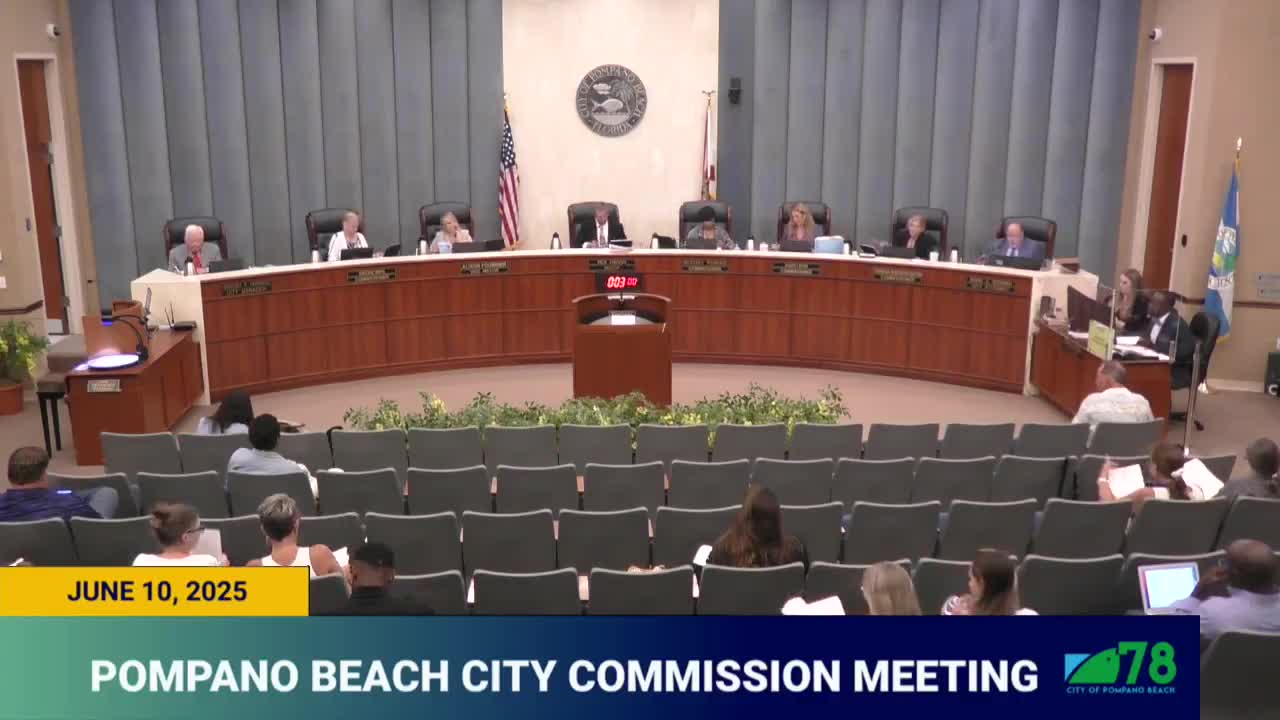
Pompano Beach commission deadlocked after heated debate over downtown financing; preservation concerns surface
Summary
After more than five hours of debate, the Pompano Beach City Commission recorded split roll-call tallies on whether to authorize up to $137 million in certificates of participation to finance civic buildings in the planned downtown redevelopment.
After more than five hours of public comment and back-and-forth among commissioners, the Pompano Beach City Commission debated an ordinance to authorize the city to issue certificates of participation to help finance civic facilities tied to a downtown redevelopment project.
The ordinance under consideration would approve the form of multiple financing documents and authorize issuance, in one or more series, of tax-exempt and/or taxable certificates of participation with an aggregate principal cap “not to exceed $137,000,000,” language read aloud during the ordinance (transcript). Assistant City Manager Suzette Sibyl told the commission the city estimated the long-term public option could save the city roughly $100 million compared with the private financing alternative identified in the master development agreement.
Why it matters: the financing mechanism determines whether the city borrows directly (public certificates) or accepts private financing offered by the master developer. Commissioners, staff and members of the public framed the vote as one about cost and about control — who decides civic-building designs, how tax-increment revenues are used, and whether historic community assets will be protected.
Commission discussion and public comment
Commissioners pressed staff and the city’s CRA counsel for details on next steps, legal risk and timelines. CRA counsel Claudia McKenna explained that the master development agreement requires the parties to complete certain steps and that disputes about city approvals could trigger a mediation/arbitration sequence; she said design-concept approvals for civic buildings follow a process that first attempts to reach agreement and then, if unresolved, could proceed to mediation and (ultimately) litigation if a party alleges the city unreasonably withheld consent.
Public commenters concentrated on two recurring concerns: preservation of the E. Pat Larkins community center and broader trust and process questions in the northwest CRA. Several long-time neighborhood residents and community leaders urged the commission to keep the E. Pat Larkins Center standing and to guarantee meaningful, early engagement with Northwest neighborhoods before major decisions are finalized. Speakers included longtime community advocate Pat Larkins and multiple neighborhood residents who said they fear that renovations “in place” will be limited and that the center’s history could be lost if future decisions move the facility or allow demolition.
Commissioner debate focused on process and trust. Commissioner Sigerson Eaton and Commissioner Smith argued in favor of the public financing option as a way to save money for the city; several other commissioners — including Commissioner Perkins and Commissioner Fessick — said they were not comfortable making a major financing decision without additional workshop-level discussion, clearer guarantees for the E. Pat Larkins Center and assurances about consultant roles and public engagement. Vice Mayor Fournier urged finding a path forward that included community input and also noted the potential savings of the public financing route.
Motions, roll calls and next steps
Commissioners briefly debated tabling or postponing the financing ordinance. The transcript records a motion to postpone and several roll-call tallies. In one roll call on a motion to postpone the item the transcript records the following: Commissioner Fessick — Yes; Commissioner Perkins — Yes; Commissioner Sigerson Eaton — No; Commissioner Smith — No; Vice Mayor Fournier — Yes; Mayor Hard(en) — No. Later, during the motion to adopt the financing documents, the transcript records a roll call with these votes: Commissioner Fessick — No; Commissioner Perkins — No; Commissioner Sigerson Eaton — Yes; Commissioner Smith — Yes; Vice Mayor Fournier — No; Mayor Hard(en) — Yes.
The transcript does not include a clear, explicit announcement in the record that the financing ordinance was adopted or defeated after the final roll call; it records the roll-call tallies but does not show a formal statement of the motion’s legal outcome in the minutes provided to this transcript. Because the meeting record supplied here does not include a definitive final declaration of passage or failure, the article reports only the recorded roll-call tallies and that the transcript did not show a conclusive outcome.
Community concerns and staff responses
Commissioners and community speakers repeatedly raised concerns about who is advising the city on the redevelopment. Some commissioners and residents urged the city manager to remove or reassign longstanding consultants who they said have hurt trust with Northwest neighborhoods. City Manager and CRA staff said the master developer (RocaPoint) is actively working on the project and that consultant contracts can be examined, but legal staff said contract termination would require a review of existing contract language and notice provisions.
Assistant City Manager Suzette Sibyl confirmed that the financing parameters being authorized this evening would leave in place a funding allocation of approximately $10.3 million in bond proceeds that could be used either to renovate the E. Pat Larkins Center in place or, if a future commission chose, to support a replacement — but she emphasized that any decision to build a new facility would require a future commission action.
Where this goes from here
Commissioners asked for and were promised additional workshops, data and community engagement before further, definitive design approvals are finalized. CRA counsel reiterated that certain design approvals under the master development agreement follow a separate consent process; she also said that if disputes arise alleging the city unreasonably withheld consent, the agreement contemplates negotiation and mediation before a court or referee process might be invoked.
Votes at a glance (items recorded on the transcript)
- Item 4: State Revolving Fund amendment (loan agreement SW0624B0 with Florida DEP). Roll call recorded in the transcript as: Commissioner Fessick — Yes; Commissioner Perkins — Yes; Commissioner Sigerson Eaton — Yes; Commissioner Smith — Yes; Vice Mayor Fournier — Yes; Mayor Hard(en) — Yes. (Recorded as approved by roll call in meeting.)
- Item 6: FDOT District 4 amendment to landscape maintenance MOA for A1A (Waldorf) — recorded roll call: Commissioner Fessick — No; Commissioner Perkins — No; Commissioner Sigerson Eaton — Yes; Commissioner Smith — Yes; Vice Mayor Fournier — No; Mayor Hard(en) — Yes. (Roll-call recorded in transcript. The transcript does not include a separate, explicit, post-roll-call declaration of passage or failure.)
- Item 11: Agreement renewal with Central Square Technologies for the Naviline ERP system (five-year renewal). Roll-call recorded as unanimous yes (commissioners recorded as voting yes).
- Items 12–13: Historic Preservation Committee appointments (Barbara Umbrister Boynton and Mona Silverstein). Recorded as unanimous approval.
- Item 14 (Downtown financing ordinance — certificates of participation, aggregate principal cap not to exceed $137,000,000): recorded roll-call tallies include at least two calls recorded in the transcript: (a) a roll call on a motion to postpone recorded as Fessick — Yes; Perkins — Yes; Sigerson Eaton — No; Smith — No; Fournier — Yes; Mayor Hard(en) — No; (b) a later roll call on the financing recorded as Fessick — No; Perkins — No; Sigerson Eaton — Yes; Smith — Yes; Fournier — No; Mayor Hard(en) — Yes. The transcript does not contain a separate, clear statement that declares the final legal outcome after the last roll call in the portions provided here; the record contains the tallies above but does not show the meeting minute language ‘‘motion carries’’ or ‘‘motion fails’’ immediately following those tallies.
What reporters and residents asked for
Commissioners asked staff for a public workshop on the downtown civic-concept plan, for clearer engagement plans with Northwest neighborhoods and for a review of consultant roles. Several commissioners asked the city manager and city attorney to provide more written detail about the legal timelines and potential consequences of delaying the financing decision.
Ending
The downtown financing debate highlighted a broader problem the commission must address before the next vote: residents and some commissioners said the process has not generated enough trust or early, binding answers about community priorities, preservation of neighborhood history and the role of long-term consultants. Commissioners left the meeting with a direction to schedule follow-up workshops and to provide more granular cost and timeline documentation; the transcript evidence shows recorded roll-call tallies but does not supply a definitive final outcome in the provided excerpt, so readers should consult the official minutes or the city clerk’s office for the certified vote and final disposition of the financing ordinance.