Get Full Government Meeting Transcripts, Videos, & Alerts Forever!
Get email alerts on the Affordable Housing Gobonds topic
No spam. Unsubscribe anytime.
City reports progress on 2015, 2016 (PAS) and 2019 affordable‑housing GO bonds; 2015 fully spent
Summary
The Mayor’s Office update said the 2015 affordable‑housing general‑obligation bond is fully spent; the 2019 bond remains about 75% issued/encumbered with roughly $106 million to issue, and the 2016 Preservation and Seismic Safety (PAS) program continues to finance rehabilitation and seismic retrofit projects.
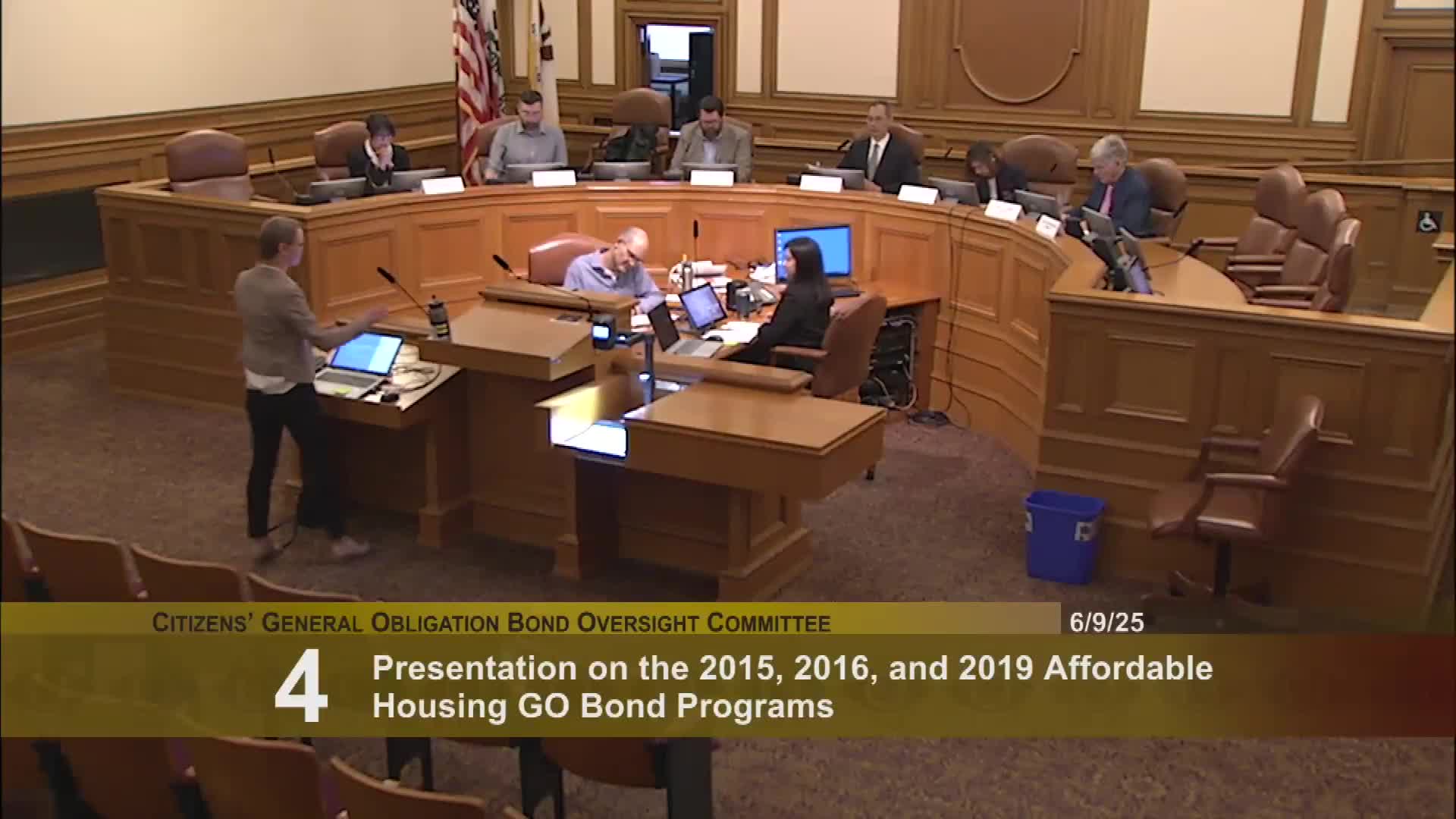
Andrea Fermor, finance director in the mayor’s office’s housing and community development program, updated the committee on the city’s affordable‑housing general obligation (GO) bond programs using data through December 2024.
Fermor reported the 2015 GO bond funds have been fully spent and the city is working with the comptroller’s office and the Office of Public Finance on closeout. She said the 2015 program added more than 1,500 affordable housing units to the city’s stock.
The 2019 GO bond, a $600 million authorization passed in November 2019, is roughly three‑quarters spent or encumbered; Fermor said about $106 million remains to be issued. Funds set aside for public housing and educator housing were largely issued; remaining issuance is primarily tied to senior housing projects. The city has identified five potential senior housing projects (four in predevelopment) and expects those to be ready for gap funding in early 2026.
Fermor described the 2016 preservation and seismic safety (PAS) program as being designed to preserve affordability and fund seismic retrofits and rehabilitation rather than new construction. She said the PAS program was authorized up to $260 million and funds a mix of deferred loans, below‑market loans and permanent takeout financing; examples cited included the El Dorado (65 units; approximately $2 million in PAS financing) and a 4‑unit project on Natoma funded entirely with PAS.
Fermor said the city leverages GO bond funds by loaning them to community project sponsors, who pair bond funds with state and private sources to develop projects; the city’s loans are typically relatively low‑cost gap financing in multi‑layered funding packages. She also noted the presentation used December 2024 data and the office completed additional issuances and activity through early 2025.
The committee did not take action; Fermor answered commissioners’ questions about PAS permanent take‑out financing and the role of a housing accelerator fund in fronting early costs.