
Carroll County health department reviews rankings, flags mental-health and long-commute risks
Get AI-powered insights, summaries, and transcripts
Sign Up Free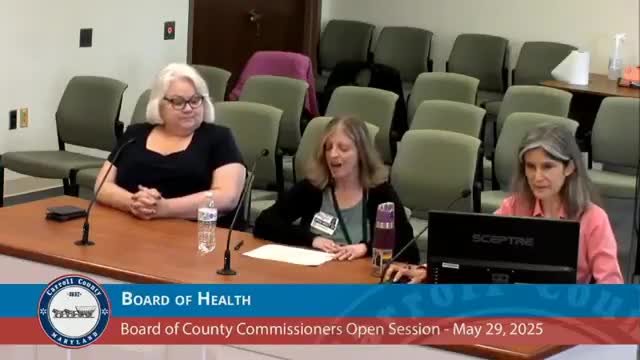
Summary
The Carroll County Health Department presented the 2025 County Health Rankings and Roadmaps and local health data to the Board of Commissioners on May 29, emphasizing strong social and economic indicators but raising concerns about mental health, long commutes and shortages of primary care and behavioral-health providers.
Carroll County Health Department epidemiologist Amy (no last name given) told the Board of Commissioners on May 29 that the county fares “slightly better than the average county in Maryland for population health and well‑being and better than the average county in the nation,” while noting specific local concerns.
The annual County Health Rankings and Roadmaps report, produced by the University of Wisconsin Population Health Institute and funded by the Robert Wood Johnson Foundation, uses 29 indicators to compare counties. Amy and Maggie (identified as the health department public information officer and health strategist) walked commissioners through the report and additional local health measures the department uses for strategic planning.
Carroll County scored well on several social and economic metrics—including high school completion, low uninsured rates and relatively low unemployment—but commissioners and department staff highlighted several persistent concerns: long one‑person commutes, reduced numbers of primary care and mental‑health providers per capita, and higher local rates of some cancers and Lyme disease.
Amy summarized the rankings and pointed to specific measures. “In 2025, 13 percent of adults reported fair or poor health in Carroll County, compared with 15 percent statewide and 17 percent nationally,” she said, noting the county’s rate has edged up since 2020 but remains below state and national levels. She added that the primary care physician ratio has worsened slightly, from 2,120:1 in 2020 to 2,260:1 in the most recent report.
Maggie said the county’s physical‑environment measures have improved in some areas—air pollution, for example, declined from 10.5 to 7.9 micrograms per cubic meter over several years—but noted two newly tracked metrics: broadband access and library access. She also described county efforts to combine state dashboards with locally collected data.
Discussion at the meeting focused heavily on behavioral health and youth survey data. The health department presented Youth Risk Behavior Survey results showing elevated reports among middle and high school students of persistent sadness or hopelessness and suicide‑related behaviors; in the survey, more than 20 percent of respondents reported having seriously considered suicide. Commissioners pressed staff on survey methodology and participation: the survey is administered on an opt‑out basis via MSDE and the CDC, and department staff said they did not have the opt‑out rate available but would try to obtain it.
Commissioners urged the department to prioritize ways to increase survey participation and to target resources where the data indicate need. “If these are the priorities you’re laying out in front of us … how do we get to a better number, a better solution to prioritize, and then resource?” asked Commissioner Rothstein during the discussion.
Department staff described outreach and partnership work, including a forthcoming “Here For You” campaign to publicize department services and a planned data dashboard to give the public easier access to county metrics. Staff also reported work with community partners on projects funded by CareFirst and local organizations to reach neighborhoods with higher rates of poverty and food insecurity.
The presentation included detailed breakdowns of other topics: radon levels (countywide high values prompting testing and abatement outreach), rabies surveillance (raccoons and bats were most commonly positive statewide; in Carroll County foxes and skunks tied as second most common locally), and chronic‑disease screening rates (mammography rates improved from 44 percent to 49 percent over time, while lung and colorectal screening lagged state averages).
Commissioners and department staff agreed to continue the county’s local health improvement coalition work with Carroll Hospital Center and other partners and to consider reinstating a behavioral‑health work group to coordinate services and reduce duplication. Staff said they would circulate dashboards and source data to the board and follow up on requests for more methodological detail about school surveys and opt‑out rates.
The health department did not bring an ordinance or vote item to the board; the session was a data presentation and request for strategic‑planning input from the commissioners. The department asked commissioners to identify priorities to guide its upcoming strategic plan and offered to supply additional local data and outreach materials to help commissioners and partners.