Get Full Government Meeting Transcripts, Videos, & Alerts Forever!
Get email alerts on the City Projects Trolleys topic
No spam. Unsubscribe anytime.
City of Miami reports steady trolley ridership, 35 roadway projects and new trolley efficiency study
Summary
The City of Miami presented a second-quarter update to the Citizens' Independent Transportation Trust: about 1.1 million riders Jan'Mar 2025 on city-operated routes, continued construction on multiple projects (including Charles Avenue phase and traffic-calming), and a new trolley efficiency study with consultant Kimley-Horn to review routes and.
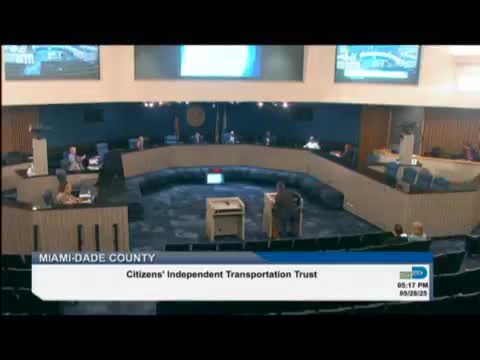
City of Miami officials told the Citizens' Independent Transportation Trust that city-operated trolley and on-demand services continued to perform well in the first quarter of 2025 and provided an update on roadway capital projects funded by the surtax.
"For the January 25, January to March 2025, we we had about 1,100,000 riders," Juvenal Santana, director of the City of Miami Department of Resilience and Public Works, told the trust. Santana said the city operates 13 routes on weekdays, 11 on Saturdays and six on Sundays and has charted roughly 390,000 riders per month during the quarter.
Santana said the city has reengaged consultant Kimley-Horn and issued a notice to proceed on a trolley efficiency study that will examine routes, public input and potential extensions, including study of an extension along the Biscayne Corridor to the northern city limit and a potential connection to El Portal.
City staff also summarized 35 active roadway capital projects that include water-main work, drainage, traffic-calming installations and full roadway reconstruction. Santana highlighted Charles Avenue Phase 2 (reconstruction with a new 12-inch water main extending to Main Highway) and Silver Bluff traffic-flow modifications (26 locations identified to address cut-through traffic from U.S. 1) as active efforts supported by joint participation agreements with Miami-Dade Water and Sewer.
The presentation included a funding snapshot showing about $210 million in projects with CITT funding assigned; Santana said about $21 million of that has already been spent on capital work. He also noted a recent cash-transfer spike reflecting approximately $34.6 million that reimbursed the general fund after an earlier funding hold.
Questions from trust members covered potential trolley connections with Brightline and whether trolleys could serve additional cruise-port terminals; city staff said the Coral Way trolley connects to several port terminals now (D, E and F) and that incorporating Brightline connections is part of the trolley master plan.
Why it matters: City projects and trolley networks funded with surtax dollars affect local mobility, water and sewer coordination, traffic calming in neighborhoods and short-term transit operations. The trolley efficiency study could lead to route changes, service extensions and additional public input.
Next steps: The trolley study will solicit public feedback; city staff will return with detailed project status reports and the requested multi-month project closeout list for older projects.