Get Full Government Meeting Transcripts, Videos, & Alerts Forever!
Get email alerts on the Municipal Budget topic
No spam. Unsubscribe anytime.
Philadelphia officials outline key elements of proposed FY26 budget at East Oak Lane town hall
Summary
City officials presented the mayor's proposed fiscal year 2026 budget at an East Oak Lane town hall, detailing tax changes, multi-year operating and capital spending proposals, a large housing borrowing plan and new spending focused on public safety, cleanliness and workforce programs.
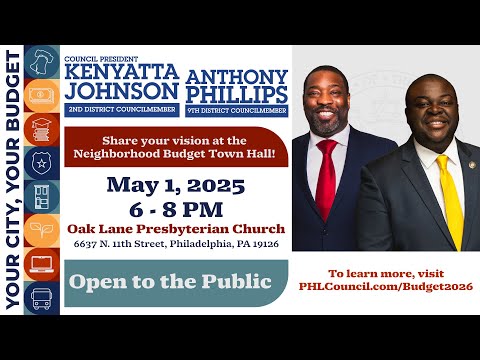
Philadelphia City Council members and staff presented an overview of the mayor's proposed fiscal year 2026 budget at an East Oak Lane town hall meeting at Oak Lane Presbyterian Church. Council President Kenyatta Johnson and Ninth District Councilmember Dr. Anthony Phillips hosted the event; Helen Lawhead, chief financial officer for City Council, led the presentation of the proposal.
Lawhead summarized the budget basics and timeline and urged public feedback before Council completes hearings and adopts a final budget. "The budget is the City of Philadelphia's yearly plan that shows how much money will be spent on programs and services," Lawhead said as she opened the presentation.
City officials and staff stressed that the document shown is a mayoral proposal and that Council will hold further hearings and make adjustments. The proposal includes multi-year spending increases and several tax changes designed to support new initiatives and to alter business and wage taxes.
The nut of the proposal: over the next five years the plan would add roughly $2.3 billion in new operating spending and about $1.5 billion in capital investments, according to Lawhead. For fiscal year 2026 specifically, the proposal calls for nearly $356 million in new operating spending, with the largest portion — about $186 million — directed at public safety priorities. The capital program for FY26 would add roughly $337 million in new spending.
What the proposal would change - Taxes and small-business support: The mayor's proposal would reduce the business income and receipts tax and lower the wage tax for residents and nonresidents. To offset some revenue effects and to aid small businesses, the proposal sets aside $30 million per year (about $150 million over five years) to help small firms adapt to the change.
- HOME housing initiative and related revenue changes: The budget would support the mayor's HOME (Housing Opportunities Made Easy) initiative by eliminating the construction impact tax, increasing the real estate transfer tax, and raising the document recording fee; those revenues would be directed to the housing initiative. The plan also proposes increasing the city's portion of real estate tax revenue that is forwarded to the school district and raising on-street parking rates in Center City by $1, with proceeds directed to the schools.
- Large-scale housing borrowing and debt service: The administration proposes borrowing $800 million to support HOME. Lawhead said the city would need about $263 million over the next five years to help pay debt service on that borrowing.
- Labor and contingency reserves: The plan sets aside a $550 million labor reserve to address pending municipal labor contract negotiations.
Major program and capital highlights - Public safety: The mayor's plan would direct more than half of the new operating dollars in FY26 to public safety. The capital plan includes about $67 million over five years for a new forensic science center, $25 million in FY26 for anti-violence grants, additional funding for body cameras for prison staff, and funding for Vision Zero street-safety measures.
- Clean and Green / neighborhood maintenance: The largest single portion of new capital spending would go to clean-and-green neighborhood investments — Lawhead cited roughly $122 million in new capital spending aimed at cleaning streets, expanding district-based cleaning, plantings and mural-arts projects.
- Economic opportunity and workforce: The proposal would include $10 million for workforce development (described during the meeting as directed to city-run workforce programs), nearly $9 million to the Pennsylvania Horticultural Society, and additional funding for corridor planning in Center City.
- Schools and youth programs: The Mayor's proposal would add $12 million to the School District for an extended-day/extended-year expansion, increasing the program from 25 to 40 schools and serving as many as 9,700 students with before- and after-school care. The plan also proposes a $15 million, five‑year commitment to the Community College of Philadelphia for workforce programs. Council member speakers said the city also contributes roughly $280 million annually to the school district in other line items.
- Wellness and substance-use response: The proposed budget sets aside operating and capital funds for a wellness initiative. Lawhead said the plan includes $260 million in operating funds and $75 million in capital funds to support the mayor's wellness proposals. Council members later described additional funding moves tied to midyear transfers and capital investments to stand up treatment and recovery facilities.
- 2026 events and related spending: The city is proposing $100 million for events connected to 2026 activities; Council members noted the airport is planning a separate $500 million investment for the same period.
Next steps Lawhead and Council President Johnson reminded attendees that City Council will hold hearings and may revise the mayor's proposal before adopting the final budget. "City Council is finishing up our hearings over the next couple weeks, to tweak this proposal and reach a final adopted budget," Lawhead said.
What was not decided at the town hall All figures presented were described as Mayor's proposals; Council members repeatedly emphasized that formal adoption requires Council action after hearings and review. Several attendees asked for additional detail on individual line items — for example, precise programs funded within the wellness initiative and the administrative steps to implement workforce and housing programs — which Council members said would be explored during upcoming hearings.
Ending note Councilmembers invited residents to monitor Council hearings online and to submit written comments during the Council review period.