Get Full Government Meeting Transcripts, Videos, & Alerts Forever!
Get email alerts on the Legislative Organization topic
No spam. Unsubscribe anytime.
Utah Senate elects Jay Stewart Adams as president, adopts rules and introduces dozens of bills on opening day
Summary
On the opening day of the 2025 general session the Utah State Senate swore in newly elected and re-elected senators, elected Sen. Jay Stewart Adams as Senate president by acclamation, adopted the prior rules, approved a practice to read only short bill titles, and read dozens of bills for first reading that were referred to committees.
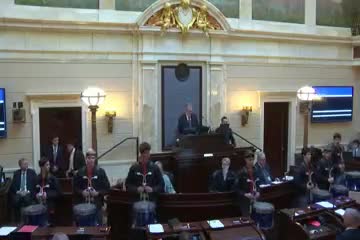
SALT LAKE CITY — The Utah State Senate organized for the 2025 general session on its opening day, swearing in newly elected and re-elected members, electing Sen. Jay Stewart Adams as president by acclamation and taking several procedural steps to begin the 45-day session.
Senate President Jay Stewart Adams, after being nominated from the floor and elected by acclamation, was administered the oath of office and addressed the chamber, urging protection of what he called the "Utah dream" and promising to "support, obey, and defend our constitution, our republic, and I will do everything I can to keep it." The Senate also approved a motion to print Adams' remarks in the Senate journal.
The organizational actions culminated in committee appointments, the adoption of standing rules carried over from the prior special session, and the formal reading of dozens of bills on first reading. Senate leadership named majority and minority leadership and appointed standing committee chairs and vice chairs.
The body took several explicit procedural votes: the Senate approved a motion expressing appreciation to ceremonial participants including the American Fork High School drumline and the Utah National Guard; it adopted the rules and interim rules used by the previous session; and it approved continuing the practice of reading only short titles of bills and resolutions on the Senate calendar unless the chamber directs otherwise. Those motions passed by voice vote or acclamation as recorded on the floor.
The reading clerk placed many measures before the chamber on first reading. A long list of bills — covering topics from education and taxation to water, energy, criminal justice, and health — were read and sent to the Rules Committee or placed on the second-reading calendar in the order read. The Rules Committee met and recommended assignments of specific bills to standing committees; the Senate adopted that committee report.
Senators also appointed bipartisan committees to notify the governor and the House of Representatives that the Senate is organized and ready to do business. The Senate recessed to reconvene later in the day for the State of the Judiciary presentation.
Quotes from the floor highlighted the tone leaders sought to set for the session. "Let's get to work," Sen. Kirk Cullimore, majority leader, said after organizational business concluded. Minority Leader Sen. Luz Escamilla urged unity, saying the Democratic caucus would "stop looking for reasons to divide and instead seek opportunities to unite." President Adams framed the session around energy production, education, and tax reductions in his remarks to the chamber.
Votes at a glance
- Motion to express appreciation to ceremonial participants (invocation, presentation of colors, national anthem, pledge, and performance): motion moved from the floor and ruled passed by voice vote; outcome: approved. - Election of Senate president: Motion to nominate Sen. Jay Stewart Adams (mover: Sen. Kirk Cullimore); second: Sen. Karen Kwan; outcome: elected by acclamation. - Motion to print President Adams' remarks in the Senate journal (mover: Sen. Mike McKell): outcome: approved by voice vote. - Motion to adopt the same rules, joint rules and interim rules from the 2024 extraordinary session until new rules are adopted (mover: Sen. Lincoln Fillmore): outcome: approved by voice vote. - Motion to continue practice of reading only short bill titles unless the Senate directs otherwise (mover: Sen. Lincoln Fillmore): outcome: approved (passed by the required constitutional two-thirds majority as announced on the floor). - Rules Committee report recommending committee assignments for bills introduced: motion to adopt committee report (mover: Sen. Lincoln Fillmore): outcome: adopted by voice vote.
Bills introduced (first reading, sent to Rules Committee or placed on second-reading calendar)
The reading clerk read a long list of Senate bills and resolutions on first reading. Representative examples from the list read and referred include: Senate Bill 1 (public education-based budget amendments), SB 11 (ballot distribution revisions), SB 22 (long term disability benefit modifications), SB 31 (refugee services amendments), SB 32 (class size reduction modifications), SB 61 (energy corridor amendments), SB 62 (Spaceport Exploration Committee), SB 73 (statewide initiatives amendments), SB 83 (law enforcement policy requirements), SB 102 (public education funding modifications), and many others. The full list of titles was read on the floor and those bills were placed either on the second-reading calendar or sent to committees as announced by the Rules Committee in plenary.
Context and next steps
The actions taken are typical for an organizational day: swearing-in, election of leadership, adoption of rules and clerical introduction of bills. The Senate will consider the introduced measures in committee and on the floor during the session. Senators appointed committees to notify the House and the governor that the Senate is organized; the chamber recessed and planned to reconvene later in the day for the chief justice's State of the Judiciary address.
Ending
No final policy debates or substantive floor votes on individual bills were recorded during the organizational session; the day centered on ceremonial matters, leadership organization, rule adoption and introductory procedural business to begin the work of the 2025 general session.