Get Full Government Meeting Transcripts, Videos, & Alerts Forever!
Get email alerts on the Stormwater Utility topic
No spam. Unsubscribe anytime.
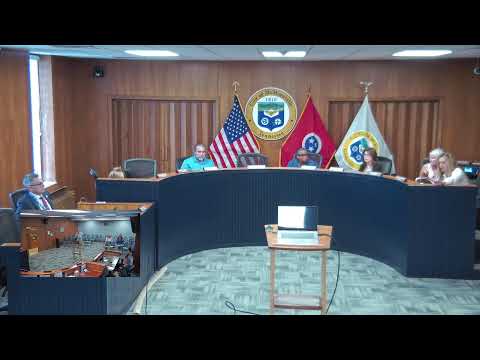
McMinnville officials discuss stormwater funding, user-fee options and priority projects
Summary
City staff and an MTAS advisor reviewed the Phase II stormwater permit requirements, funding options including a stormwater utility fee, estimated project costs and a proposed $2.50–$3.00-per-ERU monthly fee to fund maintenance and capital priorities.
John Clarkson, a municipal advisor with the University of Tennessee Municipal Technical Advisory Service (MTAS), told the City of McMinnville Joint Finance and Street Drainage Committee that the city must both maintain its drainage system and meet Phase II stormwater permit requirements and that doing both will require a dedicated and sustainable revenue stream.
Clarkson said McMinnville currently falls under a Phase II MS4 stormwater permit, which requires six program elements including public education and outreach, illicit-discharge detection and elimination, and post-construction runoff controls. “McMinnville is under a phase 2 permit,” he said, adding that the enabling Tennessee law allows municipalities to create stormwater user fees that “shall be based upon impervious square footage.”
The presentation reviewed four broad funding paths: pay from existing general‑fund revenues, adopt a general‑fund tax increase dedicated to drainage, leverage capital borrowing (bonds or state revolving funds) for capital work, or create a dedicated stormwater utility funded by a user fee. Clarkson cautioned that borrowing should generally fund capital improvements, not ongoing maintenance, and pointed committee members to the Clean Water State Revolving Loan Fund (SRF) as a source that can finance planning, equipment and construction with favorable terms including, in some cases, principal forgiveness.
City staff member Lyndon (last name not specified) and Public Works Director Frank (last name not specified) presented local conditions and a draft budget for an in‑house drainage program. Staff identified roughly 10 priority problem areas across the city — including Morrison Street/General Shell, Lagoon Drive, Mullican/Hobson, McBride Street where a railroad acts as a dam, and sinkholes near the middle school — and described needed work such as upsizing culverts, adding box culverts, repairing sinkholes to TDOT standards and routine maintenance such as annual sinkhole cleanouts.
A homeowner who spoke during the meeting described repeated basement flooding and raw sewage concerns, saying a recent event left “feet of water” in the basement and that water in yards and drains now contains E. coli. That testimony was cited by staff as an example of how legacy infrastructure and undersized culverts are causing public‑health and property impacts.
Staff presented three user‑fee scenarios built on an Equivalent Residential Unit (ERU) — the recommended ERU used in McMinnville examples was 2,500 square feet of impervious surface — and approximated revenues and staffing. The options shown included a $2.50 monthly ERU rate (minimal staffing, limited professional services), a $2.85 rate that adds a mid‑level manager, and a $3.00 rate that would support a full‑time engineer and a larger staff. Staff estimated a master drainage plan at about $200,000 and cited single culvert replacements in the $10,000–$15,000 range. For personnel, an all‑in cost for a heavy‑equipment operator was stated as roughly $57,000; a full‑time engineer budget was presented at about $120,000.
Committee members asked whether a stormwater fee must be in place before applying for SRF loans. Clarkson said a locality can apply without an existing fee but must identify a revenue source to demonstrate repayment; he noted many cities pass a fee first to show a dedicated funding stream and then leverage SRF funds to accelerate projects. Clarkson also emphasized public education and transparency, warning that “if you go much past a year or two from the implementation where people have been paying for it, they’re going to ... ask what have y’all been doing with the money.”
Staff discussed collection mechanics: most municipalities add the fee to a combined utility bill (water/trash/stormwater) so that billing and lien authority follow existing collection practices. Staff noted a local implementation nuance: some commercial properties (for example, General Shell) do not currently receive water bills and would need to be billed directly or have a lien placed on the property if unpaid.
Committee members raised equity concerns and alternatives: one council member said many residents live on fixed incomes and urged exploring apportionments or geographically targeted assessments for specific projects that mostly benefit particular neighborhoods. Clarkson said apportionment for a defined drainage district is a possible tool but would require legal review and local approval.
No formal vote or ordinance was recorded during the session. Staff committed to provide detailed personnel cost estimates and to distribute the presentation slides and draft budget models to the committee for further review.
The meeting closed with staff offering to connect McMinnville with other Tennessee cities that have implemented stormwater utilities and with resources from the Tennessee Stormwater Association and MTAS to support drafting ordinances, billing practices and public‑education campaigns.