Get Full Government Meeting Transcripts, Videos, & Alerts Forever!
Get email alerts on the Land Use Zoning topic
No spam. Unsubscribe anytime.
Cherokee County staff propose tighter rules for gas stations and car washes; public hearing set June 17
Summary
County staff presented draft text amendments to zoning rules for gas stations, convenience stores and car washes, proposing special-use permitting in General Commercial, standards for canopies and ancillary equipment, color limits and a one-acre minimum lot size; the board will hear the proposal at a public hearing June 17.
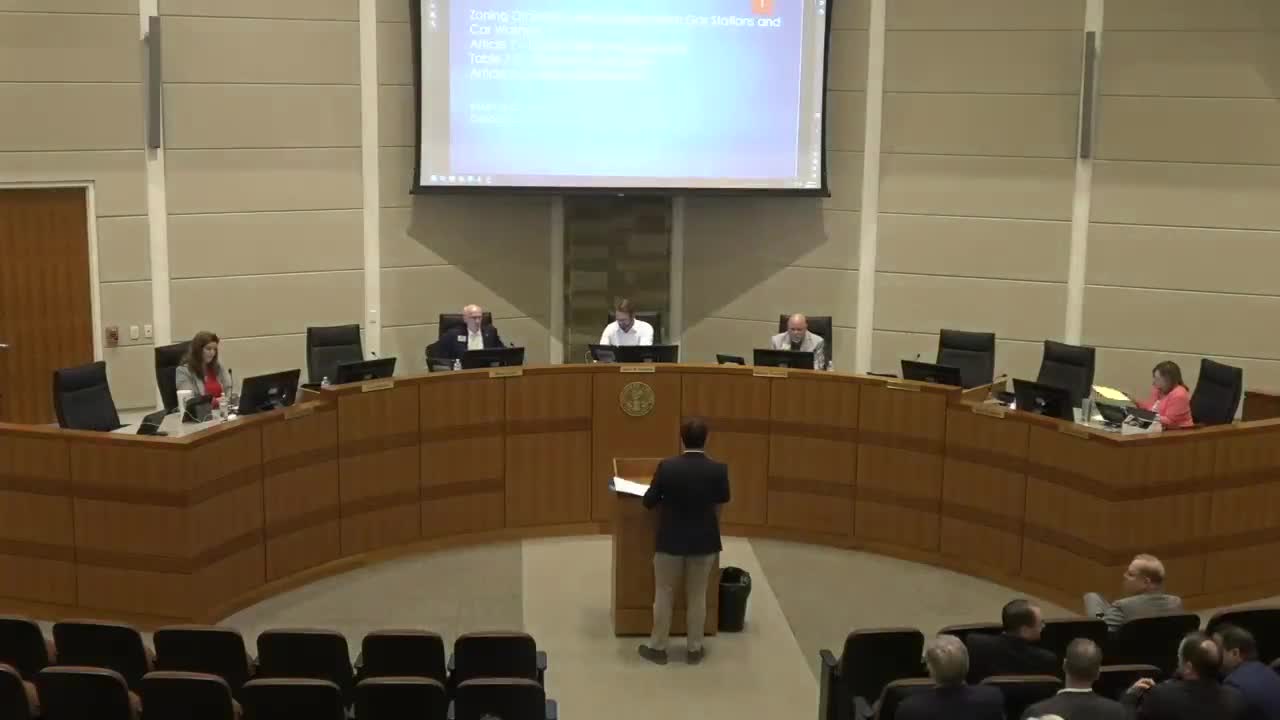
County staff presented a package of proposed text amendments on June 3 to the Cherokee County Board of Commissioners that would change how gas stations, convenience stores and car washes are regulated in unincorporated Cherokee County.
The changes would require gas stations and car washes in the General Commercial (GC) zoning district to obtain a special-use permit rather than be permitted by right. The draft also adds a new supplemental regulation (§7.7-3H in staff materials) that would set standards for fuel pump canopies, ancillary service equipment, building colors and minimum lot size. Staff said the measures are intended to address zoning, environmental, noise and traffic concerns and reflect a cluster of these uses in District 4.
Staff told commissioners the county currently has 64 gas stations with convenience stores and 16 car washes within county boundaries (excluding cities), and that many are concentrated in District 4. The draft definitions are drawn from a review of other jurisdictions and NAICS codes. Among the specific proposals are: requiring canopies to meet the primary building setback for the zoning district and to be architecturally integrated with the main building; prohibiting painted bands of color on canopies that indicate business identity; requiring ancillary equipment (vacuum machines, air pumps, freestanding accessory kiosks) to meet building setbacks and not be closer to the primary street right-of-way than the primary building; requiring neutral exterior colors for buildings and ancillary structures (blacks, whites, beiges, grays) while leaving sign color governed by the sign code; and reducing the minimum lot size for these uses from 2 acres to 1 acre.
Staff also proposed that traffic-control and fire-turnaround plans be submitted and approved during the land disturbance permitting process. The packet the board saw included a draft timeline: county staff said the matter is before the board on June 3, a public hearing has been advertised for June 17, and the existing 90-day moratorium on the uses (adopted by the board the prior month) is scheduled to expire June 30 unless extended.
Commissioners asked whether the proposed color restrictions should apply to all such businesses. Some said limiting brand colors on fuel canopies could provoke pushback from national brands and suggested the county allow branded colors subject to director-level review. Several commissioners favored directing the stricter color and visual requirements more toward large car washes and detailing operations than toward gas stations and convenience stores. Commissioners also discussed splitting “car wash” definitions into automated tunnel washes versus hand-wash/detailing services, to avoid imposing industrial-scale requirements on small, hand-wash/detailing operators.
Staff said the minimum lot-size change (to approximately 1.2-acre average lots observed) reduces variance requests, and that any special-use permit application would allow consideration of variances where appropriate. Staff committed to deliver revised language to the board before the June 17 hearing.
The board did not take a final vote on the amendments on June 3; staff recorded that the public hearing is scheduled for June 17 and that the 90-day moratorium is expected to expire June 30 unless the board acts to extend it.