Get Full Government Meeting Transcripts, Videos, & Alerts Forever!
Get email alerts on the Cultural Resources topic
No spam. Unsubscribe anytime.
Albemarle planning commissioners back broader protections, inclusive inventories for cultural resources
Summary
Planning staff presented the draft cultural resources chapter of the AC44 comprehensive plan; commissioners broadly supported an overlay study, stronger local protections and incentives, and more inclusive inventories that highlight African American and other under‑represented sites.
Albemarle County planning staff presented the cultural resources chapter of the county's AC44 comprehensive plan at the May 27 Planning Commission meeting, and commissioners signaled broad support for more proactive protection, updated inventories and measures to make preservation more inclusive.
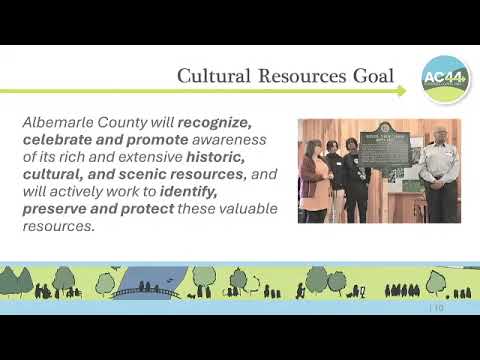
The presentation, led by Ben Holt of the county's Long Range Planning Division and Margaret Maliszewski of the Planning Division, framed cultural resources as central to the county's identity and quality of life. "Cultural resources are really what make Albemarle the unique county that it is," Maliszewski told commissioners, summarizing the chapter's goals and objectives.
Commissioners and members of the public pressed staff on several specifics. Commissioners generally endorsed an "overlay study" that would map overlapping resources (historic structures, scenic corridors, conservation easements and biodiversity sites) to set protection priorities. They also expressed conditional support for stronger local regulations, such as a preservation ordinance or a targeted demolition ordinance, provided measures are narrowly tailored and do not unduly burden property owners.
Staff summarized prior feedback and the draft objectives. Holt told the commission the chapter emphasizes maintaining accurate, updated surveys, increasing protection through local regulations and incentives, supporting adaptive reuse, and telling more inclusive local histories that recognize the contributions of African American and Indigenous communities. Staff plans to add captions for images and incorporate inclusive historical narratives into the draft chapters posted on the county's Engage AC44 website.
Commissioner comments ranged from advocating adaptive reuse and stronger incentives to warnings about "weaponizing" preservation rules. Commissioner Moore and others asked staff to ensure rules are not so broad that they freeze entire landscapes. Commissioner Firehawk asked whether a local scenic highway designation could provide protections the county's existing entrance corridor regulations do not; staff responded it would be a local designation implemented via local ordinance, not the state scenic highway program.
Multiple commissioners and public commenters urged the county to expand its focus beyond high‑style architecture to modest homes, Freedman communities and living cultural institutions such as festivals, community gardens and rural social organizations. Commissioner Murray and others asked that inventories include living communities and sites of ongoing cultural activity, not just cemeteries or static monuments.
Public comment reinforced calls for inclusive preservation. Diane Brown Towns, a former member of the county's Historic Preservation Committee subcommittee, urged the commission to create a repository documenting free and enslaved families and proposed a museum or interpretive repository tied to conservation goals. "I returned to Lane High School Auditorium today . . . to speak to you about the need for a repository to highlight and preserve the history of free and enslaved people," Brown Towns said.
Staff recommended further work to (1) conduct the overlay study, (2) evaluate legal tools including a targeted demolition ordinance, (3) create a GIS inventory layer and genealogical resources, (4) assemble a restoration/reuse "toolbox," and (5) explore incentives such as tax or other programs. Commissioners asked staff to clarify implementation pathways (e.g., consultant vs. in‑house work), identify likely funding or partners (UVA and local nonprofits were discussed), and show how objectives would align with other AC44 chapters (environmental stewardship, parks, transportation and resilient communities).
The commission did not take a formal vote on regulatory changes at the May 27 session; the discussion was recorded as direction for staff as they refine the chapter for Board review. Staff said the cultural resources chapter (and image caption updates) will go to the Board of Supervisors on June 4 as part of the AC44 chapter rollout.
Ending
Staff will draft more detailed implementation steps and return to the commission with clarified language around proposed ordinances, incentives and the overlay study. Commissioners asked staff to include clearer language on who would hold easements or conservation interests, spell out whether incentives would be real estate tax breaks or other tools, and add explicit actions supporting partnerships and living cultural resources such as festivals and community gardens.