Get Full Government Meeting Transcripts, Videos, & Alerts Forever!
Get email alerts on the Downtown Zoning Lower Level Uses topic
No spam. Unsubscribe anytime.
Petoskey board backs permitting lower-level commercial uses; residential below grade remains contested
Summary
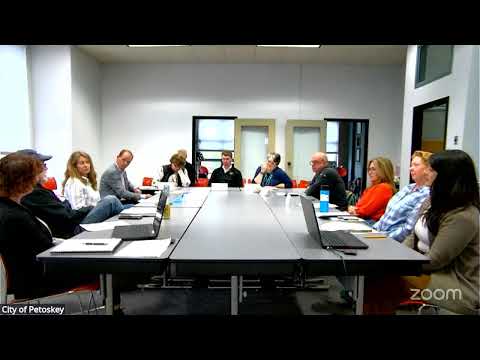
The Downtown Management Board reviewed proposed amendments to the B-2 Central Business District on May 20, 2025 and signaled support for allowing commercial and civic uses in lower levels of downtown buildings while expressing mixed views on permitting residential units below grade as a special condition use.
The Downtown Management Board of the City of Petoskey discussed proposed changes to the B-2 Central Business District on May 20, 2025, signaling support for permitting commercial and civic uses in lower-level (below-grade) spaces while expressing continued concern about allowing residential uses there.
City staff member Miss Clayton, who briefed the board, said the planning commission "was looking at some possible changes in the B 2 Central Business District, which is the majority of downtown. And it is to address lower levels of buildings because the code doesn't currently address them." Clayton summarized the draft amendment as adding a column to the existing use table to indicate which lower-level uses would be allowed and which would require special review.
The draft would permit many commercial uses now allowed on first and upper floors—"general retail, food service establishment, personal service, brewpub, microbrewery, winery, health fitness facilities, studios, professional or medical office, as well as civic uses"—to also be allowed in lower-level spaces, Clayton said. The amendment would treat single-family and a defined "co-living" (boarding-house–type) arrangement as special condition uses (SCUs) in lower levels, meaning developers would need to seek planning commission review under the special condition use standards (section 1717 referenced in the presentation).
Board members raised site-specific and long-term concerns. The mayor warned that converting lower levels to residential could be difficult to reverse later: "once you get residentials in there, they'll never change back to commercial," and urged careful thought about long-term downtown stewardship. Other members cited safety and habitability questions — lack of egress windows, sprinkler and fire-suppression requirements, and potential management problems in shared housing — noting those would be addressed by building- and fire-code requirements if a project moved forward.
Several board members said many existing lower-level commercial spaces are already in use and would remain grandfathered. Amy (board/staff participant) and others asked for clarity on definitions and address-based determinations in Petoskey's varied downtown topography: whether a space is considered lower-level or ground-floor can depend on the front-door elevation and official address.
Members also discussed incentives and feasibility: city staff said the developer pursuing the Leo's Building project is seeking MEDC support and an "Oprah" incentive that, as described in the meeting, would freeze taxable value on improvements for a period (the presenter said the period "maxes out" at 12 years). Staff emphasized that code and building inspections, plus the special condition use review, would be required before any residential conversion could proceed.
By the end of the discussion the board took informal direction to staff. The group indicated majority support for allowing commercial and civic uses in lower-level spaces and majority support in principle for allowing single-family and co-living units as SCUs, while recording there was not complete consensus on residential in the lower level. The board also asked staff and the planning commission to consider whether hotel/lodging uses should be treated as an SCU for lower-level situations.
The planning commission is holding a public hearing on the amendment the following day; the Downtown Management Board's comments will be submitted in writing or delivered at that hearing.
Background: the staff presentation referenced existing language in the zoning table (Table 9-1) and cross-references to section 901 (residential use listings) and section 1717 (special condition use standards). The draft also includes standards that would require compliance "with the most recently adopted Michigan building electrical, mechanical, plumbing, and fire codes for the City of Petoskey and Emmet County," and would prohibit short-term rentals in converted lower-level residential units, among other operational requirements.