Get Full Government Meeting Transcripts, Videos, & Alerts Forever!
Get email alerts on the Zoning Variance topic
No spam. Unsubscribe anytime.
Board upholds variance and building permit for 695 Rhode Island Street; neighbors’ objections over rear yard and unit changes denied
Summary
The Board of Appeals denied appeals to overturn a rear‑yard variance and an associated building permit for 695 Rhode Island Street, finding the zoning administrator's variance decision and the permit review complied with applicable criteria and code.
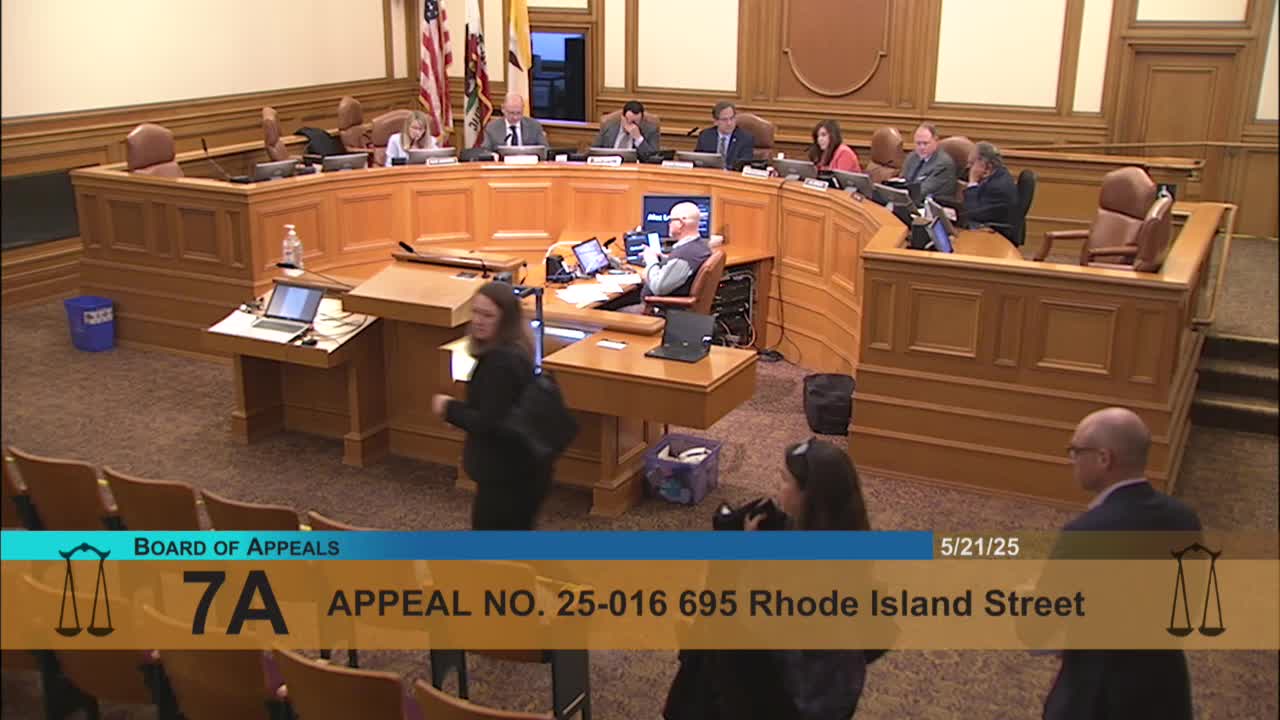
The San Francisco Board of Appeals on Wednesday denied appeals challenging both a rear‑yard variance and the related building permit for 695 Rhode Island Street, concluding the zoning administrator and Department of Building Inspection had properly reviewed and approved the applications.
The matter combined two appeals: one of a zoning decision granting a rear‑yard variance for a proposed horizontal and vertical expansion, and one of the building permit for the same work. The applicant proposes a three‑story rear addition and interior changes to a two‑unit building. Neighbors, represented by counsel, argued the changes would remove or shrink an existing unit and that parts of the building had the characteristics of an undocumented dwelling unit (UDU), which they said would trigger further discretionary review by the planning commission.
The board reviewed the zoning administrator's variance decision (issued April 3, 2025) and the administrative record. Zoning Administrator Corey Teague told the board that the variance decision was based on findings specific to the parcel: lot depth, slope and surrounding building patterns combined to create circumstances distinct from the typical lot on the block, and the variance satisfied the five required findings under Planning Code Section 305(c). Teague also noted that the disputed variance decision was not dependent on the applicant's written variance application arguments but on the zoning administrator's independent findings.
On the issue of whether the lower level constituted an unauthorized dwelling unit, DBI staff said their records show a 1991 permit expired without work completed and that, while the basement is physically configured as a separate space in the plans, the department had not determined it was an unauthorized dwelling unit because there was not sufficient documentation of separate, long‑term occupancy as a leased unit. DBI further noted the existing basement has two means of egress that meet the code exception for basement sleeping rooms.
After deliberation commissioners concluded the appellant had not shown the variance findings were improperly made and that DBI and planning reviews supported issuance of the building permit. The board voted 5–0 to deny both appeals — finding the variance and permit approvals valid.
Why it matters: The decision clears the way for construction of an enlarged single upper unit while retaining the building permit; neighbors argued the project would reduce the supply of "affordable by design" floor area and alter mid‑block open space characteristics. The board emphasized that variances are to be decided case‑by‑case and that the zoning administrator's findings were supported by the record.
Quotations and process: Appellant counsel said the submitted plans show the lower level has a bedroom, full bath, independent access and other features consistent with a UDU; he argued this removed more than 25% of a unit’s floor area and would require discretionary review. Zoning Administrator Teague countered that a physical configuration alone does not prove an unauthorized dwelling unit — the department looks for evidence of separate, documented long‑term occupancy — and that the variance decision relies on its own findings.
Next steps: With the board’s decision, the project may proceed under the variance and issued building permit; any further alterations or disputes would follow standard permit‑review and enforcement channels.