Get Full Government Meeting Transcripts, Videos, & Alerts Forever!
Get email alerts on the Code Enforcement topic
No spam. Unsubscribe anytime.
Abatement Appeals Board puts 116 Merced Ave. order in abeyance for one year, cuts permit penalty
Summary
The Abatement Appeals Board unanimously held the order of abatement for 116 Merced Avenue in abeyance for one year and reduced the permit penalty from nine times to two times the permit fee, after the property owner’s attorney cited COVID delays, medical hardship and planning/DBI coordination problems.
The Abatement Appeals Board on Wednesday voted unanimously to hold the order of abatement for 116 Merced Avenue in abeyance for one year and to reduce the permit-penalty multiplier from nine times to two times the permit application fee.
The action preserves the Department of Building Inspection—s (DBI) authority to enforce the underlying notice of violation if the owner does not complete required work within a year, but delays recording the order and its one-time assessment while the owner pursues an alteration permit to remove an illegal dwelling unit.
DBI senior building inspector Gilbert Lam told the panel that the original notice of violation was issued Aug. 30, 2019, after a site inspection found habitable rooms in the basement, including a kitchen and bathroom. The director—s hearing process and permit history, Lam said, left the case unresolved and the abatement was issued Nov. 5, 2024, because of continued noncompliance.
The owner—s attorney, Brett Gladstone, described a series of delays he called a "perfect storm" that included COVID-related interruptions, the owner—s medical issues, inconsistent instructions between DBI and the Planning Department and sharply higher construction costs. Gladstone asked the board for a one-year moratorium under the building code—s financial-hardship provision and for suspension or subordination of any lien during that time. "The grounds for the moratorium — are financial hardship," Gladstone said, and he requested that the monthly monitoring fee be suspended while the owner obtains financing and files permitting paperwork.
Janet Campbell, the property—s architect, told commissioners that planning staff had refused repeated requests to do a site visit and that that refusal prevented planners from appreciating structural and ceiling-height constraints that made legalization difficult. "They refused. If they had come, they would have seen the condition and why the legalization could not be done," Campbell said, describing areas with ceilings below 7 feet 6 inches and stair and landing conditions that would require broader renovation to meet code.
Commissioners pressed whether the owner intended to pursue removal of the illegal unit or legalization. Counsel for the appellant and the architect said Planning had approved the dwelling-unit removal and that the owner planned to file an alteration permit the following week to remove the unit. DBI staff said either path — removal or legalization — was acceptable to the department.
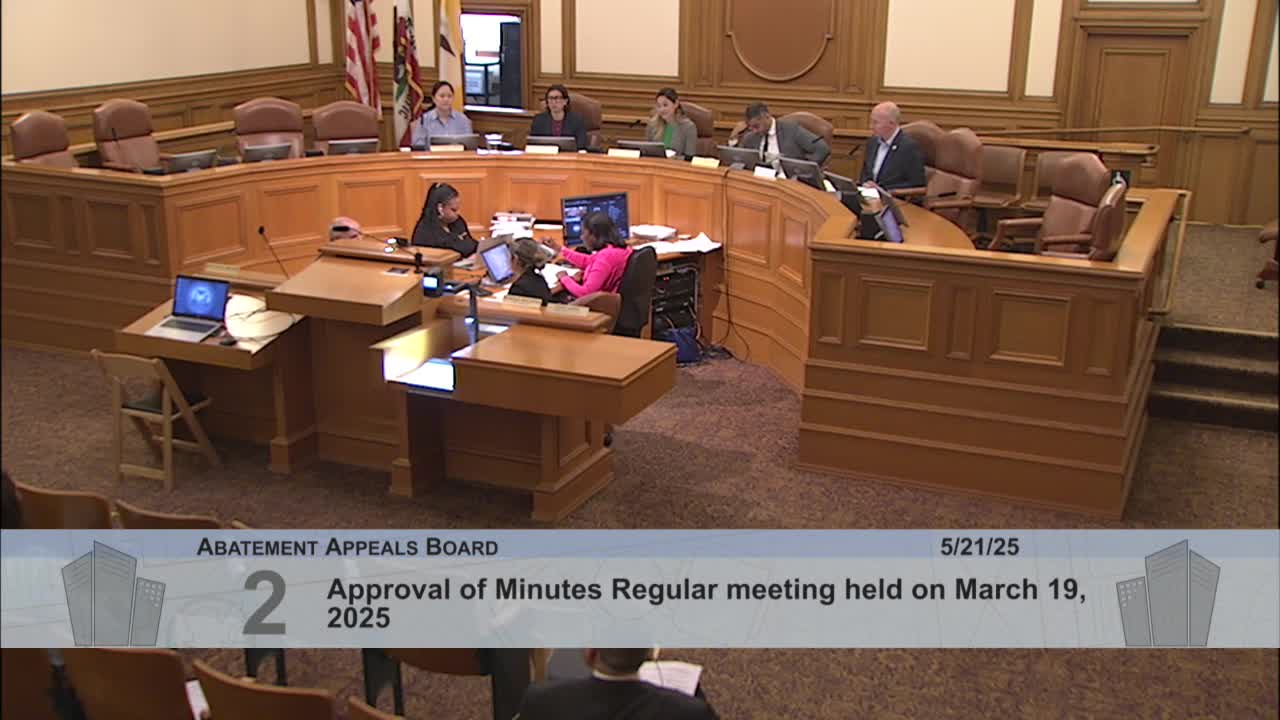
Commissioner Ming moved to hold the order in abeyance for one year and to reduce the penalty from nine times the permit application fee to two times the fee; President Chavez seconded. The five commissioners present voted yes: President Chavez, Vice President Newman, Commissioner Calamucci, Commissioner Ming and Commissioner Williams. The motion carried unanimously.
DBI staff explained the practical effect of the abeyance: the order will not be recorded while the case is held in abeyance for a year, and if the owner completes required work and obtains a certificate of final compliance (CFC) within that period, the order will not be recorded and the one-time assessment will not be generated. If the work is not completed within the abeyance period, the order may be recorded and assessments issued.
The board also discussed monitoring fees and permit-assessment fees. DBI staff described monthly monitoring fees as a code-required mechanism "to compel property owners to get compliance" and to cover staff time. The board—s motion did not cancel monitoring fees but put the order into abeyance for a year; as DBI staff explained, monitoring fees are assessed when an order is recorded and the one-time bill is generated.
The owner—s attorney also requested reduction of the approximately $9,000 in DBI charges; the board—s action reduced the permit penalty multiplier (from the nine-times default for work without permit to two times) consistent with the appellant—s request and commissioners— equity concerns.
If the appellant files the alteration permit and DBI issues the necessary inspections and a CFC within the year, the order will remain unrecorded and no assessment will be generated. If the work is not completed within the abeyance, the order may be recorded and assessments applied.