Get Full Government Meeting Transcripts, Videos, & Alerts Forever!
Get email alerts on the Public Transit Funding topic
No spam. Unsubscribe anytime.
Michigan panel hears that state transit funding lags rising costs and demand
Summary
House subcommittee received fiscal overview and local testimony showing Comprehensive Transportation Fund dollars and one-time federal aid have propped up bus operations, but state shares of eligible operating expenses have slid and local agencies increasingly rely on millages and varied local revenue to avoid cuts.
Lansing — The Michigan House Appropriations Subcommittee on State and Local Transportation heard testimony in May 2025 that state funding for public transit has not kept pace with rising operating costs and ridership demand, leaving local transit agencies to fill growing budget gaps.
Bill (fiscal staff) opened the briefing with an overview of how state transportation dollars flow into public transit, telling the panel the primary state sources are the Michigan Transportation Fund (MTF) and an earmark into the Comprehensive Transportation Fund (CTF). "The CTF also receives an earmark of auto related sales tax," Bill said, and those two revenues together "add up to about $400,000,000." He described local bus operating (LBO) as a major line item and noted that recent federal COVID-relief appropriations were included in 2024 and 2025 figures.
The discussion matters because state appropriations determine how much local agencies can cover of their eligible operating expenses. "The distribution follows a formula ... established in Act 51," Bill said, summarizing statutory ceilings that allow urbanized agencies to receive up to 50% of eligible operating expense and nonurban agencies up to 60%, while noting actual state shares have fallen: "in 2025 it's estimated that urbanized agencies will receive ... 29% of their eligible operating expense, and non urban agencies will receive 34%."
Jean Rustemond, administrator of the Office of Passenger Transportation at the Michigan Department of Transportation (MDOT), told the committee MDOT splits the CTF roughly 60/40 between the Office of Passenger Transportation and the Office of Rail and that program allocations vary year to year based on need. "We do share that pot of money with the Office of Rail ... it's about a sixtyforty split," Rustemond said. She described MDOT's duties: receiving and distributing federal funds, administering subrecipient audits and operating reports, and matching federal capital grants. Rustemond said the department manages a mix of state line items — local bus operating, transit capital, rideshare/vanpool, specialized services, and a service-initiatives fund used for pilot projects and technology.
Rustemond and fiscal staff told the committee that one-time federal COVID-relief funding bolstered LBO in recent years (an additional $45 million in 2024 and $20 million in 2025 were cited in testimony) and that those federal funds are likely expiring. She also said the state typically provides the nonfederal match for federal capital grants and that the capital line item is roughly $70 million to match federal funds.
Representatives pressed for operational detail. Representative Robinson asked whether MDOT tracks ridership; Rustemond said the department publishes ridership reports and can provide them to committee members. Representative Morgan asked for a breakdown of how much of the budget covers wages and vehicles; Rustemond said wages and salaries are included in the LBO line item and offered to provide a follow-up report.
Local transit leaders described how state LBO money is used on the ground and the consequences of flat or declining state shares. Harmony Lloyd, vice president of planning and innovation at SMART and vice chair of the Michigan Public Transit Association, said public transit reaches all 83 counties and cited systemwide usage: "we do about 25,000 rides every day ... about 47,000,000 trips a year." Lloyd gave local examples of expanded service after new funding: agencies in northern Oakland County (NOTA and WOTA) posted ridership gains of roughly 155% and 177% after a county millage; People's Express ridership rose about 192%; Ross Regional (Roscommon) provided more than 65,000 rides in 2024 after adding medical trips for seniors; Max (Holland/Zeeland) recorded about 240,000 rides in 2024; Ann Arbor's express route carried roughly 84,000 riders in its first year; and a Battle Creek pilot produced 33,000 trips provided with 150,000 requests unfilled.
John Delmas, director of the Michigan Public Transit Association, urged renewed state investment. "We think that full funding of it is about $400,000,000 per year into the CTF," Delmas said, arguing current formulas and recent policy changes have left transit with a smaller state share. He noted the House package that changed fuel sales tax treatment yielded only about $50 million net for the CTF and described a long history of road-focused revenue additions that did not proportionally increase transit funding.
Advocates and agency leaders also outlined recurring operational pressures: rising vehicle and parts costs, Buy America and procurement constraints, insurance and cybersecurity costs, driver shortages and training, and complex federal grant administration. Rustemond said MDOT is pursuing data and planning tools — including a Michigan-specific economic-benefit tool and pilots funded by a state Michigan Mobility Challenge — and that the department is considering a more comprehensive statewide transit plan, coordinated with the Council on Future Mobility and Electrification.
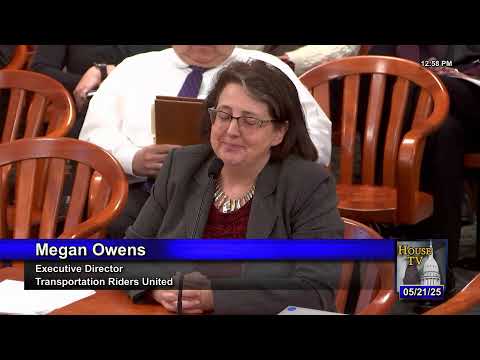
Transportation Riders United emphasized the human impacts. "Anyone who is riding transit is going somewhere to either spend money, to make money, or to learn to earn money," said Megan (Transportation Riders United). She and other presenters urged lawmakers to consider both local millage support and sustained state appropriations to avoid service cuts that would affect workers, seniors and people with disabilities.
Votes and committee business were limited. Representative Borton moved to adopt the minutes of the May 7 meeting; "there being no objection, the motion prevails by unanimous consent," the chair said. No other formal actions or votes on funding levels occurred during the hearing.
The committee asked MDOT and stakeholders for follow-up materials: MDOT agreed to provide ridership reports and a more detailed breakdown of wage/vehicle costs; MDOT also said it will work on identifying resources and a roadmap for a potential statewide transit plan. The committee adjourned after the panel of witnesses completed testimony and brief questioning.
Ending: The hearing framed public transit as a mix of state formula funding, federal grants and diverse local revenue streams (including millages). Witnesses told lawmakers that one-time federal relief has temporarily masked funding pressure and urged stable state investment so local agencies can maintain and expand service without deep cuts.