
Encinitas staff detail homeless action plan progress: navigation center, outreach and HMIS participation
Get AI-powered insights, summaries, and transcripts
Sign Up Free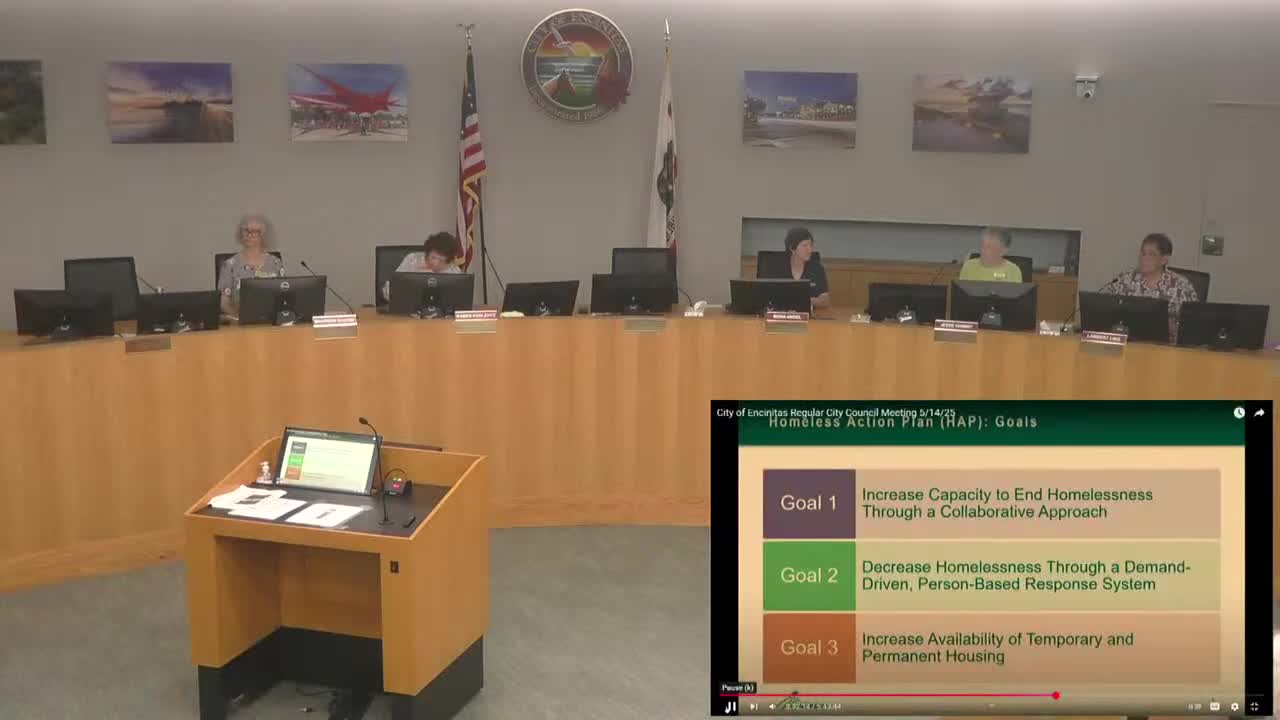
Summary
City staff told the Senior Citizen Commission about partnerships, service statistics and next steps under the city's 2021 Homeless Action Plan, including Buena Creek Navigation Center operations, PATH and Jewish Family Services program outcomes, and the city's recent start with the regional HMIS system.
City staff provided an update on the City of Encinitas's Homeless Action Plan (HAP) during the May 20, 2025, Senior Citizen Commission meeting, summarizing partnerships, program outcomes and planned data coordination.
Patty Anders, planning manager with Development Services, reviewed the HAP's three primary goals: increase capacity for a collaborative response, decrease the number of people experiencing homelessness through person-centered services, and increase temporary and permanent housing availability. Anders said the HAP was adopted by city council in February 2021 and is an action-oriented guide based on data and stakeholder engagement.
Staff described partnerships with the County of San Diego Office of Homeless Solutions, Jewish Family Services (JFS), People Assisting the Homeless (PATH), and the recently opened Buena Creek Navigation Center (BCNC), a low-barrier navigation center operated by Retread in partnership with the city of Vista. Anders said BCNC has 24 rooms (capacity up to 48 people); Encinitas has exclusive use of six rooms (12 beds).
Calendar-year 2024 program statistics provided by staff: PATH conducted outreach in the city roughly two days per week, served 100 unduplicated clients and placed 15 people into permanent housing. JFS's safe parking program (started February 2020) provides 25 parking spaces at the Encinitas Senior and Community Center; in 2024 JFS served 36 unhoused individuals with 16 positive exits, an average stay per vehicle of 119 days and an average nightly occupancy of 76 percent (about 19 vehicles). Since 2020 the JFS program has served 224 individuals, staff said.
The BCNC report for 2024 showed 56 unduplicated residents served; 44 program exits with 13 placed into permanent housing, five into temporary housing and seven into institutional situations. Staff said there were 17 "negative exits" (individuals who returned to homelessness). The average length of stay at BCNC was 49 days and the year-to-date occupancy rate was 83 percent (about 10 beds), staff reported. Challenges cited included limited transportation to the center and some clients not being ready for housing.
Staff said the city began participating in the Regional Homeless Management Information System (HMIS) in August 2024. HMIS is a U.S. Department of Housing and Urban Development'mandated data system for recipients of most federal and state homeless funding; participation will allow the city to access additional grant opportunities and to develop a city-specific "by-name" list to coordinate services and prioritize the most vulnerable unhoused individuals. Staff said the by-name list will be a non-public tool and that the next steps are coordinating data methodology, obtaining provider authorization for data sharing and establishing joint case conferencing meetings.
On program management, staff asked the commission to "receive the report and provide direction" on extending the Jewish Family Services safe parking agreement. Manager Hamer later said the city council had approved an extension of the Jewish Family Services program through December (at the time of the commission meeting). Staff emphasized that public reports of encampments via the My Encinitas app indicate public submissions and do not directly reflect the number of individuals experiencing homelessness.
Quotes from the meeting included Anders describing the HAP as "an action oriented strategy" and staff noting HMIS participation will "help staff track resources offered, understand the needs of the people they serve, promote effectiveness and efficiency, and really importantly, it reduces duplication of efforts."
The commission did not take a formal vote on HAP policy changes at the meeting; staff asked for direction on the JFS agreement extension and said further coordination with regional partners would continue.