Get Full Government Meeting Transcripts, Videos, & Alerts Forever!
Get email alerts on the Right To Grow Gardens topic
No spam. Unsubscribe anytime.
Sponsor says right-to-grow bill aims to protect private vegetable gardens; committee pulls bill for revision
Summary
Representative Dan Bodd presented House Bill 1149 to protect personal, noncommercial vegetable gardens; municipal league language and concerns about homeowners’ associations and front-yard gardens prompted senators to pull the bill for further work.
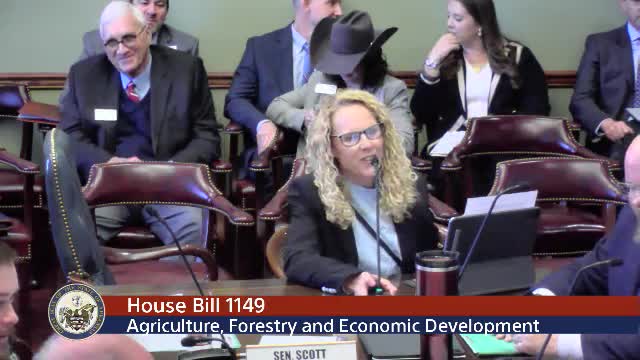
House Bill 1149, presented to the Senate Agriculture, Forestry & Economic Development Committee by Representative Dan Bodd, would protect a property owner’s right to cultivate a vegetable garden for personal consumption or noncommercial sharing and limit local governments’ ability to broadly prohibit such gardens.
Bodd said the measure was informed by work on a national agricultural task force and by examples from other states where lawmakers sought to encourage local food production during the pandemic. “What we learned during the pandemic is we don't have enough food supply,” Bodd said, describing the measure as intended to let people “grow a garden, feed your family, sustain yourselves.”
The municipal league provided an amendment intended to address local concerns, and John Wilkerson, general counsel for the Municipal League, told the committee the added language was intended to make clear the bill would not prohibit vegetable gardens and that cities already regulate vegetation that can block signage or obstruct visibility. Senators raised questions about whether the bill’s language would allow large front-yard gardens in subdivisions without homeowner associations, how cities could regulate size or placement without naming “vegetable gardens” specifically, and whether the statute’s language created a double negative that would complicate local enforcement.
Senators expressed sympathy for the bill’s goals but also said they wanted clearer language to avoid unintended consequences in subdivisions and municipalities. Several senators suggested the sponsor revise the wording to clarify where and how localities may regulate gardens (for example, by allowing local rules on lot coverage or height of vegetation that are general in nature).
The sponsor agreed to pull the bill for revision; the committee adjourned with the bill withdrawn for redrafting. No formal vote on the bill was recorded.
Ending: Sponsor said he would return with clarified language after consulting with municipal stakeholders; the committee agreed to take up the bill again after revisions.