Get Full Government Meeting Transcripts, Videos, & Alerts Forever!
Get email alerts on the Recreational Tramways Liability topic
No spam. Unsubscribe anytime.
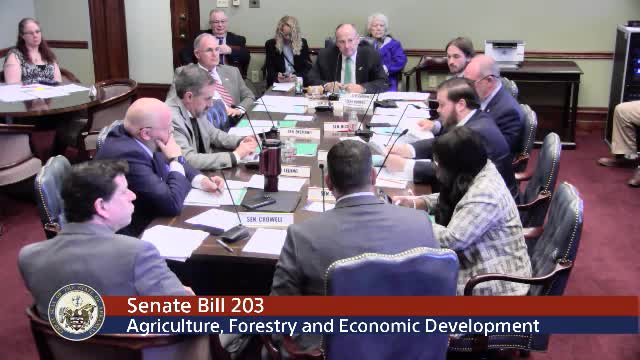
Senate committee advances bill limiting some liability for recreational tramway operators, clarifies inspections
Summary
The Senate Agriculture, Forestry & Economic Development Committee voted to advance Senate Bill 203, which would create limited tort protections for operators of recreational tramways that comply with ANSI lift standards and annual inspections; the committee debated who may perform inspections and how comparative-fault rules apply.
The Senate Agriculture, Forestry & Economic Development Committee on Tuesday voted to advance Senate Bill 203 as amended, a measure that would give operators of recreational tramways — such as mountain-bike “bike lifts” and ski-style tramways used year-round — limited tort protections when they meet specified inspection and operational standards.
The bill’s sponsor, Senator Hester, told the committee there was “a really exciting announcement last week of the opportunity to get 2 of these bike tramways in the state of Arkansas,” and said the measure is modeled on statutes in states such as Idaho, Utah and Colorado.
The nut graf: supporters say the bill aims to encourage outdoor recreation investment while keeping safety enforcement in place. The bill ties protections to compliance with the American National Standards Institute (ANSI) ski-lift code and a requirement that an operator certify an annual inspection. It also preserves liability when an operator acts intentionally or recklessly.
Committee discussion focused on three main areas: who may perform required inspections, the role of state inspectors, and how the bill treats comparative fault.
On inspections, Parks, Heritage and Tourism general counsel Clay Stone explained that the term “including the state” was retained in the definition of operator so the statute would cover state-owned sites as well as private operators. Stone said operators may perform their own annual inspection to maintain ANSI certification, but the state retains the right to inspect at any time. The sponsor clarified that the annual inspection requirement is tied to ANSI certification and that the Arkansas Occupational Safety and Health Office (the state OSHA office) would have authority to conduct inspections and make investigators available.
Committee members repeatedly raised concern about allowing an operator’s own employee to perform the annual inspection. Senator Hickey asked whether an employee inspection could be sufficient and whether that could create a conflict of interest; Hester responded that the bill does not protect negligent inspectors and that an operator who hires a private inspector could still be sued and could bring a third-party claim against the inspector if appropriate.
The committee also debated the bill’s language on contributory negligence. University of Arkansas School of Law representative Jacob Warlow said the bill’s treatment differs from Arkansas’s usual modified comparative-fault framework, which reduces recovery by the plaintiff’s percentage of fault rather than barring recovery entirely when the injured person is partially at fault. Warlow recommended using the state’s existing comparative-fault statutory scheme rather than a rule that would bar recovery if the injured party bore any fault.
Sponsor Hester said the amendment adopted in committee clarified that the contributory-negligence defense would apply only in negligence actions and would not shield operators for intentional or reckless conduct.
The committee adopted an amendment (moved by Senator Letting and seconded by Senator Gilmore) and later passed the bill as amended on a voice vote (motion to pass by Senator Stone, seconded by Senator Gilmore). The record shows a voice vote; numerical tallies were not recorded in the transcript.
Ending: Hester told colleagues she would follow up on outstanding inspection and fault concerns before floor consideration; the measure will be engrossed on the floor the next day and would receive a final floor vote thereafter.