Get Full Government Meeting Transcripts, Videos, & Alerts Forever!
Get email alerts on the Environment Single Use Plastics topic
No spam. Unsubscribe anytime.
Abington adopts ban on single-use plastics and expanded polystyrene; board declines paper-bag fee for now
Summary
The Abington Township Board of Commissioners adopted Ordinance 22-26 prohibiting single-use plastic bags and expanded polystyrene foam products, while debate over a convenience fee for paper bags continued and a single dissent was recorded on the final vote.
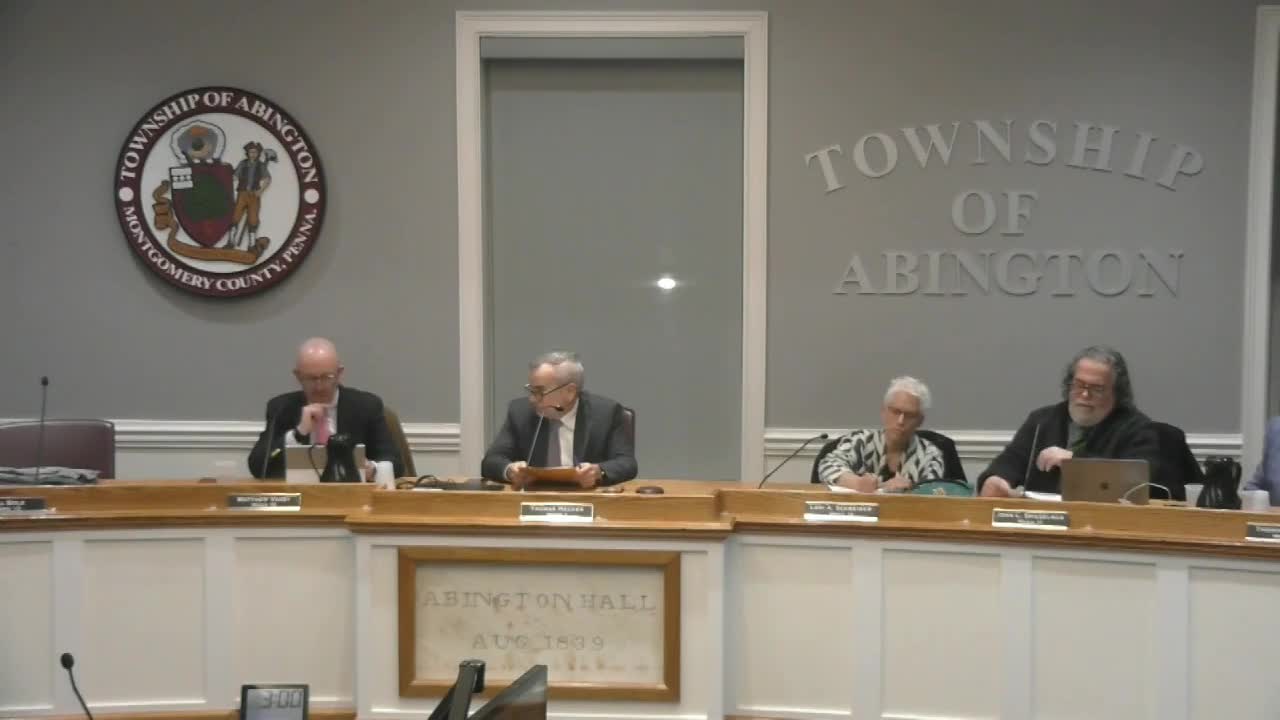
The Abington Township Board of Commissioners voted Feb. 13 to adopt Ordinance 22-26, banning single-use plastic bags and expanded polystyrene foam products in the township.
The ordinance, moved and seconded during the board's new-business section, passed after roughly an hour of public comment and discussion among commissioners about whether the measure should include a 10¢ convenience fee on paper bags to encourage reusable bag use.
Supporters at the meeting and in the public record said the ban will reduce litter and environmental harm. Jackie Pickering, a Meadowbrook resident who spoke during the public-comment period, told commissioners she had checked with major retailers and found many already offer incentives or do not charge for paper bags. "What we don't want to do is have people just move to paper because [they] end up in the landfill," Pickering said.
Others urged stronger rules. Resident Amit Simon asked the board to require recycled-content paper if the fee is not adopted: "If you're implementing a policy that will knowingly increase the use of paper bags ... why not have a provision that requires use of recycled paper?" he said, arguing recycled paper would reduce the ordinance's environmental trade-offs.
Commission discussion focused on two issues: whether a paper-bag fee should be added now and whether the ordinance should require a minimum recycled-content standard for paper bags. Vice President Matt Vahey clarified earlier edits to the draft ordinance: "We removed the requirement to print that the material is recycled. We did not remove the requirement that the material has to be recycled. It has to have at least 40% post-consumer material." That 40% post-consumer-content requirement remains in the adopted ordinance.
Commissioner John Spiegelman, who said he had considered proposing the bag fee as an amendment, summarized his plan to monitor implementation before pursuing a fee: if the shift from plastic to disposable paper is observed in local retailers, he said, he will bring an agenda item to add a convenience fee in the months after the ordinance takes effect. "If the latter is the case ... I will be asking our board leadership and township administration for an agenda item to amend this ordinance with a bag fee," Spiegelman said.
Other commissioners voiced concerns that a convenience fee could place an undue burden on some residents or be unpopular with local businesses, while several said they supported the underlying ban but preferred to revisit a fee later.
The motion to adopt Ordinance 22-26 carried with one recorded dissent and otherwise affirmative voice votes.
The board also heard public suggestions for nonregulatory measures to accompany the ban, including voluntary sustainable-storefront recognition programs and business engagement to encourage reusable bags. Abakaki Evans, an associate member of the township's Environmental Advisory Council, pointed to a neighboring borough's voluntary storefront recognition program as a possible model for Abington.
Implementation notes provided during the meeting indicated the ordinance will be bid- and grant-compliant where federal funds are involved; staff said some components of projects tied to federal funding (for example, curbside or recycling work) must meet federal guidelines.
The board approved the ordinance and moved to the remaining agenda items.