Get Full Government Meeting Transcripts, Videos, & Alerts Forever!
Get email alerts on the Boards Commissions Review topic
No spam. Unsubscribe anytime.
Rules committee begins four‑year review of Jacksonville boards and commissions
Summary
Council Research and the mayor's office presented an overview of the mandatory four‑year review of local boards and commissions, highlighting outdated listings, several vacancies and an antiquated application process; the committee scheduled deeper reviews over the next two months.
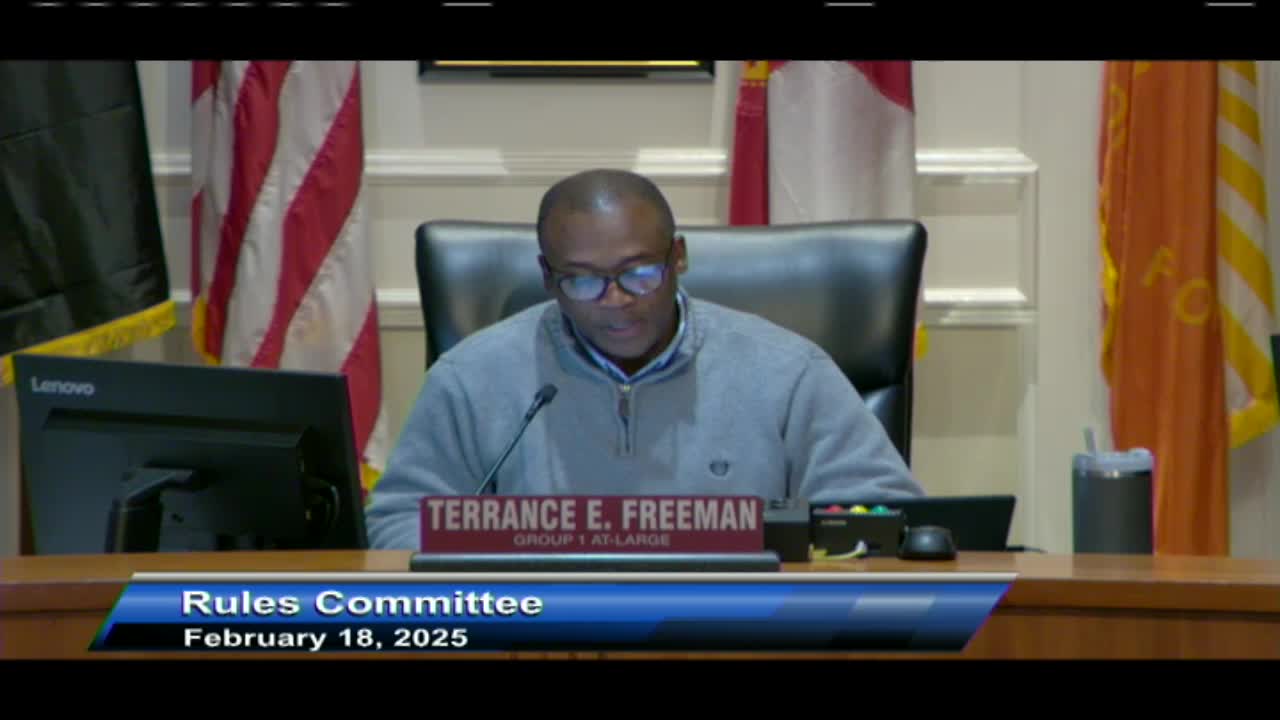
The City of Jacksonville Rules Committee on Feb. 18 heard a presentation from Council Research and the mayor’s office on the committee’s statutorily required four‑year review of boards and commissions.
Colleen Hamsey, Council Research, and Garrett Dennis of the mayor’s office told the committee the review is intended to inventory membership, appointing authority, vacancies, duties and staffing for boards listed in chapter 50 (appendix A) of the Jacksonville ordinance code. Hamsey said the appendix is “somewhat outdated” and that several newly created boards are not yet reflected in the appendix provided to the committee.
The review matters because section 50.110 of the ordinance code requires the Rules Committee to examine and recommend whether locally appointed boards should continue, be sunset, or have membership or duties adjusted. Hamsey said packets distributed to committee members include board-by-board background, membership and staffing information, and a color‑coded summary showing which appointing authority (council, mayor, governor or combination) places members on each board.
Committee members pressed administration staff about whether the review includes evaluation of board effectiveness and how vacancies are managed. Councilmember Michael Boylan asked whether the review assesses the impact or effectiveness of each board and whether overlapping boards might be merged. Garrett Dennis said staff regularly consult with department staff and that the review is intended to flag candidates for consolidation or schedule changes on boards that meet infrequently.
Members flagged several practical issues. Councilmember Johnson and others noted two boards with substantial vacancies, including Elder Affairs and a veterans or JSAB committee (as discussed in committee remarks), and expressed concern that lack of quorum has prevented regular meetings. Committee members also called attention to the application process for board seats: currently, applicants must download, print and submit paper forms. Councilmember Johnson said she is working with the council’s public information officer to create a digital application process to increase accessibility.
Hamsey told the committee the Rules Committee would take three committee meetings—February, March and April—each to devote roughly 20 minutes to this work: an overview now, deeper dives at a subsequent meeting and potential legislative recommendations at the third meeting. Dennis said staff will prepare committee reports and additional background for whichever boards members request for deeper review.
The committee did not vote on legislative changes during the Feb. 18 meeting. Members asked staff to return with details on which boards have chronic vacancies, which appointing authorities control each board, and whether any boards could be merged or sun‑set.
Hamsey and Dennis said they will gather that information and suggested the committee identify specific boards for a March deep dive.
For now, the committee recommended more outreach to recruit qualified members and modernization of the application system to improve access and reduce administrative burdens on seniors and other populations that have difficulties with paper‑only processes.