Get Full Government Meeting Transcripts, Videos, & Alerts Forever!
Get email alerts on the Home Retrofit Mitigation topic
No spam. Unsubscribe anytime.
Sponsor withdraws Arkansas retrofit bill after committee questions over funding, distribution and oversight
Summary
Sen. Justin Boyd introduced Senate Bill 179 to fund home retrofits to the IBHS Fortified standard with $10 million from premium tax collections and $2 million for administration. Committee members raised questions about eligibility, geographic distribution, contractor certification and the fiscal impact; Boyd withdrew the bill to rework details.
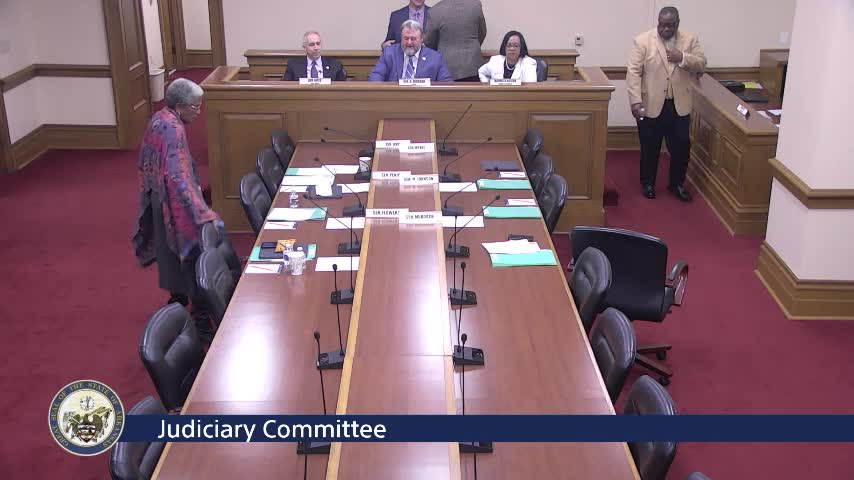
Senator Justin Boyd presented Senate Bill 179 — branded in testimony as the Strengthen Arkansas Homes Act — to the Arkansas Senate Insurance & Commerce Committee as a grant program to retrofit dwellings to the Insurance Institute for Business & Home Safety (IBHS) Fortified standard, funded by premium-tax revenue. After extended questioning from committee members about eligibility, fund distribution and oversight, Boyd told the committee, “I’m pulling it down,” and said he would rework the proposal.
The bill as introduced would direct $10,000,000 from premium-tax collections to grants for home mitigation and up to $2,000,000 for program administration, according to testimony. Brian Powell of the National Association of Insurance Commissioners (NAIC) described the model as a grant program that pays for retrofits certified to IBHS standards and said post-mitigation claims assessments show substantial reductions in loss: “we're seeing that the reduction of loss ... around 67%,” Powell said. The program would generate a certificate from IBHS that could trigger insurer premium discounts.
Committee members pressed the sponsor and witnesses on several operational points the bill text did not specify. Senator Reginald Murdock asked whether funds should be allocated by congressional district to ensure geographic equity; Senator Boyd said he was open to the idea but worried demand could spike after a storm event and that the insurance department should advise on allocation. “My concern is there might be more demand after a storm event than before a storm event,” Boyd said. He agreed to continue discussions with the insurance department and other stakeholders.
Participants discussed alternate funding sources in addition to premium-tax money, including philanthropy, employer contributions and direct insurer donations. Witnesses said some states have used a mix of premium taxes, licensing fees and insurer donations to support similar programs. Boyd acknowledged a disclosed fiscal impact of roughly $12,000,000 and said the program “could be funded with revenue collected by the insurance department without a year-over-year decrease in the department's general revenue distribution,” while admitting the $12,000,000 figure could reduce what would otherwise be transferred to general revenue in coming years.
Banking and mortgage concerns were raised during questioning. Laurie Trogdon, president and CEO of the Arkansas Bankers Association, described how rising property-insurance premiums affect mortgage escrows and borrowers: when insurance increases, banks must recoup shortages through future mortgage payments, potentially stressing households. Trogdon said the association had “no issue with the bill” as introduced but offered context on the mortgage-escrow dynamics.
Questions about workforce and quality control also featured prominently. Powell and other witnesses said IBHS or partners would train and certify contractors and independent evaluators to inspect retrofits on a factory or site basis; an independent evaluator would verify completed work and the IBHS certificate would attest to compliance. Committee members sought clarity on whether Arkansas currently has a sufficient pool of certified contractors and on fees for contractor certification; witnesses said a training and accreditation build-out is part of program implementation and certification typically carries a modest fee.
Witnesses pointed to nonprofit partners such as Habitat for Humanity as common administrators or subcontractors in other states, using affiliate networks and corporate partnerships to deliver retrofits in targeted communities. Powell noted economic benefits tied to mitigation work, including local job creation and increased home values; he said studies show about $12 in savings for every dollar invested when accounting for recovery and cleanup costs avoided after storms.
Jimmy Harris, deputy commissioner of market regulation at the Arkansas Insurance Department, responded to a question about whether Arkansas rate reviews consider out-of-state catastrophes: “rates in Arkansas are required to be based on the experience within our borders,” he said, while acknowledging reinsurance costs and catastrophes are a factor in broader market dynamics.
After more than an hour of presentation and questions, Senator Boyd told the committee he planned to revise the measure and withdrew the bill from consideration at that time. He said he would continue consulting with members, the insurance department and stakeholders to address distribution mechanics, eligibility language and other operational matters before resubmitting or seeking further action.
The committee did not take a formal vote on SB179. Committee leadership later cautioned members about measures with potential general revenue impact and said those decisions would be made after further consideration.