Get Full Government Meeting Transcripts, Videos, & Alerts Forever!
Get email alerts on the Open Meetings Brown Act topic
No spam. Unsubscribe anytime.
Kingsburg Planning Commission receives Brown Act training; approves agenda and minutes
Summary
City Attorney Nolan gave the Planning Commission a detailed Brown Act refresher covering open-meeting rules, serial-communication risks, new remote-participation limits and cybersecurity closed sessions. The commission approved the meeting agenda and the minutes from Dec. 12, 2024; Commissioner Bellini abstained on the minutes.
Kingsburg — The Kingsburg Planning Commission on Jan. 9 heard a detailed Brown Act training from City Attorney Nolan and then approved the meeting agenda and the commission minutes from Dec. 12, 2024.
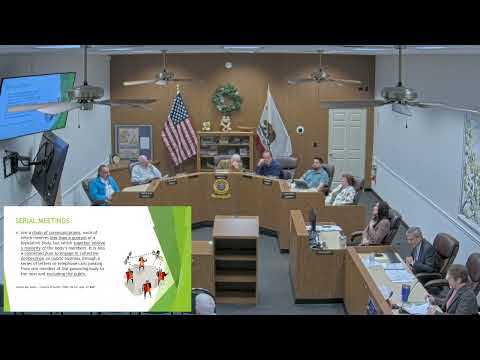
City Attorney Nolan told commissioners the Brown Act requires that planning bodies "do your business in public" and warned that commissioners must avoid private or serial communications about items that will come before the commission. "You cannot do, take on your business and do the things the Planning Commission does, behind closed doors," Nolan said. He added: "emails never go away, and they can create a virtual serial meeting."
The training reviewed standard open-meeting rules and newer updates. Nolan noted that regular meeting agendas must be posted at least 72 hours in advance, special meetings at least 24 hours, and emergency meetings may be noticed within one hour to the media. He said the public-comment period should be provided at each meeting and that the commission typically limits comments to five minutes per speaker, with extra time for translators or when representing multiple people.
Nolan described several recent statutory and advisory changes affecting local bodies. He summarized new limits on remote participation, saying a commissioner may use remote attendance for just cause or an emergency two times per year for bodies that meet once a month, five times a year for bodies that meet twice a month, and seven times a year for bodies that meet three to four times per month. He also said recent changes authorize closed sessions to address cybersecurity and critical-infrastructure information. "We are now able to go into closed session to talk about issues, critical structure, critical infrastructure controls and critical infrastructure information relating to cybersecurity," Nolan said.
The city attorney also cited two Attorney General opinions discussed during the presentation: one addressing how remote participation interacts with the Americans with Disabilities Act, and another indicating that a "State of the City" address can constitute a meeting under the Brown Act and therefore should be agendized if officials plan to discuss city business.
Nolan pointed to a new public-notice requirement for amendments to the zoning ordinance that change which uses are permitted on property. Those zoning-ordinance changes, he said, now require 20 days' public notice instead of the standard 10 days when the amendment affects permitted uses.
The training included practical guidance on recusals and due process. Nolan said commissioners should disclose conflicts on the record and recuse themselves when they have a financial interest or an appearance of impropriety; as an example he cited ownership of property within 500 feet of a matter before the commission. He advised commissioners to consult staff for factual questions but to avoid discussing pending matters with third parties in a way that could create serial communications.
Following the training, the commission took two routine actions. The commission approved the meeting agenda by motion and second; the chairperson announced the motion carried after members said "aye." Later the commission approved the minutes for the Dec. 12, 2024 meeting by motion and second; that motion carried with one abstention by Commissioner Bellini.
The training concluded with Nolan offering to answer follow-up questions. "I'm happy to answer any questions that you may have with regards to the Brown Act or the public hearing procedures," he said.