Get Full Government Meeting Transcripts, Videos, & Alerts Forever!
Get email alerts on the Housing Zoning topic
No spam. Unsubscribe anytime.
Planning Commission backs zoning changes to implement housing element and Measure T, recommends higher administrative approval threshold
Summary
The San Mateo Planning Commission recommended Feb. 11 that the City Council adopt zoning-code amendments to implement the city's 2023'2031 Housing Element and to align zoning with Measure T and the 2040 General Plan, and it amended the staff recommendation to set an administrative approval threshold of 50 units for projects meeting objective design standards while also asking the council to consider eliminating that threshold for such projects.
The San Mateo Planning Commission recommended Feb. 11 that the City Council adopt two ordinances to amend the city's zoning code to implement the 2023'2031 Housing Element and to bring zoning into consistency with the General Plan and Measure T.
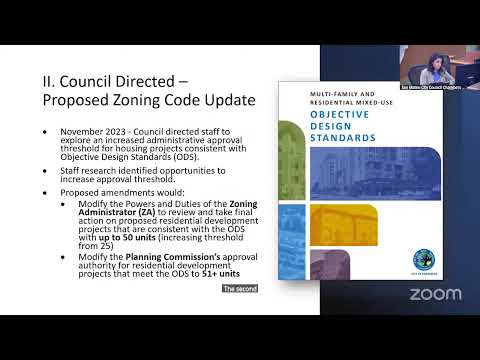
The recommendation, passed 4'0to'00 with one commissioner absent, also included a policy direction on administrative approvals: the commission endorsed staff's package of code amendments and amended the recommendation to set an administrative approval threshold at 50 units for projects that meet objective design standards, while adding a supplemental recommendation that the council consider eliminating the threshold entirely for such projects.
The zoning changes before the commission stem from the city's housing element and the 2040 General Plan, staff said. "The zoning code amendments before you tonight stem from the San Mateo housing element, which was adopted in May by the City Council and certified by the State Department of Housing and Community Development in July," Planning Manager Anira Sandhir told the commission. Staff described three broad groups of proposed changes: updates driven by state law and housing element policies (definitions and permitted uses for a range of housing types); revisions to administrative approval thresholds; and amendments to make existing zoning consistent with Measure T and the General Plan land-use table.
Why it matters: the city's General Plan and Measure T increased potential housing capacity citywide; staff and commissioners said the zoning amendments are intended to convert that capacity into projects while ensuring state-law compliance. Staff said the General Plan'level environmental impact report covers up to roughly 19,700 new housing units through 2040 and recommended a categorical exemption under CEQA Guidelines section 15183 for the zoning amendments as consistent with the certified General Plan EIR.
Key provisions and discussion
- Uses, definitions and state compliance: Staff proposed permitting residential uses in commercial and office zones in some cases; aligning local definitions for single-room occupancy, supportive housing, emergency shelters and manufactured homes with state law; removing special-use-permit requirements in certain mixed-use districts; and clarifying accessory dwelling unit allowances. Staff said these are largely code cleanups to reflect state law and previously adopted policies.
- Administrative approval threshold: Staff recommended raising the zoning administrator approval threshold from 25 to 50 units for projects that meet the city's objective design standards. Commissioners debated a range of alternatives during the meeting: one commissioner proposed a higher threshold (150 units) or removing the threshold entirely; others queried the public-notice and neighborhood-outreach implications of removing public hearings for larger projects. Commission discussion repeatedly returned to the tension between streamlining approvals for predictable, standards-compliant projects and preserving public hearings for large developments.
- Notice and outreach: Staff clarified that administrative approvals include early neighborhood meetings and legal noticing before a decision, but do not include a public hearing. Administrative decisions can be appealed to the Planning Commission.
Public comment and equity concerns
Cara Cox, an in-person speaker who identified herself as a real-estate agent and former San Mateo resident, welcomed more housing production but urged the city to encourage homeownership and condominium development in addition to rental multifamily housing. "We need to build condos. We need to create ownership in the community," Cox said, adding concerns that most new multifamily development is rental product and that the city lacks a "ladder" to ownership for middle-income residents.
Vote and next steps
The commission voted to recommend that the City Council find the ordinances exempt under CEQA Guidelines section 15183, adopt the zoning amendments to implement the Housing Element, and adopt the zoning amendments for Measure T/General Plan consistency. The motion as adopted included the administrative-threshold amendment (50 units for administrative approval when projects meet objective design standards) and a supplemental recommendation that the council consider eliminating the threshold for projects that meet objective design standards.
City staff said the council will consider the ordinances at an introduction hearing followed by a second reading. If council directs additional study on alternative thresholds or location- or ownership-based incentives, staff said it would need time to research and potentially bring revised language back to the Planning Commission.
Background and context
Staff told commissioners the city's Housing Element contains 53 policies and about 150 implementation actions; the General Plan and Measure T created substantial additional theoretical capacity in study areas identified by the land-use table. Staff also noted the city has already adopted objective design standards and a by-right ministerial path for certain affordability levels in prior code updates; the current package builds on those earlier changes.
The Planning Commission closed the item after the vote and moved to routine reports and announcements, including reminders about upcoming meetings and commissioner trainings.