Get Full Government Meeting Transcripts, Videos, & Alerts Forever!
Get email alerts on the Agriculture Avian Influenza topic
No spam. Unsubscribe anytime.
Delmarva Chicken Association: nine cases of avian influenza on Delmarva, industry urges biosecurity and continuity measures
Summary
Delmarva Chicken Association and growers briefed the Eastern Shore delegation on high-path avian influenza cases in the region, control-area releases, economic importance of the poultry sector and legislative priorities including hauling permits and PFAS alternatives.
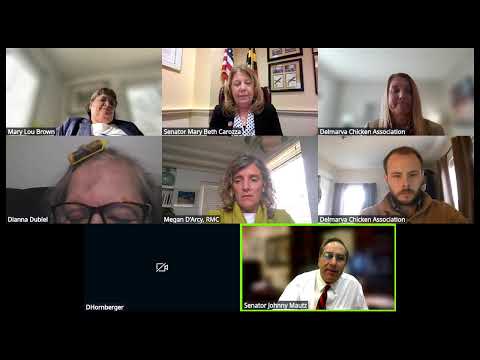
Annapolis, Feb. 7 — The Delmarva Chicken Association told the Eastern Shore delegation on Friday that high-path avian influenza (HPAI) has been detected across Delmarva and that the industry is focused on containment, rapid cleanup and continuity of business for commercial growers.
Mary Lou Brown, a Dorchester County grower and the association's board president, said there have been nine HPAI detections on Delmarva, five in Maryland. Brown described four federal-state "control-area releases" that have already ended temporary restrictions for affected areas, including a release announced the day of the meeting in Queen Anne's County. "These control area releases are really important milestones," Brown said, because they remove movement restrictions within the 0-to-10-kilometer control zones and allow bird placements to resume so long as required cleaning, audits and steps occur.
Why it matters: The poultry sector is a major part of the Delmarva and Eastern Shore economy, the association said. The group cited about 1,200 family farms supplying five chicken companies, nearly 4,700 chicken houses, about 18,000 allied employees and roughly $4.8 billion in economic output tied to chicken production on Delmarva in the most recent figures they presented.
Industry priorities and state concerns
The association stressed biosecurity as the central defense: dedicated footwear and clothing for poultry houses, limits on visitors, and strict loading and unloading protocols for transport. Growers said the rapid response and a unified command structure led by USDA and state agriculture and natural-resource agencies have helped speed removals, cleaning and return-to-production steps.
Holly Porter, executive director of the Delmarva Chicken Association, said industry and state liaisons are coordinating messaging and logistics. Porter noted one key legislative priority: an "exceptional hauling permit" to expedite permitted movement during outbreaks; the bill has passed a Senate committee and advanced in the House, according to the association.
The association also flagged related policy areas: solar siting, PFAS restrictions, and climate legislation. Growers told the delegation they support phasing out PFAS where feasible but want workable alternatives, and they asked lawmakers to avoid using prime agricultural land for large solar projects that would reduce productive farmland.
Bottom line
Delmarva Chicken Association leaders asked lawmakers for continued focus on containment, continuity-of-business measures and rapid permitting during HPAI incidents. They said early coordination across USDA and state agencies has led to prompt releases in several control areas and urged that biosecurity steps remain the top priority for growers and local officials.