Get Full Government Meeting Transcripts, Videos, & Alerts Forever!
Get email alerts on the Department Of Planning Budget topic
No spam. Unsubscribe anytime.
Subcommittee reviews Maryland Department of Planning budget, historic tax credit and Maryland250 spending
Summary
The Transportation and the Environment Subcommittee heard a presentation on the Maryland Department of Planning's fiscal 2026 allowance, focusing on the historic revitalization tax credit reserve, the Maryland 250 commission, contractual conversions and continued funding requests for SHINE and heritage-area grants.
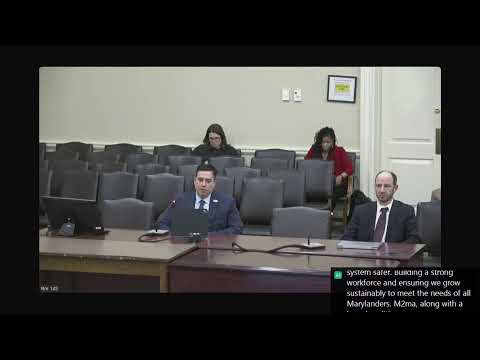
The Transportation and the Environment Subcommittee of Appropriations met Feb. 19 to review the Maryland Department of Planning's fiscal 2026 allowance, including the department's requested staffing changes, a federal drone pilot grant, the $22 million historic revitalization tax credit reserve and funding for the Maryland 250 commission and heritage-area grants.
Legislative Analyst Elizabeth Bridal told the panel the fiscal 2026 allowance for the Department of Planning is $52.7 million, a $3.3 million decrease from the prior year, with roughly 80% from general funds. Bridal said much of the decline is the loss of one-time federal funds used in fiscal 2025, including about $1.8 million from the U.S. Department of Transportation for a drone pilot to move health-care supplies between Crisfield and Smith Island, and $1.5 million for the Maryland 250 commission.
The budget includes $22 million deposited into a reserve fund to back the historic revitalization tax credit program, Bridal said, noting $20 million is for the competitive commercial program and $2 million for the small commercial program. DLS recommended reducing the competitive commercial allocation by $2 million to $18 million in fiscal 2026, Bridal said. She also said the homeowner rehabilitation credit is claimed directly on tax returns and is not paid from the reserve fund.
Maryland Department of Planning Secretary Rebecca Flores and agency staff described three items DLS highlighted: contractual-conversion plans, the Maryland 250 commission and the historic tax credit program. Flores said the contractual conversions are concentrated in the Maryland Historic Trust and Jefferson Patterson Park and Museum and that conversions will be phased in over time because many positions are paid from special funds.
Director Elizabeth Hughes of the Maryland Historic Trust told the subcommittee the small commercial tax-credit program had about $2.3 million in unassigned credits carried forward, including roughly $500,000 rolled from fiscal 2024 and $1.8 million unspent in the current fiscal year. Hughes said the small commercial program tends to be less used and that, if cuts are necessary, targeting reductions to the small commercial component would be preferable to reducing the competitive commercial reserve.
On Maryland 250 — the commission coordinating statewide events and grants for the 2026 observance — Flores said the commission has received state and federal funds, including $1.5 million in federal ARPA funds encumbered in December 2024 for small grants and festivals, and the fiscal 2026 allowance includes $250,000 in general funds. Director Hughes said ARPA funds cannot generally be used for operating expenses and are earmarked for regional festivals and grant programs.
Representatives of Marylandheritage organizations and grant recipients testified during the public-comment portion. Lucille Walker of the Southern Maryland National Heritage Area and coalition co‑chairs and others urged full funding for heritage-area grants, saying a proposed BRFAA provision that would allow $340,000 of program open-space funds to be used for grant software procurement would reduce grant dollars and eliminate the equivalent of three capital grants and one major program grant. Lindsay Baker of Maryland Humanities and several small museum leaders asked the subcommittee to restore funding for the SHINE general‑operating grant program, which provides $10,000 re‑grants to small nonprofits; Baker said the program regranted roughly $2.35 million across FY23–25 and had 93 unfunded applicants this year.
Bridal also noted the fiscal 2026 allowance adds seven regular positions, reflecting contractual conversions, and DLS asked the department to comment on its plan for those conversions.
The subcommittee asked agency staff to provide additional information on Maryland 250’s remaining funding and to clarify details of contractual conversions and grant encumbrances. No formal action or vote on the budget items took place during the hearing.
The planning presentation and public testimony stretched across topic areas that the department said involve both special and general funds and include several one‑time federal grants; members pressed staff for clarification about which funds were encumbered and which would be available to offset requests in fiscal 2026.