Get Full Government Meeting Transcripts, Videos, & Alerts Forever!
Get email alerts on the Usm Budget topic
No spam. Unsubscribe anytime.
University System of Maryland says near‑5% state cut will force reductions in staff and student services
Summary
University System of Maryland leaders told the House Appropriations Committee subcommittee that an approximate 5% reduction in state funding (about $111 million) will require workforce reductions, operating cuts and reduced deferred maintenance, and could weaken student services and progress at HBCUs.
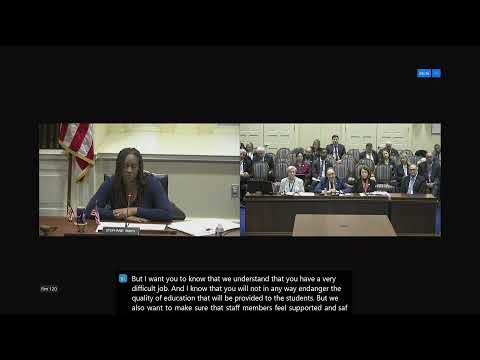
At a meeting of the House Appropriations Committee Education and Economic Development Subcommittee, University System of Maryland (USM) leaders said an approximately 5% reduction in state funding — roughly $111 million — will require difficult decisions including workforce reductions, cuts to operating spending and reduced deferred maintenance.
Chancellor Dr. Perron told the subcommittee that “I must say very plainly and clearly that the nearly 5% cut we’re sustaining is going to be difficult for our universities, for the faculty and staff they employ, for the students they educate.” He said the system is already lean after years of efficiency efforts and warned the reductions will have tangible impacts on people and services.
The USM presented a three‑part plan to absorb the reduction: workforce actions (estimated to cover 40% of the reduction, about $45 million, affecting roughly 400 positions including a mix of eliminated vacant positions and reductions to filled or contingent roles); operating‑budget reductions (about 50% of the gap, or roughly $55 million, through cuts to contractual services, supplies and travel); and reductions in deferred maintenance (about 10% of the gap, approximately $11 million). Chancellor Perron said the workforce actions “will affect about 400 positions” and warned cuts could reduce student‑facing services such as advising, counseling, mental‑health services and career services.
USM officials said those staffing changes could increase faculty‑to‑student ratios and delay student graduation, and they emphasized the system’s role in producing Maryland’s workforce — “we award about 80% of the bachelor’s degrees that are awarded in this state,” Perron said. Leaders also flagged the risk to progress made at historically Black colleges and universities (HBCUs), saying HBCU officials are concerned that cuts to student services, fundraising and marketing could stall gains funded through the state’s HBCU settlement.
Officials told the committee they will exhaust non‑personnel options before reducing existing staff and will treat increases in tuition as a last resort if cost‑cutting measures prove insufficient. The system also plans to expand efficiency efforts, including shared services and purchasing, and to explore online delivery for some student services such as mental‑health supports.
Budget analyst Sarah Baker presented the system’s budget exhibits and noted the governor’s allowance and working appropriation changes. Baker recommended concurrence with the governor’s allowance during her presentation; the transcript does not record a formal committee vote on that recommendation.
Questions from committee members sought detail on vacancy rates and the makeup of positions likely to be affected; Senior Vice Chancellor Ellen Herbst said the system’s reported vacancy rate was just under 5% as of Dec. 30 and that vacancy rates vary by campus and by faculty versus staff categories. USM officials said details about the precise distribution of the 400 positions would be refined as individual universities work through allocations.
The system framed protecting people as its top priority and said it would “exhaust every personnel action we can before reducing our existing workforce,” while continuing to prioritize affordability for students.
Notes: the presentation referenced one‑time funding restores, research expenditure increases centered at College Park and UMB, and a removal of some one‑time legislative items; exhibits cited by USM staff appear in the transcript but the committee did not take a formal vote in the recorded segment.