Get Full Government Meeting Transcripts, Videos, & Alerts Forever!
Get email alerts on the Homelessness topic
No spam. Unsubscribe anytime.
Committee names employment and homelessness subcommittee chairs as homelessness response becomes a 2025 priority
Summary
The Veterans Affairs Advisory Committee named Melissa Hartcrow employment subcommittee chair and Donald Brown homelessness subcommittee chair and discussed gaps in veteran homelessness services, point-in-time counts and rapid-housing efforts.
The City of El Paso Veterans Affairs Advisory Committee voted on Jan. 16 to appoint new subcommittee chairs and identified veteran homelessness as a top priority for 2025.
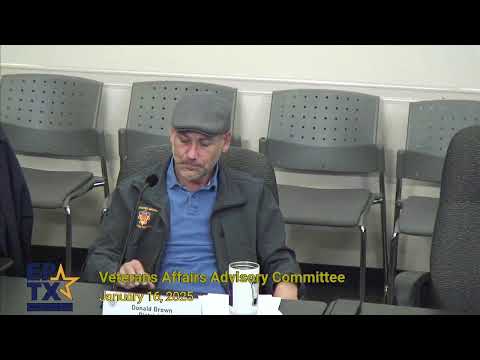
Members voted Melissa Hartcrow as employment subcommittee chair and Donald Brown as homelessness subcommittee chair during agenda item 8. "All in favor, say aye," the presiding officer called; both appointments passed by voice vote.
Committee members and city staff described a noticeable uptick in veteran homelessness and recounted a recent case in which a veteran who had been in the homeless services system for about three years died after a short window of hospitalization, but was not connected to VA benefits. Staff said the city is forming a cross‑functional team with the police department and coordinating with local providers — including the Opportunity Center, the El Paso Coalition for the Homeless and Emergence Health Network — to identify barriers to rapidly housing veterans and preventing recidivism to the streets.
The committee announced plans to participate in the point-in-time homeless count (scheduled within the next 30 days) and to hold a subcommittee meeting to map services, clarify eligibility criteria for intensive community-based mental-health (MEC) services and identify where veterans fall through service gaps. Staff asked subcommittee leads to report back with identified barriers and recommendations.
During the discussion, members also raised specific operational gaps: eligibility thresholds that exclude some seriously ill veterans from MEC or veterans treatment court, and difficulty obtaining rapid emergency sheltering when CIT or specific VA outreach teams are unavailable. Committee members proposed creating a not-for-profit rapid-response fund or mechanism that could place a veteran in temporary hotel shelter while benefits and clinical interventions are arranged.
The committee will circulate membership assignments for the subcommittees and follow up with scheduled subcommittee meetings and a web-based map of veteran resources.