Get Full Government Meeting Transcripts, Videos, & Alerts Forever!
Get email alerts on the School Discipline topic
No spam. Unsubscribe anytime.
Middletown School Committee approves first reading of districtwide cell phone policy after hours of debate
Summary
After extensive debate on stakeholder input, emergency contact procedures and enforcement, the Middletown School Committee voted to approve the first reading of a districtwide cell phone policy. Members asked for more time for implementation planning and stakeholder outreach before a second reading.
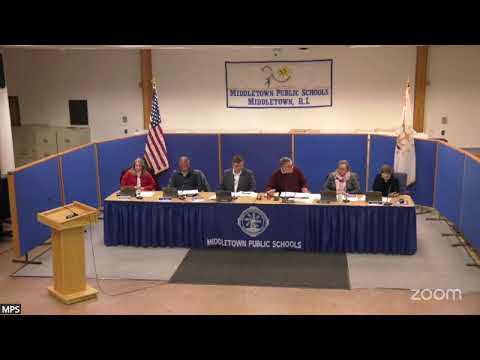
MIDDLETOWN, R.I. — The Middletown School Committee approved the first reading of a districtwide cell phone and electronic-device policy on Feb. 13, setting a framework to restrict student phone use during instructional time while committee members pressed for more stakeholder input and clearer implementation protocols.
The policy, presented as a first reading, was framed by proponents as an action to prioritize instruction and student well‑being. "This policy addresses the responsibility of the school district to provide a safe and healthy learning environment for our students," said Member Greg, who introduced the policy and summarized research linking heavy social media use to mental‑health and classroom‑engagement concerns. "I have one vote and that vote will be used to address the health and safety of our students over the continuing act of kicking the can down the road."
Support for the concept appeared in written correspondence included in the meeting packet. An email from Kristen McLean, identified as an English teacher at Middletown High School, said she supports a districtwide policy and noted the idea of implementing phone pouches while acknowledging logistical challenges. Additional emails from students signed "Aliyah Meyer" and "Rebecca Duggan" and an anonymous parent urging phones be stored in backpacks were also read into the record.
Why it matters: Committee members said the policy would create consistent rules across schools and reduce classroom disruptions attributed to phones and social media. Supporters cited national research and an advisory from the U.S. Surgeon General about social media’s effects on youth mental health; the committee record contains citations and summaries provided by the policy’s proponent.
Key points from the discussion included: - Stakeholder input and transparency: Several members, including Teresa Spangler and Tammy Holden, said the policy had been circulated only shortly before the meeting and that the policy subcommittee meeting that developed the draft was not posted to the Secretary of State website as intended. "I feel like this is being very rushed," Spangler said, urging more meetings with parents, teachers and students before implementation. - Exceptions and student needs: Members asked the policy to explicitly allow administrative discretion for students with medical needs or individualized education program (IEP) accommodations. Committee members sought language allowing the superintendent and building principals flexibility to devise enforcement protocols. - Emergency communication: Members questioned how parents would contact students in emergencies if devices are stored out of reach. The superintendent said the district has a safety plan and that parents may contact the school office in an emergency; the plan is not public for security reasons. - Enforcement and rollout timeline: Some members supported moving the policy forward at first reading while delaying a second reading to permit development of protocols and stakeholder outreach. One member proposed returning with protocols and broader engagement in roughly two months; the chair said the superintendent would be consulted before scheduling a second reading.
The committee took a voice vote on the first reading; the motion passed. The vote was recorded in the meeting as carried by the committee and the chair announced the motion passed.
What remains: Committee members asked the superintendent to gather further stakeholder feedback, clarify definitions such as what qualifies as an "emergency," and present proposed implementation protocols and communication plans before the second reading. Several members urged the administration to propose reasonable disciplinary steps consistent with existing middle‑ and high‑school practice, and to include provisions for storage, visibility and special‑needs exceptions.
The superintendent and other administrators said they would work with principals to draft the detailed protocols, hold outreach with parents and staff and provide an implementation timeline for the committee to review before the next formal vote.