Get email alerts on the School Transportation topic
No spam. Unsubscribe anytime.
PERRYTON ISD approves multi‑year plan to replace aging bus fleet
Summary
The PERRYTON ISD Board of Trustees authorized purchases this year and committed budget authority for additional buses next year, approving a plan to address an aging transportation fleet and to buy vans and cars to meet near‑term needs.
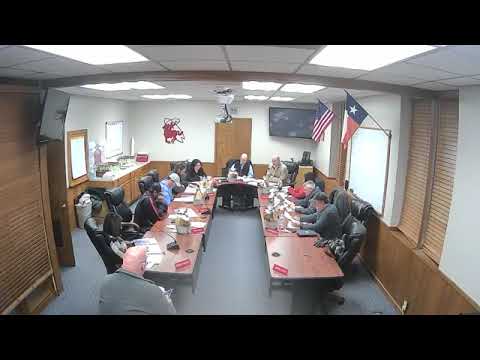
The PERRYTON ISD Board of Trustees approved a multi‑year plan to refresh the district’s aging transportation fleet, authorizing purchases for 2024–25 and committing budget authority for additional buses in 2025–26. The board’s motion passed unanimously, 7–0.
Board members voted to authorize the superintendent to purchase a 46‑passenger “Ranger” bus and a 40‑passenger Bluebird (white activity) bus for the 2024–25 school year and to allot up to $110,000 to buy a used 14‑passenger van and an additional car or equivalent “best value” vehicles. For the 2025–26 school year the board approved planning to acquire a second 40‑passenger white bus and a 71‑passenger Bluebird yellow activity bus with the higher‑power (240 hp) engine. The motion was presented on the recommendation of district staff and approved after roughly an hour and a half of discussion.
The board discussion focused on three central issues: vehicle selection and configuration, near‑term accessibility and storage, and funding/timing. Staff presented price estimates and features: the district quoted approximately $270,000 for a new 46‑passenger Ranger bus; the 40‑passenger white activity buses were presented as a lower‑cost alternative that can reach higher highway speeds (up to 75 mph) because they are not painted yellow. The 71‑passenger Bluebird yellow activity bus was discussed as a bus that can later be converted to a route bus but carries speed restrictions when configured as a yellow school bus (approx. 65 mph). The board discussed seat types (vinyl bench seats versus cloth or reclining seats), under‑floor storage, air‑conditioning options (flush‑mount front units versus side units), USB charging ports, camera systems and compatibility with existing recording hardware, and Wi‑Fi on activity buses.
Board members and staff raised operational concerns: lead times for new buses (staff said some models now have a roughly six‑month lead time), the cost and compatibility of installing new multi‑camera systems (staff estimated up to about $150,000 to replace/add cameras and the base station hardware), maintenance needs, and the district’s shortage of covered storage for buses during severe weather. Several trustees pressed staff on how new vehicles would replace, rather than add to, the number of buses in the yard, noting limited storage space and past instances of idle vehicles being stored on district property. Staff responded that the plan calls for replacing older vehicles and, where possible, repurposing activity buses for routes as the fleet is renewed.
Funding sources discussed included the district’s voter‑approved transportation allotment (referred to in the meeting as VADER money) and surplus funds/savings in the current fiscal year; staff said about $270,000 was available from the VADER allocation for the current purchase and that surplus or fund‑balance resources could cover the $110,000 for smaller vehicles. Trustees also discussed the option of leasing as an alternative financing tool but did not adopt a lease in place of purchase.
After the discussion, a board member moved the authorization and another trustee seconded; the board voted unanimously to approve the purchases and the 2025–26 authorization. The board directed staff to seek the best‑value purchases (new or used) and to return with purchase details and vendor specifications for the approved models prior to final ordering.
Implementation notes: staff will solicit formal purchase quotes and confirm lead times and outfitting (camera packages, seat options, HVAC configuration) before finalizing orders. The board also asked staff to continue exploring covered storage options and to provide a clearer plan for disposition or reuse of retired vehicles.
AI generated
The text on this page is AI generated. Summaries, highlights, analysis, and video transcripts are all produced from the original source material.
AI can make mistakes, so if you spot one, and we will fix it for everyone.
Note: the source content is unaltered by us. Any content source we link to, be it a video, an audio recording, or a document, is presented exactly as its publisher released it. That publisher is usually a government body, sometimes an individual official or another organisation.