Get Full Government Meeting Transcripts, Videos, & Alerts Forever!
Get email alerts on the Housing Budget topic
No spam. Unsubscribe anytime.
Columbus development budget prioritizes housing stability as federal rental aid winds down
Summary
City Department of Development leaders told Columbus City Council that the 2025 operating budget focuses on staffing and program dollars to deploy bond, federal and local funding to preserve and build affordable housing even as federal emergency rental assistance ends.
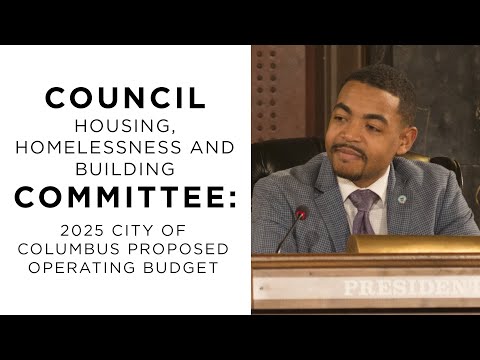
Council President Hardin opened a Jan. 21 committee hearing on the Department of Development's operating budget by saying an eviction story from his own family showed why the city must act to keep residents housed. “That young lady was my niece,” Hardin said, describing a student whose household lost a long‑standing apartment when a building sold and whose family had to move out of the neighborhood.
The Department of Development framed the proposed 2025 operating budget around implementation, not new financing, arguing staff capacity is critical to move projects that use bond, federal and other funds. “Our general fund proposed totals $34,500,000,” Deputy Director Bill Westrick told council. He said that about $13.8 million is for staff and operations and roughly $19.8 million is for programmatic costs. Westrick described a housing division operating request of $4.2 million and a homelessness operating request of $6.1 million.
Nut graf: Department leaders urged council that staffing and program continuity are essential as federal emergency rental assistance (ERA) dollars expire and as the city transitions ERA recipients and other projects onto locally controlled funds and voter‑approved bond dollars.
Department officials laid out how operating staff help leverage larger capital resources. Erin Prosser, who described the housing division's work, said voter‑approved bond funds have been essential: Columbus voters authorized a $250 million affordable housing bond and the city has deployed about $141.5 million of that to roughly 39 projects representing just over 3,000 income‑restricted units. Prosser emphasized three program goals — access, stability and opportunity — noting 523 permanent supportive housing units have been produced for very low‑income residents and that roughly $90.2 million in emergency rental assistance was deployed since the pandemic.
Council members pressed how the city will respond once federal ERA funds end. Westrick and Prosser said the department's innovation team is studying how to target remaining funds to households at highest risk of homelessness and to stretch local dollars farther, and indicated council would be part of ongoing budget conversations. "We're trying to work with our budget to see where we can make cuts, maintain the impact to the community that we want to impact, but at the same time, try to meet the needs," Westrick said.
Councilmember Green and others also raised implementation of the right‑to‑counsel ordinance (referred to in testimony as the “access to council” ordinance) passed in December. Department staff said they are using current allocations where possible to support tenant legal representation in eviction court and plan to discuss funding in the final operating budget. Legal aid and tenant advocates told the committee they believe funding is essential: Kate McGarvey of Legal Aid urged council to add $1.5 million in 2025 to fund initial phases of court representation tied to the ordinance.
Administration staff previewed a code change expected to be introduced to council (ordinance 34‑57) that would add limited flexibility to residential tax incentive rules for projects exceeding 100 units, permitting the development director to allow case‑by‑case departures from a strict 35% gross‑income cap while preserving affordability requirements and council approval via a housing development agreement.
The hearing included a range of outside stakeholders who urged continued or expanded investment. Representatives of the Building Industry Association and Affordable Housing Alliance urged faster permitting and regulatory reforms that reduce costs and speed production; nonprofit providers, including the Community Shelter Board and YWCA Columbus, warned that shelter and prevention programs face funding gaps when COVID and ARPA dollars expire.
Ending: Department leaders committed to continuing budget talks with council over the next several weeks. Several council members said they intend to look for creative local revenue and reallocation options to avoid losing shelter or prevention capacity when federal funds end.