Get Full Government Meeting Transcripts, Videos, & Alerts Forever!
Get email alerts on the Telecommunications Towers topic
No spam. Unsubscribe anytime.
Hawaii County committee delays vote on Bill 24 updating rules for telecom antennas and towers
Summary
After extensive public testimony raising health, notification and safety concerns, the Hawaii County policy committee voted 8-0 to postpone consideration of Bill 24 — a planning-department-initiated rewrite of county tower rules — to April 1 for further amendments and review.
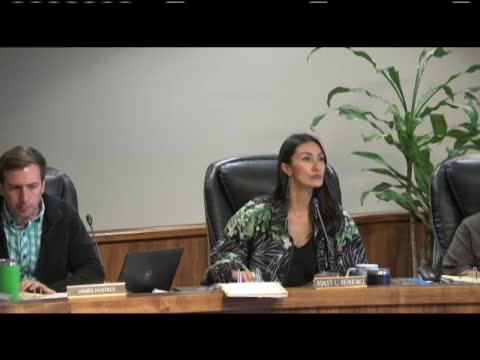
HILO — The Hawaii County policy committee on planning, land use and economic development postponed action on Bill 24, a planning-department-initiated proposal to amend county rules for telecommunications antennas and towers, to its April 1 committee meeting. The committee voted 8-0 to postpone the measure; one member was recorded as excused.
The bill, identified in the agenda as Bill 24 draft 2, would amend Chapter 25 (articles 1, 2, 4, 5 and 7) of the Hawaii County code relating to telecommunications antennas and towers. Planning staff and several community members told the committee the changes were prompted by a change in state law (Hawaii Revised Statutes section 46-89) that imposes a statutory deadline on local reviews of tower applications and could result in automatic approval if the county does not act within the required period.
“That particular law puts a lot of pressure because if it is not approved, denied, or approved with modifications, it's automatically approved without conditions,” said Jeff Darrow of the Planning Department, who described the county’s effort to reconcile its permitting process with the statutory deadline and to add application requirements and operating standards.
Why it matters: The draft would remove the use-permit process that previously triggered a public hearing and contested-case procedures for many tower applications, and instead rely on a plan-approval pathway with written application requirements, increased setbacks, and other standards. Several residents who testified said the change reduces public notice or influence over siting decisions and raised separate concerns over health effects, setbacks, and environmental impacts.
Public testimony: Dozens of individuals from Kamana City and other island communities spoke during the meeting. Jason Robello said he “strongly oppose[d] this bill at this time” and raised concerns about proximity of an existing tower near his home. Leilani Smith told the committee, “We would like a cease and desist order until these bills can be pushed forward for the safety of our children and our community,” and said her name had been placed on planning documents without her permission. Judith McDaniel, another Kamana City resident, said she was not notified before a crane installed a tower near her house and described worries about catchment water and health impacts.
Not all public commenters opposed the entire effort. Cindy Evans, who testified from Waimea and has previously worked on related legislation, said the draft “gets better and better” each time it is revised and suggested additional language to require compliance with future federal regulatory changes and to ensure easement and transfer-of-ownership provisions remain enforceable.
Technical and safety input: Deputy Fire Chief Daniel Volpe of the Hawaii Fire Department told the committee the bill should reference specific safety standards and resiliency measures. “I would like to recommend that it meets specifically NFPA 76,” Volpe said, referring to the National Fire Protection Association standard that addresses telecommunication facilities. Volpe also recommended provisions for tower-mounted environmental sensors, fire detection, and power redundancy to preserve emergency communications during power outages.
Planning and process clarifications: Planning staff explained how notice and community engagement differ between the existing use-permit process and the proposed plan-approval pathway. Under the prior use-permit approach, applications generated public hearings and greater local engagement; plan approval typically does not require the same neighbor notification. The draft includes a requirement for “documentation of proactive efforts made to notify, meet with, inform, and engage adjacent landowners and the affected community,” but staff said that language is an early attempt to preserve outreach while complying with statutory time limits. The committee chair and members discussed possible stronger pre-consultation and verification steps so applicants do not rely solely on newspaper notices.
Committee action: Council member Olaka Inaba moved to postpone consideration of Bill 24 draft 2 to the April 1 committee meeting; the motion was seconded by council member Onishi. The motion carried with eight "aye" votes; one member was recorded as excused. Planning staff and the committee said they will work with the Fire Department and Corporation Counsel on specific amendment language before the next hearing.
The committee did not take a final vote on the ordinance language. The postponement preserves time for staff to draft amendments addressing fire-safety standards (including possible NFPA 76 language), clearer community-notice and pre-consultation requirements, easement and ownership-transfer safeguards, and any technical compliance language requested by testifiers or council members. The item remains scheduled for further consideration at the committee’s April 1 meeting.