Get Full Government Meeting Transcripts, Videos, & Alerts Forever!
Get email alerts on the Emergency Management Winter Storm Enzo topic
No spam. Unsubscribe anytime.
City outlines after-action findings from winter storm Enzo; warming centers, partnerships credited
Summary
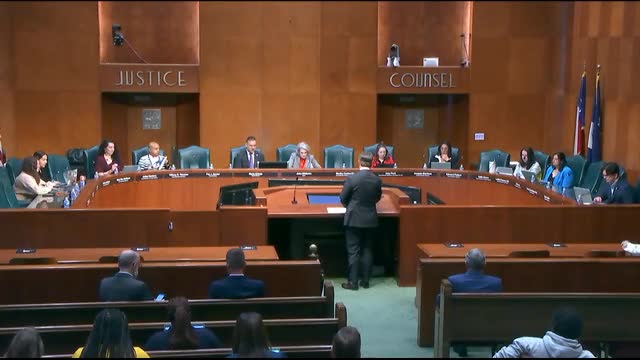
Chris Newport, chief of staff for the mayor, told the City of Houston Resilience Committee on March 6 that the city activated 10 warming centers at peak during winter storm "Enzo," sheltering more than 1,300 people, and that preliminary costs totaled about $6.5 million, including roughly $6.1 million to the general fund, largely for police and fire overtime.
Chris Newport, chief of staff for the mayor, told the City of Houston Resilience Committee on March 6 that the city’s response to winter storm "Enzo" included activating 10 city-operated warming centers at peak that together sheltered more than 1,300 people and that preliminary cost estimates show about $6.5 million in total expenses, with roughly $6.1 million charged to the general fund. Newport said the bulk of the general-fund impact was overtime for police and fire personnel.
The presentation described what city officials called an early, citywide activation that relied on municipal departments and outside partners to maintain public safety, move residents to shelter and manage mass care. "We have taken deliberate steps to get feedback from the folks that were involved with preparing for, executing, and then recovering from the activations associated with the last two winter weather events," Newport said. He said a formal after-action report would be distributed to departments later in the week and that the mayor’s office will implement quarterly check-ins to track improvements.
Why this matters: the city emphasized that swift, coordinated activations — including transportation and sheltering — likely prevented more severe injuries or deaths linked to unsafe driving and exposure. The review also highlighted continuing challenges reaching people experiencing homelessness who decline shelter and legal limits on involuntary detention during emergencies. Those constraints, city officials said, limit how much the city alone can compel life-saving interventions.
Newport credited multiple departments and nonprofit partners for the activation: the Office of Emergency Management (OEM), Houston Police Department (HPD), Houston Fire Department (HFD), the health department, parks, housing and community development, 9-1-1 and 3-1-1 operators, the Houston Food Bank, Food Not Bombs, BARC (for pet kennels), Metro (for mobile warming centers and transportation), Salvation Army, American Red Cross and the Coalition for the Homeless. He said Harris County precincts and TxDOT provided critical support on logistics and road safety. "We had more than 1,300 people at peak across the 10 city of Houston activated warming centers," Newport said.
Operational details and trade-offs: officials described that activating city multi-service centers as warming centers interrupts normal programming — senior meals, vaccinations and recreation — and that those trade-offs are part of mass-care decisions. The city said it began preparations in late fall, benefited from a clear multi-day forecast and activated early. Newport described tools used in the Emergency Operations Center (EOC) to track counts and capacity in near real time and said staff made capacity adjustments at some centers (Fondy and West Gray) after safety reviews, increasing listed capacity on the dashboard.
Costs and budget implications: Newport said departments used overtime allocations and other budget lines to absorb activation costs and that reconciliations will appear in the general appropriations ordinance presented in April. In response to committee questions, Newport said the cost estimates were not specifically pre-budgeted as a single event: "Each department has an allocation in the budget of overtime that is estimated based on past activations from previous years. But no, this was not specifically budgeted for." He added that the city intends to project such events into upcoming fiscal-year budgets.
Gaps and recommended changes: city staff identified several areas for further work: evaluating consolidating warming centers into larger facilities to simplify logistics and expand services; refining mutual-aid and data-sharing agreements with nonprofits and other governments; standardizing family-designated sites (as was done in February); clarifying and documenting food-service constraints under state law; and continuing to inventory backup power for critical facilities. Newport also recommended additional training for warming-center staff on safe interactions with people experiencing mental-health crises and expanding targeted on-site medical triage options for residents dependent on oxygen or dialysis.
Reaching people experiencing homelessness: multiple council members and staff told the committee they continue to face difficulty persuading some people experiencing homelessness to accept shelter. Newport and other officials described that the city lacks statutory tools to compel stays in the circumstances some speakers said would be life-threatening. Newport said the administration has raised the issue with state leadership and that more capacity for emergency detention or other legal mechanisms would change the city’s options. "We do not have the tools that would allow us to help more available in state law. And we need to change that," Newport said.
Communications and transportation: the city said public messaging and automated alerts helped reduce roadway incidents after the initial snow, and officials praised the broad availability of Z Trip rides during activations. Newport said Z Trip usage was not a major cost driver and noted the program’s expansion beyond city limits and to unincorporated shelters. Committee members suggested clearer website navigation for warming-center listings and considered surveys to test public awareness of available transport and shelter options.
Next steps: Newport said the mayor’s office will finalize a written after-action report and follow up with implementation steps, quarterly governance check-ins and continued engagement with nonprofit and school-district partners. The committee did not take formal votes during the presentation; members asked that staff return with more detail where needed and flagged several policy areas for follow-up.
The Resilience Committee’s next meeting was announced for April 3.