Committee advances Cloquet Forestry Center land transfer amid calls for greater transparency and long-term assurances
Loading...
Summary
The Minnesota Senate committee recommended passage of Senate File 1754 to transfer the 3,400-acre Cloquet Forestry Center to the University of Minnesota Regents so the property can be transferred to the Fond du Lac Band of Lake Superior Chippewa.
The Minnesota Senate committee recommended passage of Senate File 1754, a bill to transfer ownership of the 3,400-acre Cloquet Forestry Center to the Board of Regents of the University of Minnesota to enable a subsequent transfer to the Fond du Lac Band of Lake Superior Chippewa.
Senator Sarah Pappas, the bill author, said returning ownership to the Fond du Lac Band was a priority identified through ongoing university-tribal communications. "Returning ownership of the Cloquet Forestry Center to the Fond du Lac Band of Lake Superior Chippewa was identified as a priority," Pappas said, introducing the measure.
Bruce Savage, chairman of the Fond du Lac Band, said the parties have an "agreement in principle" that would allow the university to continue operating and maintaining the Cloquet Forestry Center for research, education and outreach after the transfer. Savage said the agreement would not require the university to pay rent, has a seven-year term, and would automatically continue unless one party gives at least six years' notice to terminate.
Alice Roberts Stavis, vice president for university services at the University of Minnesota, told the committee that about 400 acres inside the 3,400-acre center currently hold title with the state of Minnesota rather than the university. Section 1 of the bill would authorize the Department of Administration to transfer those parcels to the university so the university can transfer the property in its entirety to the Fond du Lac Band.
Rick Horton, executive vice president of Minnesota Forest Industries, testified in opposition. He said forestry stakeholders and industry groups felt excluded from discussions, criticized the process as lacking transparency and asked the committee to reject or table the bill until a complete cooperative agreement and further outreach were provided. "Every turn in the process has been cloaked in secrecy," Horton said, urging more public engagement and a clearer plan for long-term training of future foresters.
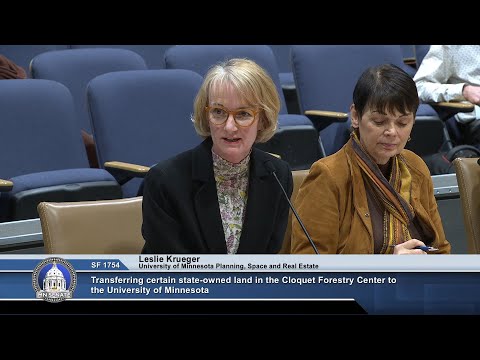
Committee members probed operational and legal details. Roberts Stavis confirmed the university would continue to operate the center and that, under the agreement described in testimony, the university would retain responsibility for maintenance and operations while paying no rent. Leslie Krieger, assistant vice president for planning, space and real estate at the university, summarized the land-acquisition history: the university acquired parcels in multiple tranches beginning in 1909; records show the university paid a fraction of appraised values at the time for some parcels. Krieger told the committee the university could provide original deeds and related payment records on request.
Several senators expressed concern about the seven-year rolling term and the six-year notice provision. Forest industry witnesses and some senators said that duration felt short relative to the long time horizons of forestry research and tree growth, and they asked for stronger contractual assurances. Roberts Stavis and Chairman Savage both said the intent among the parties is a long-term relationship, but several senators requested documentation reflecting such commitment.
Procedural history at the hearing: members debated whether to send the bill to the Environment, Natural Resources and Climate Committee first. A motion to refer the bill to the Environment Committee failed after a roll call (7 ayes, 5 noes). A subsequent motion carried to refer Senate File 1754, as amended, to the Capital Investment Committee. The committee record shows a roll-call tally of 7 ayes and 5 noes when the referral was finalized.
Committee members asked the university to provide deeds and payment ledgers for parcels acquired since 1909 and to share the full cooperative agreement between the university and the Fond du Lac Band. Members also discussed jurisdictional pathways: some favored additional review in Environment and Higher Education committees; others supported the sponsor’s request to move directly to Capital Investment.
The record shows the bill moves forward to the Capital Investment Committee with requests for more detailed documentation and continued stakeholder engagement.