Get Full Government Meeting Transcripts, Videos, & Alerts Forever!
Get email alerts on the High Rise Sprinklers topic
No spam. Unsubscribe anytime.
Panel backs expanding high-rise sprinkler grant program; committee lays Senate File 18‑95 over
Summary
Senate File 18‑95 would expand eligibility and add $10 million to a grant program to retrofit residential high‑rise buildings with automatic sprinklers. Fire safety experts, local officials and labor representatives urged expansion after the 2019 Cedar Avenue fire; the committee laid the bill over for possible omnibus inclusion.
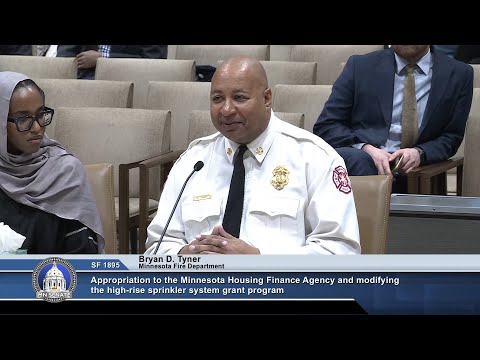
Senate File 18‑95, carrying additional funding and modified eligibility for Minnesota’s residential high‑rise sprinkler grant program, drew bipartisan support from fire-safety experts, building trades and local officials. The Housing and Homelessness Prevention Committee laid the measure over for possible inclusion in an omnibus bill.
Senator Aisha Mohammed, sponsor of the bill, said the bill is meant to continue bipartisan life-safety work begun after the November 2019 Cedar Avenue apartment fire in Minneapolis that resulted in multiple deaths. She described the 2019 fire marshal report’s finding that the absence of automatic sprinklers contributed to the fatalities and noted the 2021 law that created the current retrofit incentive.
The bill proposes to expand program criteria and appropriate an additional $10,000,000 to the Minnesota Housing Finance Agency (MHFA) to reach more buildings. Testimony described three principal changes: lowering the height threshold that defines a qualifying high‑rise (testifiers described adopting a threshold of seven stories or 75 feet to include buildings just under the previous cutoff), modifying rent- and income‑eligibility requirements to align with federal affordable‑housing definitions, and allowing MHFA to issue 0% forgivable loans in addition to grants.
Fire-safety witnesses stressed the life-safety benefit of sprinklers. Tom Brace, state coordinator for the Minnesota chapter of the National Fire Sprinkler Association and a former Minnesota state fire marshal, said, “Fire sprinklers buy time, and time buys life.” Tim Butler, a retired St. Paul fire chief and co-author of a statewide high‑rise inventory, told the committee Minnesota now has a near‑complete inventory: “The survey found 624 high‑rise buildings in the state; 569 of those are fully sprinkled,” he said, adding there are 10 unsprinkled residential high rises and 25 that are only partially sprinkled.
Local officials described buildings that missed existing eligibility by small margins. Patrick Hanlon, mayor of Hopkins, said Dow Towers — a 76‑unit, seven‑story building serving very low‑income residents — was denied under the program because it fell “two feet” below the prior statutory height threshold; he noted that more than three‑quarters of residents have disabilities and several use electric wheelchairs. Mike Wenshaw, deputy fire chief for Hopkins, told the committee Hopkins’ ladder truck (described in testimony as 107 feet long) reaches roughly five stories, which can limit exterior rescue options for taller buildings.
Sponsors and supporters said the $10 million already appropriated in 2019 had helped retrofit several projects (including Seward Towers east and west, described as near completion) but that stricter criteria left some owners ineligible. Dan Kitzberger of Minnesota Housing said the initial competitive round was undersubscribed and agency conversations suggested eligibility thresholds were barriers to applications.
Committee members and testifiers emphasized safety for vulnerable residents and first responders. The chair concluded the hearing by laying Senate File 18‑95 over for possible inclusion in the omnibus bill.
Ending note: If enacted, the bill would broaden eligibility for life‑safety retrofit funding and add program tools (forgivable loans) intended to increase take‑up for sprinkler retrofits in older residential high‑rise housing.