Get Full Government Meeting Transcripts, Videos, & Alerts Forever!
Get email alerts on the E Waste topic
No spam. Unsubscribe anytime.
Senate committee advances wide-ranging e‑waste bill after hours of testimony from counties, recyclers and retailers
Summary
Senate File 1690, a proposal to expand Minnesota’s electronics stewardship system and require producers to fund statewide collection, was recommended to pass by the Senate Committee on the Environment, Climate and Legacy after more than an hour of testimony and debate on Thursday.
Senate File 1690, a proposal to expand Minnesota’s electronics stewardship system and require producers to fund statewide collection, was recommended to pass by the Senate Committee on the Environment, Climate and Legacy after more than an hour of testimony and debate on Thursday.
The committee voted to recommend the bill, as amended, by a division vote of five in favor and four opposed. Senator Coolidge moved the recommendation; the committee referred the bill to the State and Local Government Committee.
Supporters, including county officials and recyclers, told the committee the existing program leaves gaps that burden local governments and recycling facilities. Maria Johnson, co‑director of ReCap, said Minnesota’s electronic waste contains an estimated $3,100,000,000 worth of metals annually but the state “only capture[s] around 20 percent for recycling.” Johnson said improving collection and making drop‑offs free and consistent would increase jobs and local processing: a recycler in St. Cloud “looks forward to hiring up to 200 employees upon implementation of this program,” she said.
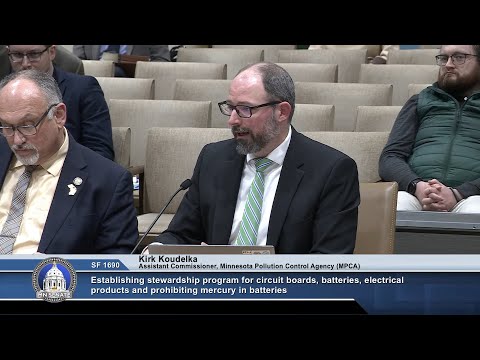
Kurt Koudelka, assistant commissioner at the Minnesota Pollution Control Agency, told the committee manufacturers are already required under existing law to collect and manage certain products but are not meeting obligations. He said nearly 4,000,000 pounds of TVs and monitors go unaccounted for each year and manufacturers have been covering “about a third” of the costs for covered items in past audits.
Hennepin County Commissioner Debbie Goettel said local governments are paying rising costs from fires and handling e‑waste, citing a $37,000 installed fire suppression upgrade and $2,650 per month maintenance at one facility and an annual taxpayer cost of about $330,000 to manage electronics and batteries in Hennepin County. Itasca County Commissioner John Johnson told the committee his county pays about $6,500 a month during summer months to ship and manage e‑waste and has experienced a lithium battery fire at a transfer station.
Recyclers described frequent fires and rising insurance costs. Lucy Milani, director of policy and advocacy at Eureka Recycling, said her company has seen “as many as 20 fires annually” and that catastrophic losses from such fires have increased in recent years, driving facility insurance costs upward.
Several industry groups — including Best Buy, the Consumer Technology Association, the Minnesota Retailers Association, the Minnesota Chamber of Commerce, NEMA (an electrical manufacturers group), the Rechargeable Battery Association and the Battery Council International — opposed aspects of the bill or asked for narrower scope or additional safeguards. Tim Dunn of Best Buy said his company operates voluntary nationwide collection and opposes the bill “as introduced,” arguing it would expand requirements to “nearly everything with a circuit board, a battery, and a plug” without a commensurate stakeholder process. Trade groups warned the bill’s broad definitions could sweep in products and markets not traditionally handled by electronics stewards.
Manufacturers and battery industry representatives also expressed concern about a single nonprofit stewardship organization model in the bill, arguing it could limit competition and raise costs. Several recyclers and Redwood Materials, a lithium‑ion recycler, asked the committee to require guardrails ensuring batteries — particularly lithium‑ion batteries — are managed by specialized recyclers and that recyclers who run direct collection still be able to maintain inventory and receive reimbursement.
Senator Kupak, the bill’s author, said the intent is to make counties “whole” by ensuring producers shoulder the costs of collection and processing and to reduce fire risk and improve convenience for Minnesota residents, particularly in rural areas that now lack convenient drop‑off options. The amended version moved the program start date and clarified some definitions, including for lead‑acid batteries.
The bill lays out convenience standards for collection locations based on population; Koudelka estimated meeting those requirements would require roughly 200 collection locations statewide. The bill would require producers to contract with a single stewardship organization that would submit a statewide plan to the MPCA for approval and reimburse collectors and recyclers under reimbursement rules that include a producer‑nominated reimbursement board.
Opponents pressed the committee on governance, oversight, enforcement and potential cost pass‑throughs to consumers. Multiple testifiers and senators noted the proposal would be the first of its kind in the nation if enacted in its current form and urged more stakeholder work on scope, reimbursement methodology and auditing of the stewardship organization’s budget. The amendment package adopted in committee added clarifications, including protections for existing lead‑acid battery collection programs and language on consent when the stewardship organization seeks to recover improperly stored product from private property.
The motion to recommend passage carried on a division call. The committee recorded five in favor and four opposed. The bill now moves to the State and Local Government Committee for further consideration.